Su Qiang, Lu Yun, He Song, Liang Jiang, Huang Song, He Yuanli, An Zhenxiang
First Clinical Medical College, Guizhou University of Traditional Chinese Medicine, Guiyang, Guizhou, China.
Department of Rheumatology and Hematology, First Affiliated Hospital of Guizhou University of Traditional Chinese Medicine, Guiyang, Guizhou, China.
Sci Rep. 2025 Jan 2;15(1):210. doi: 10.1038/s41598-024-84447-4.
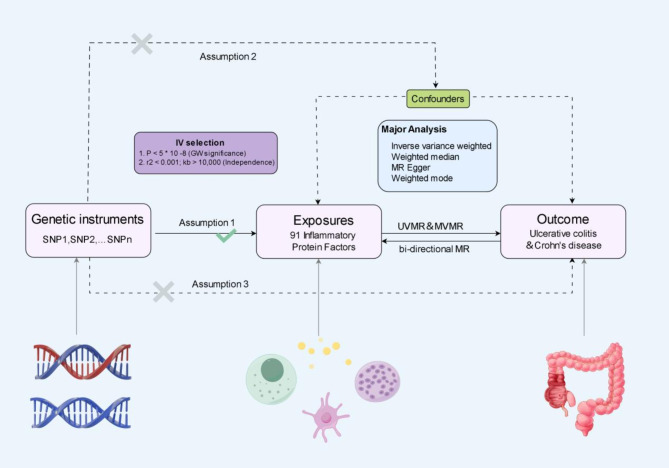
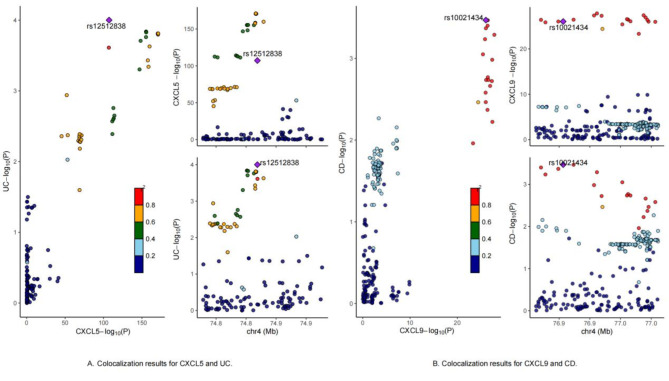
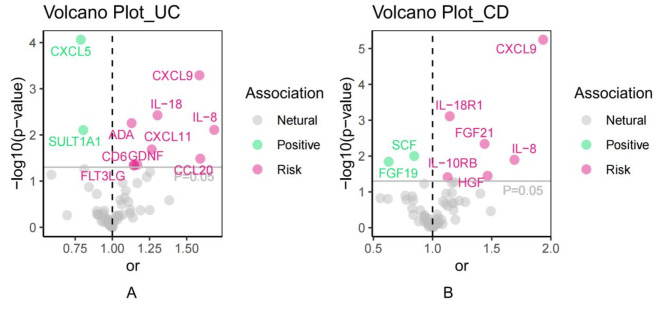
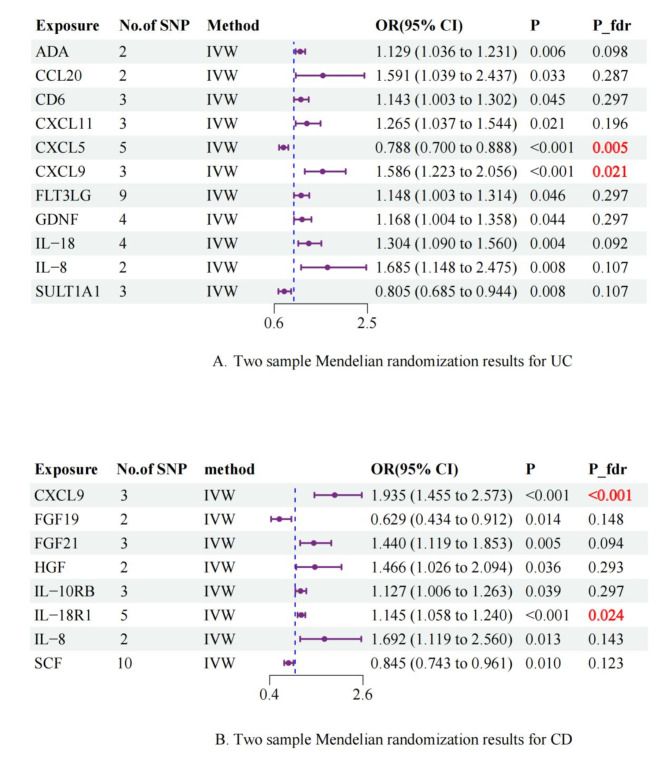
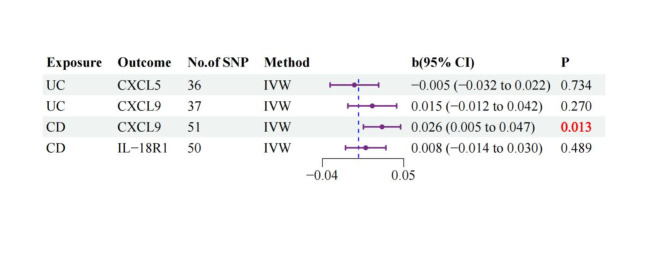
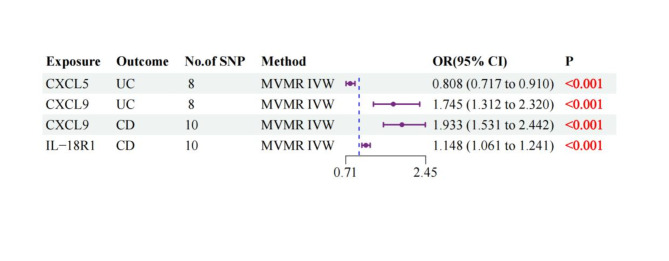
Inflammatory bowel disease (IBD), including ulcerative colitis (UC) and Crohn's disease (CD), decreases quality of life and causes disability. The underlying processes are not fully understood. This study uses Mendelian randomization (MR) analysis to identify cytokines that may be associated with UC and CD, aiding in early diagnosis and treatment decisions. Methods Genome-wide association study (GWAS) data for inflammatory cytokine levels were obtained from a cohort of 14,824 individuals of European descent. The outcome data were then analyzed using summary-level GWAS data for UC and CD from the International Inflammatory Bowel Disease Genetics Consortium (IIBDGC). The analysis was primarily conducted using inverse-variance weighted (IVW) methods, with MR-Egger and weighted median serving as supplementary analyses. Sensitivity analyses included Cochran's Q test, MR-Egger intercept test, MR-PRESSO, and leave-one-out analysis.The inflammatory cytokines were subjected to additional scrutiny through the application of the Steiger test and reverse Mendelian randomization analysis. Subsequently, multivariable Mendelian randomization (MVMR) was employed to examine the associations of metabolites on UC and CD, in conjunction with linkage disequilibrium score regression (LDSC) and colocalization analysis. After FDR correction, we identified significant genetic associations of two inflammatory proteins (CXCL5 and CXCL9) with UC, and CXCL5 and IL-18R1 with CD. These findings were further validated by MVMR. Colocalization analyses demonstrated substantial genetic overlap between inflammatory proteins and IBD, with CXCL5 showing strong evidence of shared genetic variants with UC, and CXCL9 exhibiting genetic colocalization with CD, suggesting common genetic determinants underlying these inflammatory protein-IBD relationships. The current work presents evidence that presents evidence of significant associations between seven inflammatory protein factors and UC, as well as three inflammatory protein factors and CD. These findings provide novel insights into the biological mechanisms of IBD, and have implications for the screening, prevention, and treatment of IBD.
炎症性肠病(IBD),包括溃疡性结肠炎(UC)和克罗恩病(CD),会降低生活质量并导致残疾。其潜在机制尚未完全明确。本研究采用孟德尔随机化(MR)分析来识别可能与UC和CD相关的细胞因子,以辅助早期诊断和治疗决策。方法 从一个由14824名欧洲血统个体组成的队列中获取炎症细胞因子水平的全基因组关联研究(GWAS)数据。然后使用来自国际炎症性肠病遗传学联盟(IIBDGC)的UC和CD的汇总水平GWAS数据对结局数据进行分析。分析主要采用逆方差加权(IVW)方法,以MR-Egger和加权中位数作为补充分析。敏感性分析包括 Cochr an Q检验、MR-Egger截距检验、MR-PRESSO和留一法分析。通过应用Steiger检验和反向孟德尔随机化分析对炎症细胞因子进行了额外的审查。随后,采用多变量孟德尔随机化(MVMR)结合连锁不平衡评分回归(LDSC)和共定位分析来研究代谢物与UC和CD的关联。经过错误发现率(FDR)校正后,我们确定了两种炎症蛋白(CXCL5和CXCL9)与UC以及CXCL5和IL-18R1与CD之间存在显著的遗传关联。这些发现通过MVMR得到了进一步验证。共定位分析表明炎症蛋白与IBD之间存在大量遗传重叠,CXCL5显示出与UC存在共享遗传变异的有力证据,CXCL9与CD存在遗传共定位,表明这些炎症蛋白与IBD关系背后存在共同的遗传决定因素。当前研究表明七种炎症蛋白因子与UC以及三种炎症蛋白因子与CD之间存在显著关联。这些发现为IBD的生物学机制提供了新见解,并对IBD的筛查、预防和治疗具有重要意义。