Ekren Elizabeth, Maleki Shadi, Curran Cristian, Watkins Cassidy, Villagran Melinda M
Translational Health Research Center, Texas State University, 601 University Drive, San Marcos, TX, 78666, USA.
Department of Psychology, Texas State University, 601 University Drive, San Marcos, TX, 78666, USA.
BMC Health Serv Res. 2025 Jan 2;25(1):2. doi: 10.1186/s12913-024-12109-2.
Place matters for health. In Texas, growing rural populations face a variety of structural, social, and economic disparities that position them for potentially worse health outcomes. The current study contributes to understanding rural health disparities in a state-specific context.
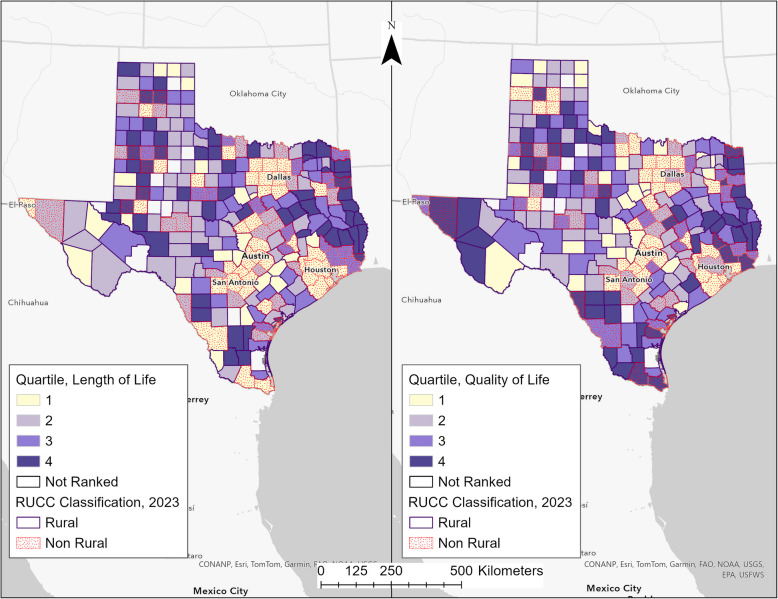
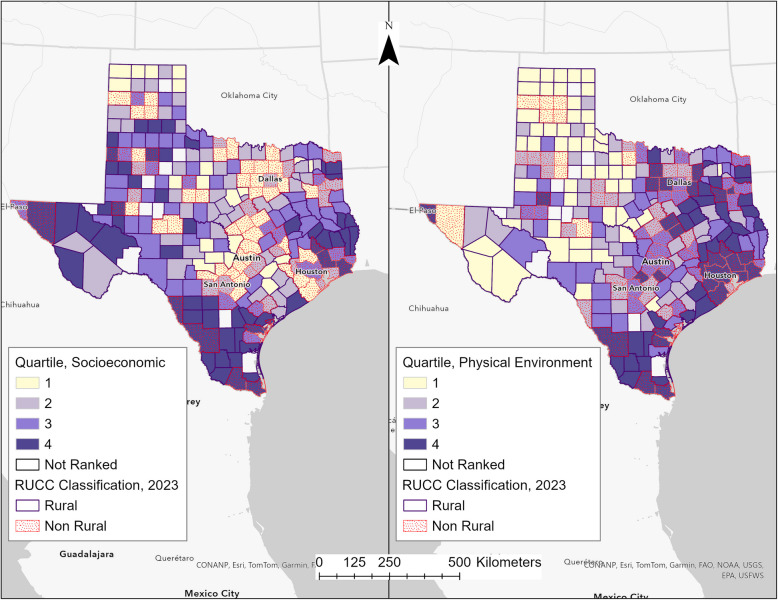
Using 2023 County Health Rankings data from the University of Wisconsin Population Health Institute, the study analyzes rural/non-rural county differences in Texas across six composite indexed domains of health outcomes (length of life, quality of life) and health factors (health behavior, clinical care, socioeconomic factors, physical environment) with a chi-square test of significance and logistic regression.
Quartile ranking distributions of the six domains differed between rural and non-rural counties. Rural Texas counties were significantly more likely to fall into the bottom quartile(s) in the domains of length of life and clinical care and less likely to fall into the bottom quartile(s) in the domains of quality of life and physical environment. No differences were found in the domains of health behavior and socioeconomic factors. Findings regarding disparities in length of life and clinical care align with other studies examining disease prevalence and the unavailability of many health services in rural Texas. The lack of significant differences in other domains may relate to indicators that are not present in the dataset, given studies that find disparities relating to other underlying factors.
Texas County Health Rankings data show differences in health outcomes and factors between rural and non-rural counties. Limitations of findings relate to the study's cross-sectional design and parameters of the secondary data source. Ultimately, results can help state health stakeholders, especially those in community or operational contexts with limited resources or access to more detailed health statistics, to use the CHR dataset to consider more relevant local interventions to address rural health disparities.
环境对健康至关重要。在得克萨斯州,农村人口不断增长,面临着各种结构、社会和经济方面的差异,这使他们面临健康状况可能更差的风险。本研究有助于在特定州的背景下理解农村地区的健康差异。
利用威斯康星大学人口健康研究所2023年的县健康排名数据,该研究通过卡方显著性检验和逻辑回归分析了得克萨斯州农村/非农村县在六个综合健康指标领域(寿命、生活质量)和健康因素(健康行为、临床护理、社会经济因素、物理环境)方面的差异。
六个领域的四分位数排名分布在农村和非农村县之间存在差异。得克萨斯州的农村县在寿命和临床护理领域更有可能处于最低四分位数,而在生活质量和物理环境领域则不太可能处于最低四分位数。在健康行为和社会经济因素领域未发现差异。关于寿命和临床护理差异的研究结果与其他研究一致,这些研究调查了得克萨斯州农村地区的疾病患病率和许多医疗服务的不可用情况。鉴于一些研究发现与其他潜在因素相关的差异,其他领域缺乏显著差异可能与数据集中不存在的指标有关。
得克萨斯州县健康排名数据显示了农村和非农村县在健康结果和因素方面的差异。研究结果的局限性与研究的横断面设计和二手数据源的参数有关。最终,研究结果可以帮助州卫生利益相关者,特别是那些资源有限或无法获取更详细健康统计数据的社区或运营环境中的利益相关者,利用CHR数据集来考虑更相关的本地干预措施,以解决农村地区的健康差异问题。