Sulena Sulena, Kulkarni Ashwin, Mathur Medha, Jyoti Naresh, Sidhu Tanvir Kaur, Badyal Dinesh, Guha Ranjit
Division of Neurology, Guru Gobind Singh Medical College, Faridkot, Punjab, India.
Department of General Medicine, Ramaiah Medical College, Bengaluru, Karnataka, India.
Int J Appl Basic Med Res. 2024 Oct-Dec;14(4):225-232. doi: 10.4103/ijabmr.ijabmr_268_24. Epub 2024 Nov 1.
Competency-based Medical Education (CBME) was introduced in the year 2019 in India. It has brought about major changes in medical education. The curriculum is learner centric, outcome based, focuses on the development of core competencies and professionalism. However, many institutions have faced challenges during the implementation of the CBME curriculum. This study was aimed at assessing the challenges faced by all the stakeholders (students, faculty, and administrators) of various medical institutions and gather their insights on proposed solutions.
This cross-sectional study was conducted over a period of 3 months, from October 1, 2023, to December 31, 2023. The study was conducted in 32 medical colleges across India. A total of 60 faculty of various disciplines, 32 administrators of the institutes, and 580 undergraduate medical students were included in the study. Perception of students and faculty was collected using a validated survey form. One-on-one interview was done for all the 32 administrators using a facilitator guide. A mixed-methods approach was used for quantitative and qualitative data collection and analysis.
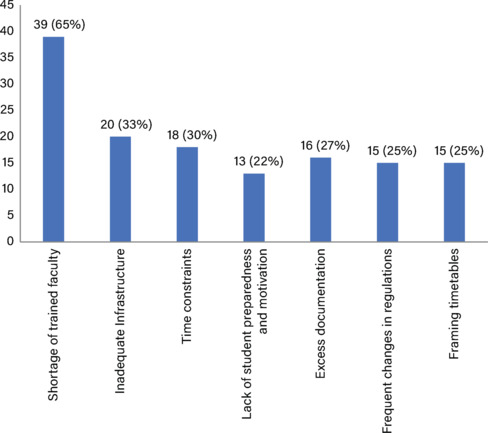
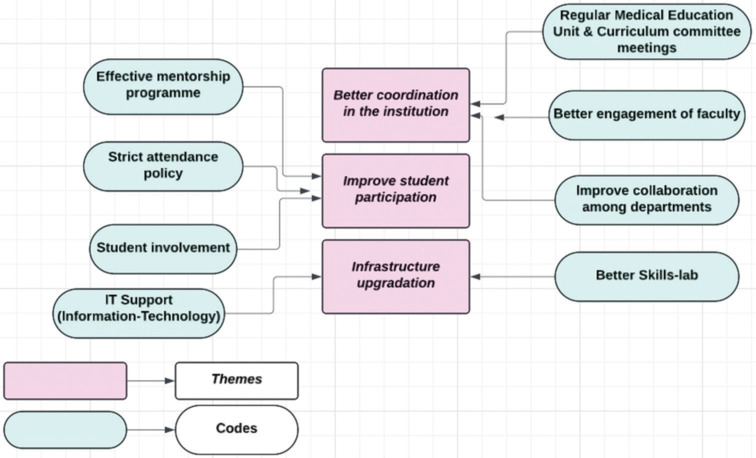
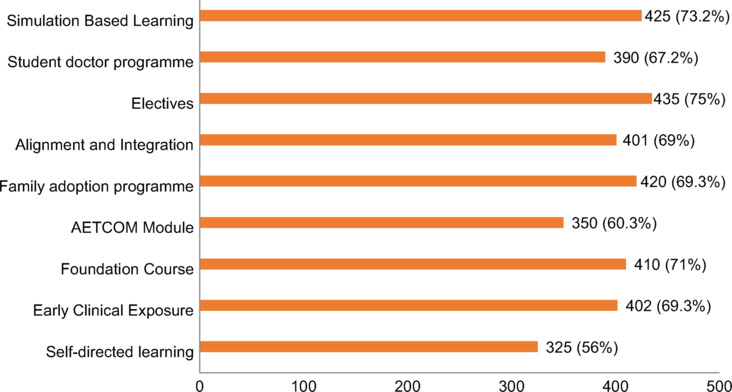
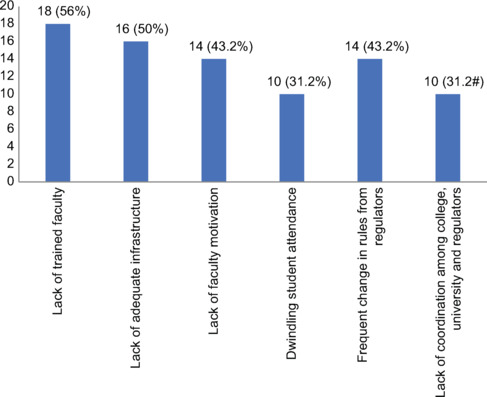
Around 40 (66.6%) faculty opined that that deficiency of trained faculty was a significant challenge in implanting CBME curriculum. Twenty (33.3%) of the faculty felt that there is a lack of adequate infrastructure required for the implementation of CBME curriculum. Among the administrators surveyed, 12 (37.5%) felt that dwindling student attendance was a major challenge, whereas 10 (31.5%) felt that there was the lack of collaboration between universities, colleges, and regulatory authorities. Four hundred and twenty-five (73.2%) of students opined that simulation-based training and 435 (75%) students opined that electives were very good initiatives by CBME curriculum. The students found the inclusion of integrated teaching, Attitude, Ethics, and Communication Module, early clinical exposure, and Family Adoption Programme in the CBME curriculum helpful.
CBME curriculum was largely accepted across all the medical colleges. The training of faculty and administrators was considered an important challenge which needs to be considered. Students opined that the newer curricular reforms enhanced their learning.
基于能力的医学教育(CBME)于2019年在印度引入。它给医学教育带来了重大变革。课程以学习者为中心,基于成果,注重核心能力和专业素养的培养。然而,许多机构在实施CBME课程过程中面临挑战。本研究旨在评估各类医疗机构的所有利益相关者(学生、教师和管理人员)所面临的挑战,并收集他们对提议解决方案的见解。
本横断面研究为期3个月,从2023年10月1日至2023年12月31日。研究在印度的32所医学院进行。共有60名各学科教师、32所院校的管理人员以及580名本科医学生纳入研究。使用经过验证的调查问卷收集学生和教师的看法。对所有32名管理人员采用引导式访谈提纲进行一对一访谈。采用混合方法进行定量和定性数据的收集与分析。
约40名(66.6%)教师认为,师资培训不足是实施CBME课程的一项重大挑战。20名(33.3%)教师认为缺乏实施CBME课程所需的充足基础设施。在接受调查的管理人员中,12名(37.5%)认为学生出勤率下降是一项重大挑战,而10名(31.5%)认为大学、学院和监管机构之间缺乏合作。425名(73.2%)学生认为基于模拟的培训很好,435名(75%)学生认为选修课是CBME课程的很好举措。学生们发现CBME课程中纳入的整合式教学、态度、伦理和沟通模块、早期临床接触以及家庭收养计划很有帮助。
CBME课程在所有医学院中得到了广泛认可。教师和管理人员的培训被认为是一项需要考虑的重要挑战。学生们认为新的课程改革增强了他们的学习效果。