Donahue Catherine C, Smulligan Katherine L, Wingerson Mathew J, Kniss Joshua R, Simon Stacey L, Wilson Julie C, Howell David R
Department of Orthopedics, University of Colorado School of Medicine, Aurora, CO, USA.
Sports Medicine Center, Children's Hospital of Colorado, Aurora, CO, USA.
Nat Sci Sleep. 2024 Dec 28;16:2257-2268. doi: 10.2147/NSS.S497858. eCollection 2024.
Poor sleep is associated with longer recovery following adolescent concussion, making the longitudinal assessment of sleep important for monitoring recovery and identifying sleep disruptions. An important consideration for successful monitoring of sleep following concussion is the feasibility and adherence of a given sleep monitoring tool when used in an at-home environment. Understanding the usability of different sleep monitoring tools is essential for determining their applicability for longitudinal assessment in an ecologically valid environment.
The purpose of this study was to: (1) report on the adherence and feasibility of at-home sleep monitoring in adolescents following concussion, and (2) compare outcomes of subjective and wearable measures of sleep between adolescents with and without a concussion.
Participants included adolescents within 21 days of a concussion and uninjured controls that participated in four separate, prospective and longitudinal investigations of sleep following concussion. Sleep data was measured with: (1) Dreem Headband; (2) Philips Actiwatch; (3) Fitbit; and (4) subjective sleep diary. Sleep data was collected nightly, and adherence was defined as percentage of nights the participant used the sleep-monitoring tool over the study duration. Independent -tests and effect sizes were calculated for the following sleep data outcomes as measured by each of the monitoring tools: duration, efficiency, latency, wake after sleep onset.
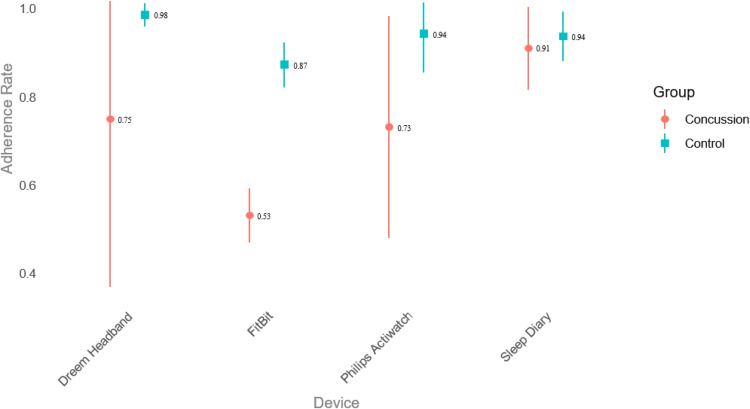
Sleep data for a total of 183 adolescents (104 with concussion, 79 uninjured controls) was assessed. Adherence rates across all devices ranged from 53% to 98%, with the subjective sleep diary showing the highest adherence rate for both groups (concussion: 91%, control: 94%). Across the four different monitoring tools, adolescents with a concussion demonstrated longer duration, latency, wake after sleep onset, and lower (worse) efficiency, with medium to large effect sizes.
The results indicate that at-home sleep monitoring is a feasible approach for tracking sleep in adolescents following concussion.
睡眠不佳与青少年脑震荡后恢复时间延长有关,因此对睡眠进行纵向评估对于监测恢复情况和识别睡眠障碍至关重要。脑震荡后成功监测睡眠的一个重要考虑因素是特定睡眠监测工具在家庭环境中使用时的可行性和依从性。了解不同睡眠监测工具的可用性对于确定它们在生态有效环境中进行纵向评估的适用性至关重要。
本研究的目的是:(1)报告脑震荡后青少年在家中进行睡眠监测的依从性和可行性,以及(2)比较有和没有脑震荡的青少年之间睡眠的主观和可穿戴测量结果。
参与者包括脑震荡后21天内的青少年以及未受伤的对照组,他们参与了四项关于脑震荡后睡眠的单独、前瞻性和纵向调查。睡眠数据通过以下方式测量:(1)Dreem头带;(2)飞利浦活动记录仪;(3)Fitbit;以及(4)主观睡眠日记。每晚收集睡眠数据,依从性定义为参与者在研究期间使用睡眠监测工具的夜晚百分比。针对以下每种监测工具测量的睡眠数据结果计算独立t检验和效应大小:持续时间、效率、潜伏期、睡眠开始后觉醒。
共评估了183名青少年(104名脑震荡患者,79名未受伤对照组)的睡眠数据。所有设备的依从率在53%至98%之间,主观睡眠日记在两组中显示出最高的依从率(脑震荡组:91%,对照组:94%)。在四种不同的监测工具中,脑震荡青少年的睡眠时间更长、潜伏期更长、睡眠开始后觉醒更多,效率更低(更差),效应大小为中到大型。
结果表明,在家中进行睡眠监测是跟踪脑震荡后青少年睡眠的一种可行方法。