Owusu Jocelynn T, Wang Lu, Chen Shih-Yin, Wickham Robert E, Michael Scott T, Bahrassa Nazneen F, Varra Alethea, Lee Jennifer L, Chen Connie, Lungu Anita
Lyra Health, 270 East Ln, Burlingame, CA, 94010, USA.
Department of Psychological Sciences, Northern Arizona University, Flagstaff, AZ, USA.
Sci Rep. 2025 Jan 3;15(1):730. doi: 10.1038/s41598-024-83144-6.
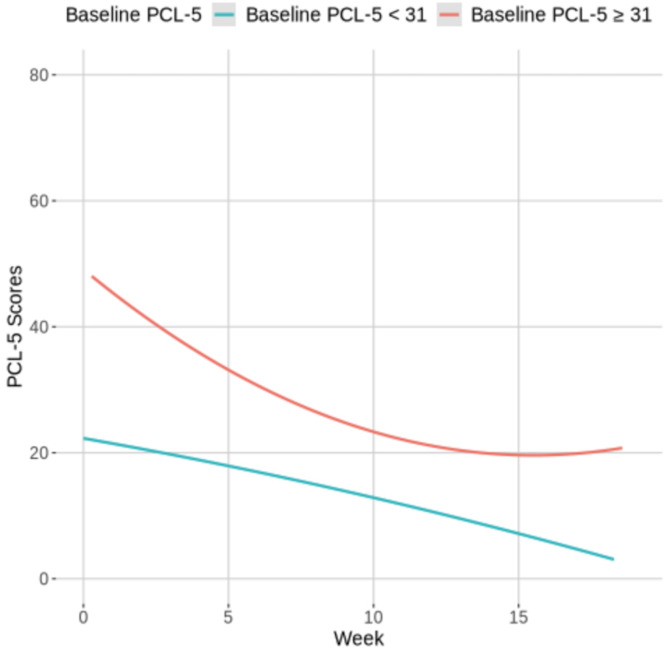
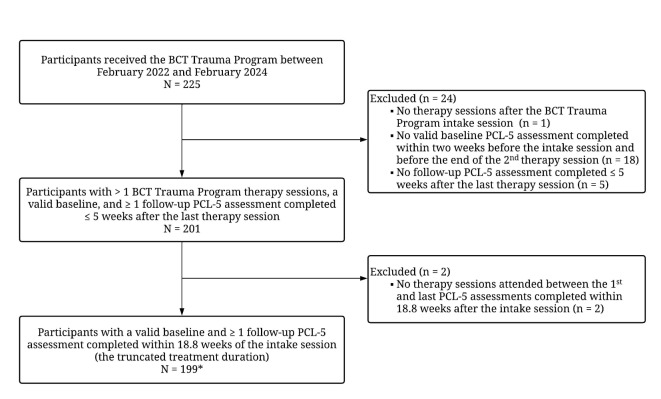
Blended care therapy (BCT), which augments live, video-based psychotherapy sessions with asynchronous digital tools, has the potential to increase access to evidence-based treatments for posttraumatic stress disorder (PTSD). However, its effectiveness in diverse, real-world settings is not well-understood. This evaluation aimed to assess clinical outcomes of a BCT program for PTSD symptoms. A retrospective cohort analysis was conducted of 199 adults who received an employer-offered BCT program for PTSD symptoms that delivered either cognitive processing therapy or prolonged exposure. PTSD symptom severity was regularly assessed using the PTSD Checklist for DSM-5 (PCL-5). Growth curve models were used to evaluate the trajectory of PTSD symptoms over the course of care, and an interaction term was added to assess outcomes by baseline PTSD symptom severity (i.e., PCL-5 ≥ 31 versus PCL-5 < 31). End-of-care reliable improvement and recovery were evaluated. On average, participants with baseline PCL-5 < 31 exhibited statistically significant declines in PTSD symptoms during care, while participants with baseline PCL-5 ≥ 31 showed statistically significantly steeper initial declines in PTSD symptoms that became less pronounced over time. Overall, 82.91% of participants demonstrated either reliable improvement or recovery in PTSD symptoms. This evaluation suggests BCT for PTSD symptoms can be beneficial in real-world settings. Future research should perform large-scale evaluations.
混合式护理疗法(BCT)通过异步数字工具增强基于视频的现场心理治疗课程,有可能增加创伤后应激障碍(PTSD)循证治疗的可及性。然而,其在不同现实环境中的有效性尚不清楚。本评估旨在评估一项针对PTSD症状的BCT项目的临床结果。对199名成年人进行了回顾性队列分析,这些成年人接受了雇主提供的针对PTSD症状的BCT项目,该项目提供认知加工疗法或延长暴露疗法。使用《精神疾病诊断与统计手册》第5版创伤后应激障碍检查表(PCL-5)定期评估PTSD症状严重程度。采用生长曲线模型评估护理过程中PTSD症状的轨迹,并添加一个交互项以根据基线PTSD症状严重程度(即PCL-5≥31与PCL-5<31)评估结果。评估了护理结束时的可靠改善和康复情况。平均而言,基线PCL-5<31的参与者在护理期间PTSD症状有统计学显著下降,而基线PCL-5≥31的参与者PTSD症状最初下降更为显著,但随着时间推移变得不那么明显。总体而言,82.91%的参与者在PTSD症状方面表现出可靠的改善或康复。本评估表明,针对PTSD症状的BCT在现实环境中可能有益。未来的研究应进行大规模评估。