Jhun Byung Hak, Park Yerin, Kim Hwang Suk, Baek Ji Hye, Kim Joonghyuk, Lee Eunji, Moon Hyejin, Oh Changjin, Jung Yongsik, Choi Seunghee, Baik Mu-Hyun, You Youngmin
Department of Chemical and Biomolecular Engineering, Yonsei University, Seoul, 03722, Republic of Korea.
Department of Chemistry, Korea Advanced Institute of Science and Technology (KAIST), Daejeon, 34141, Republic of Korea.
Nat Commun. 2025 Jan 4;16(1):392. doi: 10.1038/s41467-024-55620-0.
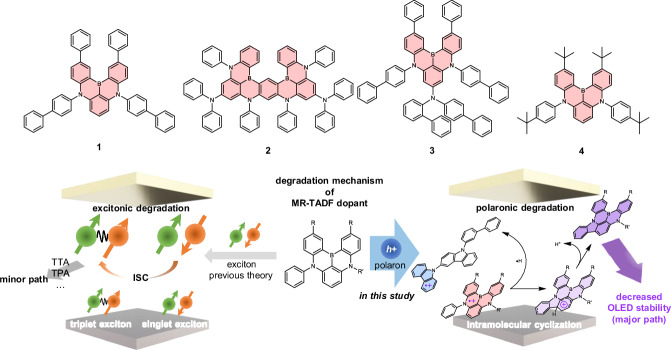
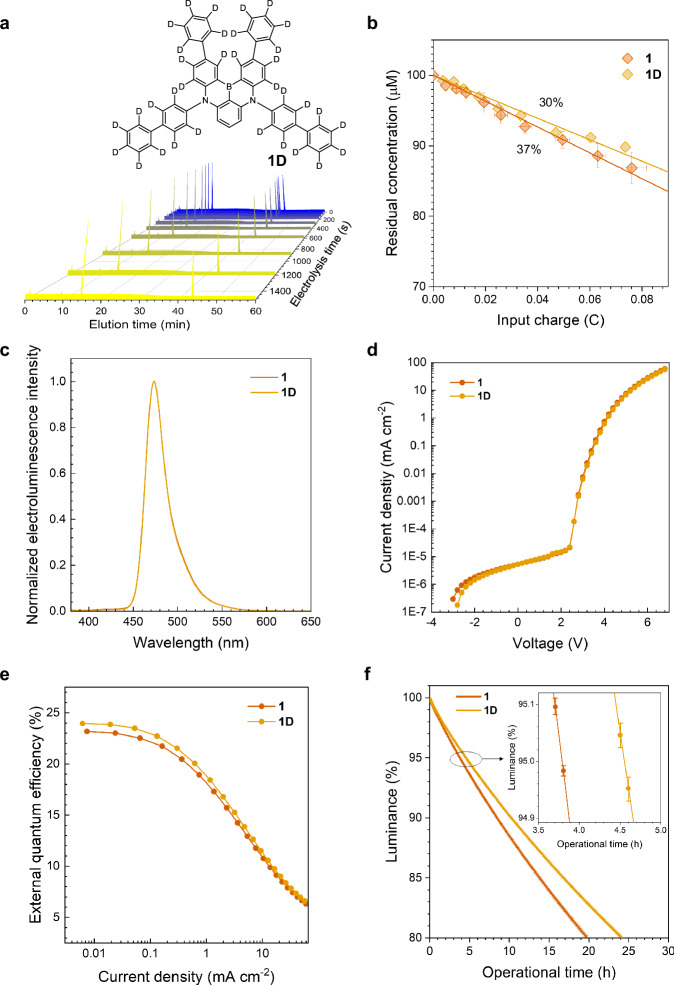
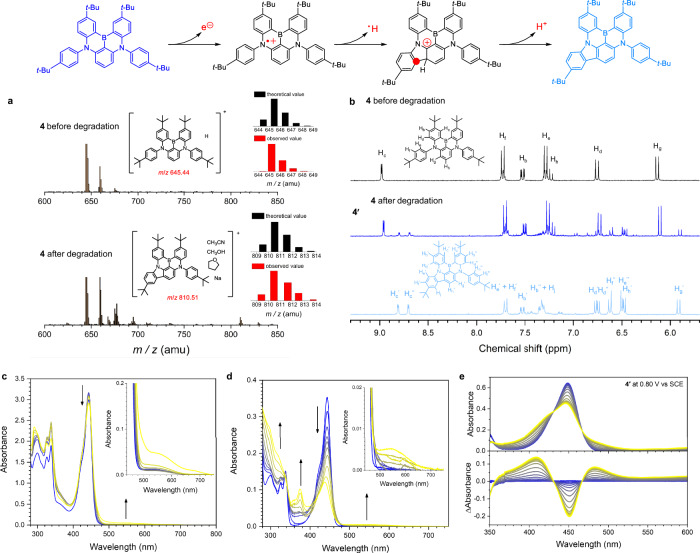
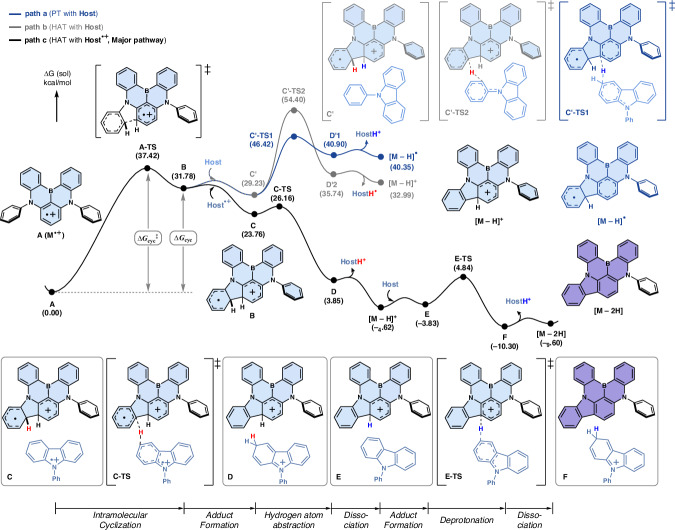
1,4-Azaborine-based arenes are promising electroluminescent emitters with thermally activated delayed fluorescence (TADF), offering narrow emission spectra and high quantum yields due to a multi-resonance (MR) effect. However, their practical application is constrained by their limited operational stability. This study investigates the degradation mechanism of MR-TADF molecules. Electroluminescent devices incorporating these compounds display varied operational lifetimes, uncorrelated with excitonic stability or external quantum efficiency roll-off. Bulk electrolysis reveals significant instability in the radical cationic forms of MR-TADF compounds, with device lifetime linked to the Faradaic yield of oxidation. Comprehensive chemical analyses corroborate that the degradation byproducts originated from intramolecular cyclization of radical cation, followed by hydrogen atom transfer. The mechanism is further supported by enhanced stability observed in a deuterated MR-TADF emitter, attributed to a secondary kinetic isotope effect. These findings provide insights into the stabilizing effects of deuteration and mechanism-driven strategies for designing MR-TADF compounds with improved operational longevity.
基于1,4-氮杂硼烷的芳烃是具有热激活延迟荧光(TADF)的有前景的电致发光发射体,由于多共振(MR)效应而具有窄发射光谱和高量子产率。然而,它们的实际应用受到其有限的操作稳定性的限制。本研究调查了MR-TADF分子的降解机制。包含这些化合物的电致发光器件显示出不同的操作寿命,与激子稳定性或外部量子效率滚降无关。本体电解揭示了MR-TADF化合物的自由基阳离子形式存在显著的不稳定性,器件寿命与氧化的法拉第产率相关。综合化学分析证实,降解副产物源于自由基阳离子的分子内环化,随后是氢原子转移。在氘代MR-TADF发射体中观察到的增强稳定性进一步支持了该机制,这归因于二级动力学同位素效应。这些发现为氘代的稳定作用以及设计具有更长操作寿命的MR-TADF化合物的机制驱动策略提供了见解。