Burt Jeremy R, Qaqish Naim, Stoddard Greg, Jridi Amani, Anderson Parker Sage, Woods Lacey, Newman Anna, Carter Malorie R, Ellessy Reham, Chamberlin Jordan, Kabakus Ismail
Department of Radiology, Cardiothoracic Imaging, University of Utah, Spencer Fox Eccles School of Medicine, 50 N Medical Dr, Salt Lake City, UT, 84132, USA.
Department of Radiology, Medical University of South Carolina, 171 Ashley Ave, Charleston, SC, 29425, USA.
BMC Med. 2025 Jan 5;23(1):3. doi: 10.1186/s12916-024-03844-8.
Lung cancer is a leading cause of cancer-related mortality. Non-small cell lung cancer (NSCLC) comprises 85% of cases with rising incidence among never-smokers (NS). This study seeks to compare clinical, imaging, pathology, and outcomes between NS and ever-smokers (S) NSCLC patients to identify significant differences if any.
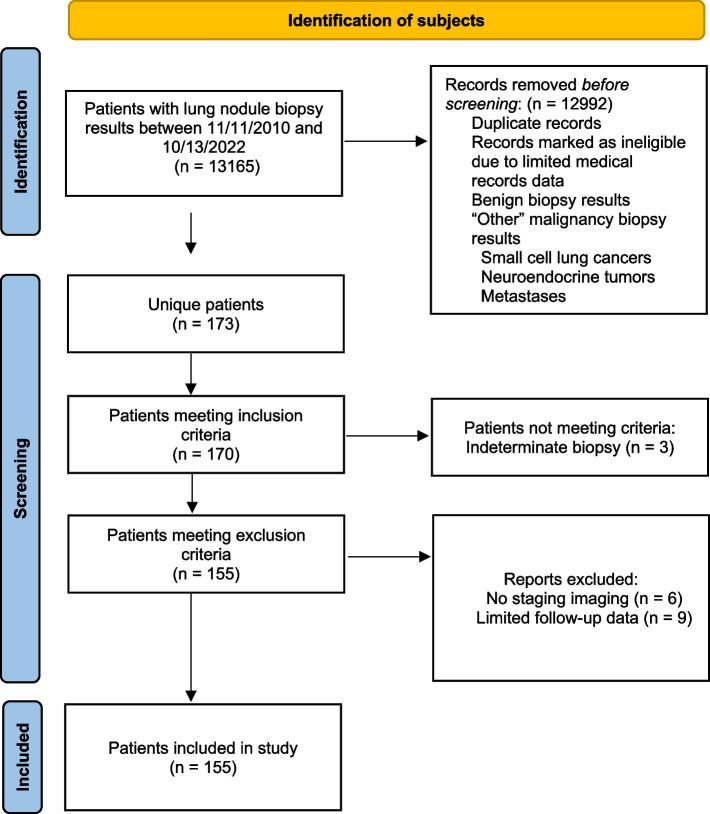
Retrospective cohort study of 155 NSCLC patients (88 S and 67 NS). The main predictor was smoking. Clinical, imaging, and pathology findings were evaluated at initial biopsy for staging. The primary outcome was all-cause mortality, and the secondary outcome was 12-month progression-free survival.
Imaging: NS and S had similar nodule size (0.81), calcification (> 0.99), and invasion of adjacent structures (> 0.99) (p values). NS slightly trended to more commonly involve the RLL vs S the RUL (p = 0.11). NS had higher numbers of extrathoracic metastases at initial biopsy for staging (p = 0.055).
NS more commonly had adenocarcinoma compared to S, who had equal numbers of adenocarcinoma and squamous cell carcinoma (p = 0.001). Rates of lymphovascular and pleural invasion were similar (p = 0.84 and 0.28). Initial staging: NS were more often initially diagnosed with stage IV disease (p = 0.046), positive nodal disease (p = 0.002), and metastatic disease (p = 0.004).
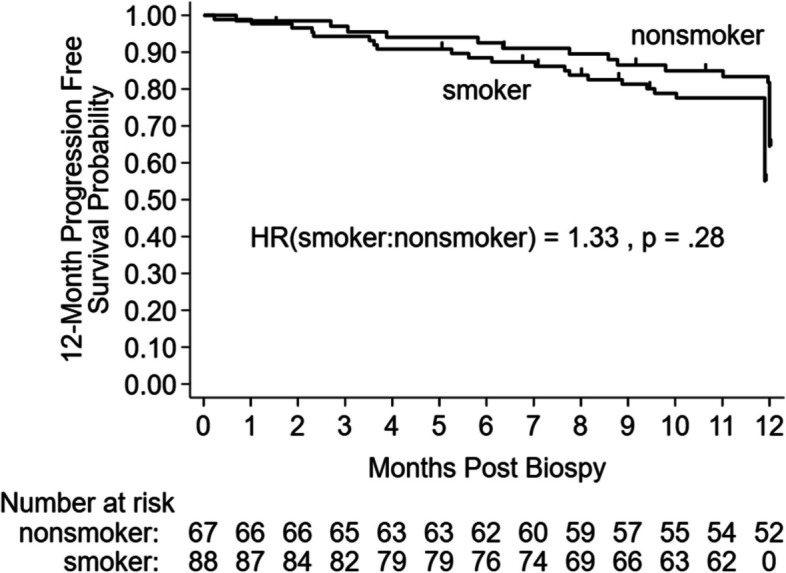
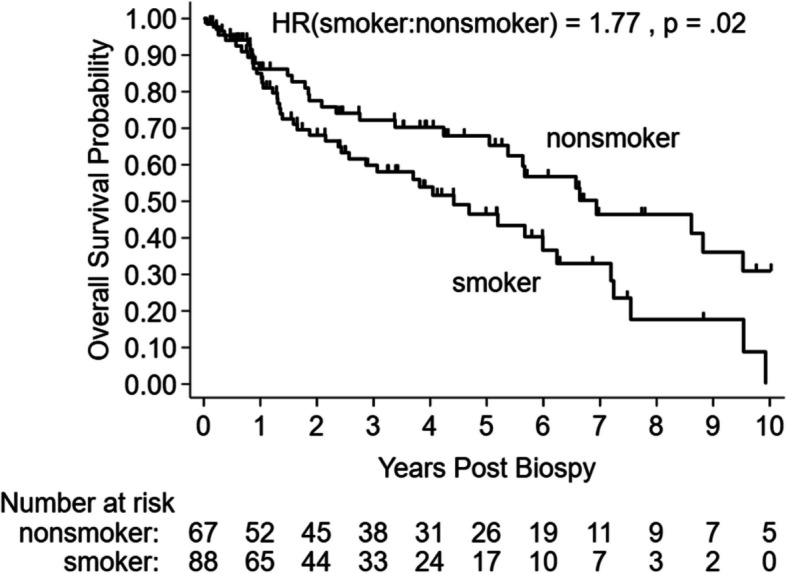
S had a non-significant trend toward worse 12-month progression-free survival (rate ratio = 1.31, p = 0.31; HR = 1.33, p = 0.28). NS and S had similar 1-year all-cause mortality (HR = 1.06, p = 0.90). S had nearly double the risk of all-cause mortality in 5 years (HR = 1.73, p = 0.056) and 10 years (HR = 1.77, p = 0.02). Median survival was 6.6 years for NS and 3.9 years for S, with NS surviving 2.7 years longer on average (p = 0.045).
CT nodule features were similar in NS and S. NS more often had metastatic adenopathy, distant metastases, and stage IV disease at initial biopsy. Despite similar 12-month progression-free survival and 1-year all-cause mortality, S had nearly double the risk of mortality in the first 5 and 10 years post-diagnosis.
Retrospectively registered.
肺癌是癌症相关死亡的主要原因。非小细胞肺癌(NSCLC)占病例的85%,在从不吸烟者(NS)中的发病率呈上升趋势。本研究旨在比较NSCLC患者中从不吸烟者(NS)和曾经吸烟者(S)在临床、影像学、病理学及预后方面的差异,以确定是否存在显著差异。
对155例NSCLC患者(88例S和67例NS)进行回顾性队列研究。主要预测因素为吸烟情况。在初次活检时评估临床、影像学和病理学结果以进行分期。主要结局为全因死亡率,次要结局为12个月无进展生存期。
影像学:NS和S的结节大小(0.81)、钙化(>0.99)及相邻结构侵犯情况(>0.99)相似(p值)。NS较S更倾向于累及右下叶(RLL)(p = 0.11)。NS在初次活检分期时胸外转移数量更多(p = 0.055)。
与S相比,NS更常见腺癌,而S的腺癌和鳞状细胞癌数量相等(p = 0.001)。淋巴管和胸膜侵犯率相似(p = 0.84和0.28)。初始分期:NS更常最初被诊断为IV期疾病(p = 0.046)、阳性淋巴结疾病(p = 0.002)和转移性疾病(p = 0.004)。
S的12个月无进展生存期有恶化趋势但不显著(率比 = 1.31,p = 0.31;HR = 1.33,p = 0.28)。NS和S的1年全因死亡率相似(HR = 1.06,p = 0.90)。S在5年(HR = 1.73,p = 0.056)和10年(HR = 1.77,p = 0.02)时全因死亡风险几乎翻倍。NS的中位生存期为6.6年,S为3.9年,NS平均多存活2.7年(p = 0.045)。
NS和S的CT结节特征相似。NS在初次活检时更常出现转移性淋巴结病、远处转移和IV期疾病。尽管12个月无进展生存期和1年全因死亡率相似,但S在诊断后的前5年和10年死亡风险几乎翻倍。
回顾性注册。