Xu Xiaoyan, Wang Lei, Wu Guangyao, Li Xixia
Otolaryngology Head and Neck Surgery, China Resources & Wisco General Hospital, Wuhan, Hubei, China.
Biomol Biomed. 2025 May 8;25(7):1571-1580. doi: 10.17305/bb.2024.11582.
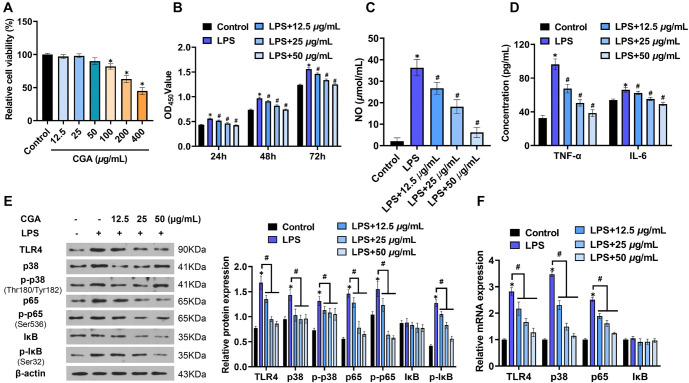
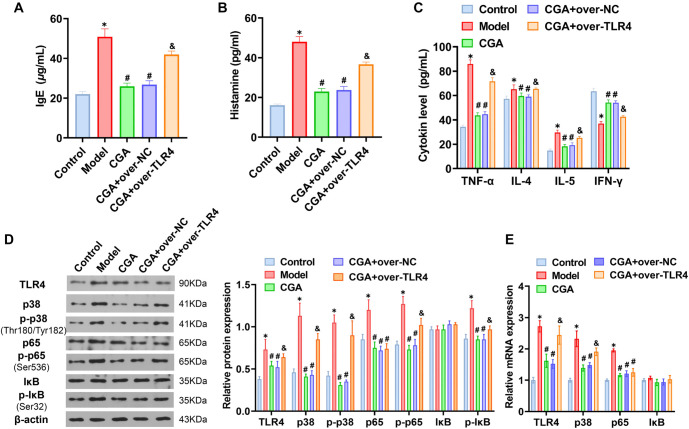
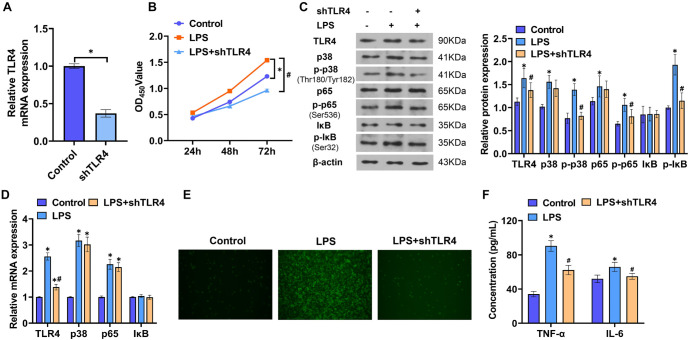
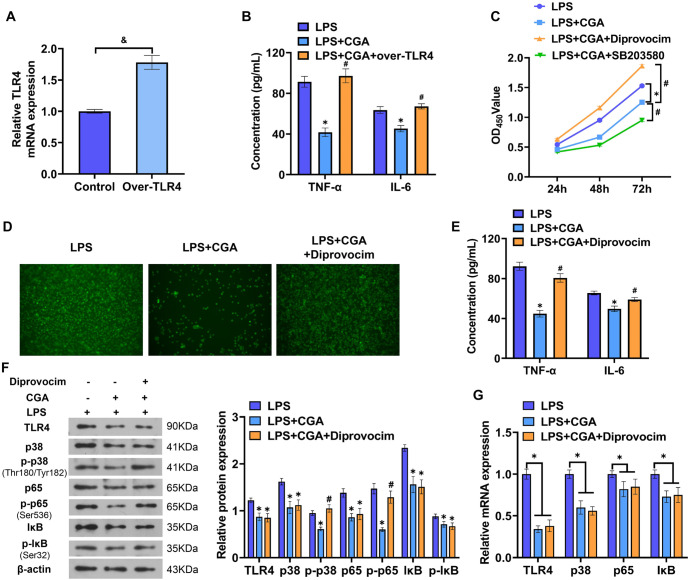
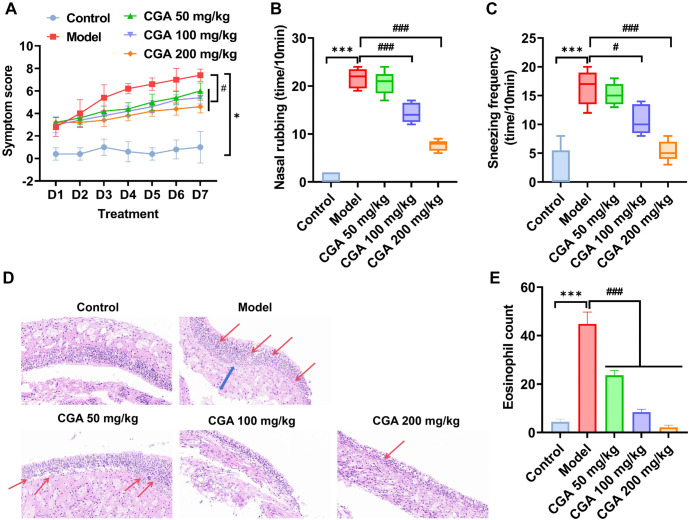
Chlorogenic acid (CGA) exhibits promising anti-inflammatory properties, making it a potential therapeutic agent for inflammatory conditions and allergic rhinitis (AR). This study aimed to evaluate the therapeutic effects of CGA on inflammation in RAW264.7 macrophage cells and on AR in mice. RAW264.7 cells were treated with lipopolysaccharide (LPS) to induce inflammation and cultured with varying concentrations of CGA, a Tlr4-silenced gene (shTlr4) transfection, and the MAPK/NF-κB pathway activator diprovocim. Cell viability was assessed using the CCK8 assay, while levels of nitric oxide (NO), TNF-α, and IL-6 were measured by Griess colorimetry, immunofluorescence, and ELISA. Expression and phosphorylation levels of the MAPK/NF-κB pathway were evaluated using qPCR and western blotting. Additionally, ovalbumin (OVA)-induced AR mice received different doses of CGA, and Toll-like receptor-4 (Tlr4) overexpression was induced. In vitro, CGA treatment significantly reduced LPS-induced cell activity, NO, TNF-α, and IL-6 secretion, and downregulated Tlr4, p-p38, p-p65, and p-IκB expression. Tlr4 inhibition suppressed cell activity and inflammation by blocking MAPK/NF-κB pathway activation. Conversely, Tlr4 overexpression counteracted the effects of CGA, increasing cell activity and inflammatory factor concentration. In OVA-induced AR mice, CGA effectively alleviated allergic symptoms, reduced inflammatory factor secretion, and inhibited TLR4/MAPK/NF-κB pathway activity. These findings suggest CGA's potential as an anti-inflammatory agent in RAW264.7 cells and AR models through modulation of the TLR4/MAPK/NF-κB pathway.
绿原酸(CGA)具有良好的抗炎特性,使其成为治疗炎症性疾病和过敏性鼻炎(AR)的潜在治疗药物。本研究旨在评估CGA对RAW264.7巨噬细胞炎症以及对小鼠AR的治疗效果。用脂多糖(LPS)处理RAW264.7细胞以诱导炎症,并与不同浓度的CGA、Tlr4沉默基因(shTlr4)转染以及MAPK/NF-κB途径激活剂二丙酰莫米松一起培养。使用CCK8测定法评估细胞活力,同时通过Griess比色法、免疫荧光和ELISA测量一氧化氮(NO)、TNF-α和IL-6的水平。使用qPCR和蛋白质印迹法评估MAPK/NF-κB途径的表达和磷酸化水平。此外,卵清蛋白(OVA)诱导的AR小鼠接受不同剂量的CGA,并诱导Toll样受体4(Tlr4)过表达。在体外,CGA处理显著降低了LPS诱导的细胞活性、NO、TNF-α和IL-6分泌,并下调了Tlr4、p-p38、p-p65和p-IκB的表达。Tlr4抑制通过阻断MAPK/NF-κB途径激活来抑制细胞活性和炎症。相反,Tlr4过表达抵消了CGA的作用,增加了细胞活性和炎症因子浓度。在OVA诱导的AR小鼠中,CGA有效减轻了过敏症状,减少了炎症因子分泌,并抑制了TLR4/MAPK/NF-κB途径活性。这些发现表明CGA通过调节TLR4/MAPK/NF-κB途径在RAW264.7细胞和AR模型中作为抗炎剂的潜力。