Huang Chuan, Chu Li-Ming, Liang Bo, Wu Hui-Lan, Li Bai-Shun, Ren Shuai, Hou Mei-Ling, Nie Hong-Chuan, Kong Ling-Yin, Fan Li-Qing, Du Juan, Zhu Wen-Bing
Clinical Research Center for Reproduction and Genetics in Hunan Province, Reproductive & Genetic Hospital of International Trust and Investment Corporation (CITIC)-Xiangya, Changsha, China.
NHC Key Laboratory of Human Stem Cell and Reproductive Engineering, School of Basic Medical Sciences, Central South University, Changsha, China.
Ann Med. 2025 Dec;57(1):2447421. doi: 10.1080/07853890.2024.2447421. Epub 2025 Jan 6.
At present, most genetic tests or carrier screening are performed with blood samples, and the known carrier rate of disease-causing variants is also derived from blood. For semen donors, what is really passed on to offspring is the pathogenic variant in their sperm. This study aimed to determine whether pathogenic variants identified in the sperm of young semen donors are also present in their blood, and whether matching results for blood are consistent with results for sperm.
We included 40 paired sperm and blood samples from 40 qualified semen donors at the Hunan Province Human Sperm Bank of China. All samples underwent exome sequencing (ES) analysis, and the pathogenicity was assessed according to the American College of Medical Genetics (ACMG) guidelines. Scoring for sperm donation matching, which was based on gene scoring and variant scoring, was also used to assess the consistency of sperm and blood genetic test results.
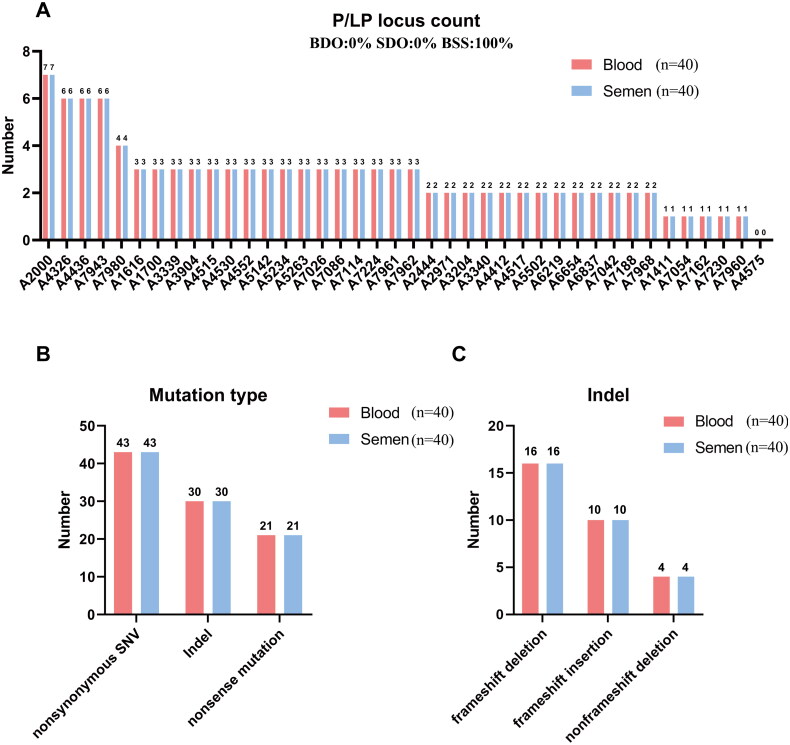
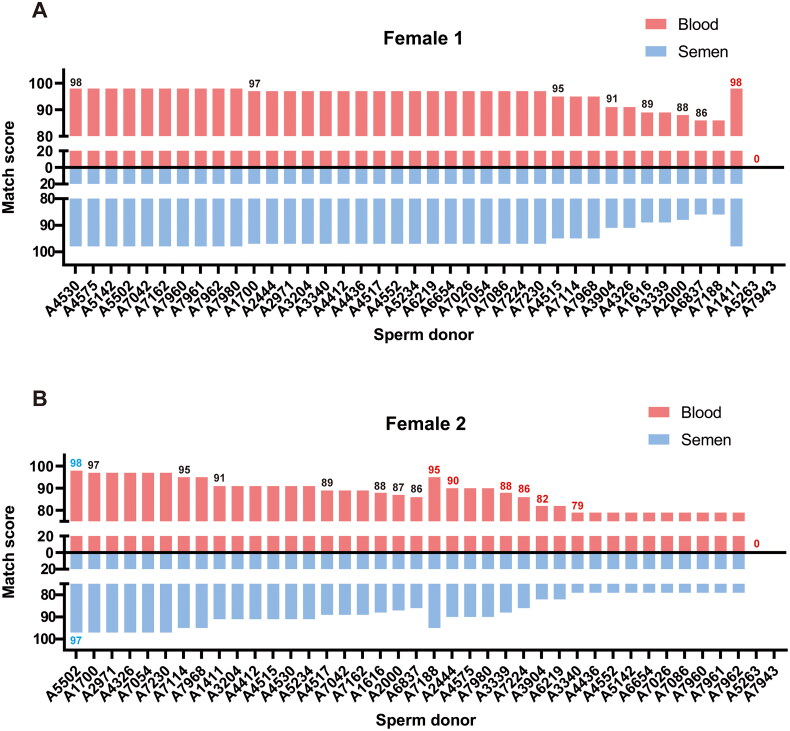
A total of 108 pathogenic (P)/likely pathogenic (LP) variants in 82 genes were identified. The highest carrier had 7 variants, and there was also one donor did not carry any P/LP variant. On average, each donor carried 2.7 P/LP variants. Among all the P/LP variants, missense mutation was the dominant type and most of them were located in exonic regions. Chromosome 1 harboured the largest number of variants and no pathogenic copy number variants (CNV) was identified in semen donors. The P/LP variant of all the 40 semen donors was consistent by comparing sperm and blood. Except for one case that was slightly different, the rest simulated matching results for blood were all consistent with results for sperm.
It is reasonable to choose either blood or sperm for genetic screening in semen donors.
目前,大多数基因检测或携带者筛查是通过血液样本进行的,已知的致病变异携带者率也来自血液。对于精液捐赠者来说,真正传递给后代的是其精子中的致病变异。本研究旨在确定年轻精液捐赠者精子中鉴定出的致病变异是否也存在于他们的血液中,以及血液检测结果是否与精子检测结果一致。
我们纳入了中国湖南省人类精子库40名合格精液捐赠者的40对精子和血液样本。所有样本均进行外显子组测序(ES)分析,并根据美国医学遗传学学会(ACMG)指南评估致病性。基于基因评分和变异评分的精液捐赠匹配评分也用于评估精子和血液基因检测结果的一致性。
共鉴定出82个基因中的108个致病(P)/可能致病(LP)变异。携带变异最多的捐赠者有7个变异,也有一名捐赠者未携带任何P/LP变异。平均而言,每位捐赠者携带2.7个P/LP变异。在所有P/LP变异中,错义突变是主要类型,且大多数位于外显子区域。1号染色体上的变异数量最多,精液捐赠者中未鉴定出致病拷贝数变异(CNV)。通过比较精子和血液,40名精液捐赠者的P/LP变异均一致。除1例略有不同外,其余血液模拟匹配结果均与精子结果一致。
对精液捐赠者进行基因筛查时,选择血液或精子进行检测都是合理的。