Xie Weiming, Wang Fei, Qian Yayun, Qiu Linghe, Zhou Qin, Shen Yuan, Wu Jianhong
Department of Pharmacy, Affiliated Mental Health Center of Jiangnan University, Wuxi, Jiangsu, China.
Department of Pharmacy, Wuxi Central Rehabilitation Hospital, Wuxi, Jiangsu, China.
Front Psychiatry. 2024 Dec 20;15:1434966. doi: 10.3389/fpsyt.2024.1434966. eCollection 2024.
This study aims to explore the differences in "Internet+" pharmacy prescriptions in psychiatric hospitals before and after the outbreak of the coronavirus disease 2019 (COVID-19) pandemic. It also seeks to examine changes in patient healthcare behaviors in the post-pandemic era and to identify the potential role of "Internet+" pharmacy in improving the current healthcare system.
Prescriptions from the "Internet+" pharmacy at The Affiliated Mental Health Center of Jiangnan University, collected between December 1, 2021, and November 30, 2023, were analyzed. The period was divided into four stages based on the COVID-19 pandemic's progression in China. Descriptive statistical analysis was conducted on various prescription-related factors, including patient information, prescription type, disease distribution, medication type, frequency of medication use, pharmacist review time, and instances of irrational medication use.
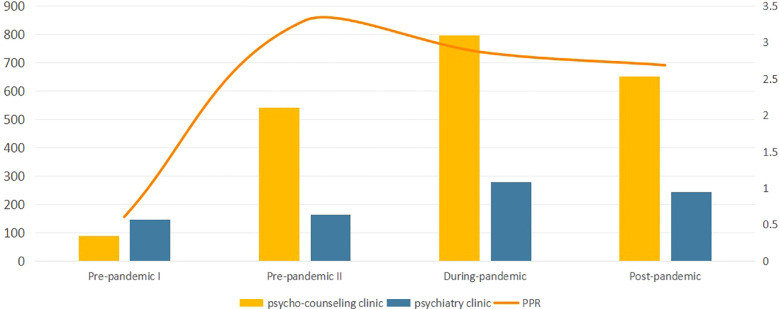
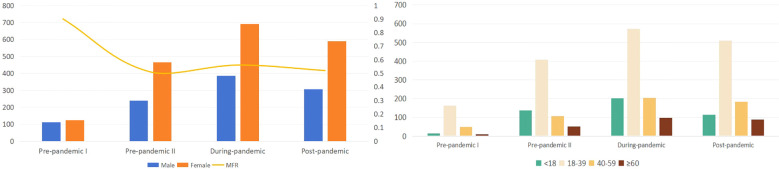
A total of 2914 prescriptions were collected. The male-to-female ratio (MFR) varied significantly across different stages of the epidemic. In the pre-pandemic II period, females represented the highest proportion (66.10%, MFR 0.51), and individuals aged 18-39 made up the majority (56.70%) across all stages. The proportion of psycho-counseling prescriptions was highest in the pre-pandemic II period (76.74%), while the total number of psycho-counseling prescriptions was greatest during the epidemic, with 798 cases. A total of 38 diseases were involved, with depression accounting for the largest proportion (38.98%) at each stage, followed by the highest usage of antidepressants (49.60%). A total of 85 types of medications were used, with quetiapine representing the highest proportion before the epidemic (16.56%, 10.92%), while escitalopram accounted for the highest proportion after the epidemic (10.98%). The majority of patients (70.87%) took medication once daily. 42.23% of pharmacist review times were ≤1 minute, and the mean review time was longest in the post-pandemic period (6175.1 seconds). During the pre-pandemic and epidemic periods, the most common pharmacist review time occurred between 12:00 and 17:59 (41.46%), while in the post-pandemic period, the most common review time was between 18:00 and 23:59 (36.70%). The initial rate of irrational prescriptions was 37.85%. After manual review by pharmacists, the irrational prescription rate of Internet prescriptions decreased to 1.13%.
The development of "Internet+" pharmacy has effectively addressed the medical needs of the relevant population and played a crucial role in combating the COVID-19 pandemic. Future advancements should focus on optimizing the allocation of healthcare resources and expanding innovative pharmacy services to broaden the developmental pathways of the 'Internet+' pharmacy ecosystem.
本研究旨在探讨2019年冠状病毒病(COVID-19)大流行爆发前后精神病医院“互联网 +”药房处方的差异。还试图研究大流行后时代患者医疗行为的变化,并确定“互联网 +”药房在改善当前医疗系统中的潜在作用。
对江南大学附属精神卫生中心“互联网 +”药房在2021年12月1日至2023年11月30日期间收集的处方进行分析。根据中国COVID-19大流行的发展情况,该时间段分为四个阶段。对各种与处方相关的因素进行描述性统计分析,包括患者信息、处方类型、疾病分布、用药类型、用药频率、药师审核时间以及不合理用药情况。
共收集到2914张处方。男女比例在疫情不同阶段有显著差异。在大流行前的第二阶段,女性占比最高(66.10%,男女比例0.51),且在所有阶段中18 - 39岁的个体占大多数(56.70%)。心理辅导处方比例在大流行前的第二阶段最高(76.74%),而心理辅导处方总数在疫情期间最多,为798例。共涉及38种疾病,各阶段抑郁症占比最大(38.98%),其次是抗抑郁药使用量最高(49.60%)。共使用了85种药物,疫情前喹硫平占比最高(16.56%,10.92%),而疫情后艾司西酞普兰占比最高(10.98%)。大多数患者(70.87%)每天服药一次。42.23%的药师审核时间≤1分钟,且平均审核时间在大流行后阶段最长(6175.1秒)。在大流行前和疫情期间,最常见的药师审核时间出现在12:00至17:59之间(41.46%),而在大流行后阶段,最常见的审核时间在18:00至23:59之间(36.70%)。不合理处方初始率为37.85%。经药师人工审核后,互联网处方的不合理处方率降至1.13%。
“互联网 +”药房的发展有效满足了相关人群的医疗需求,在抗击COVID-19大流行中发挥了关键作用。未来的发展应侧重于优化医疗资源配置,拓展创新药房服务,以拓宽“互联网 +”药房生态系统的发展路径。