Lo Tse-Yu, Su Heng-Hsuan, Ho Jhih-Hao, Chang Chia-Wei, Chen Huan-Ru, Hsu Hsun-Hao, Chang Kai-Jie, Chen Jiun-Tai
Department of Applied Chemistry, National Yang Ming Chiao Tung University, Hsinchu 300093, Taiwan.
Department of Chemistry, Duke University, Durham, North Carolina 27708, United States.
ACS Omega. 2024 Dec 16;9(52):51623-51630. doi: 10.1021/acsomega.4c09296. eCollection 2024 Dec 31.
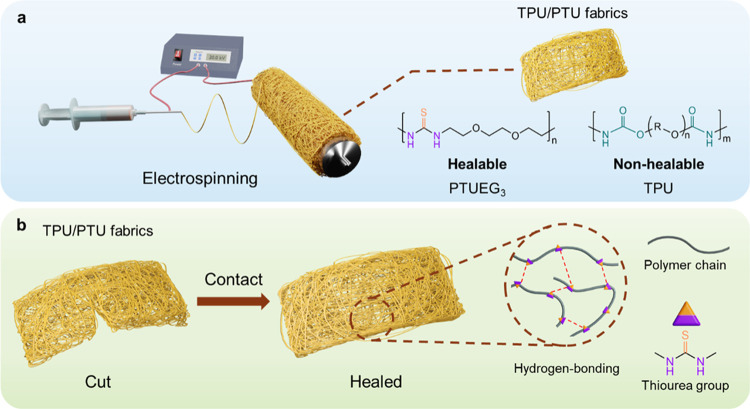
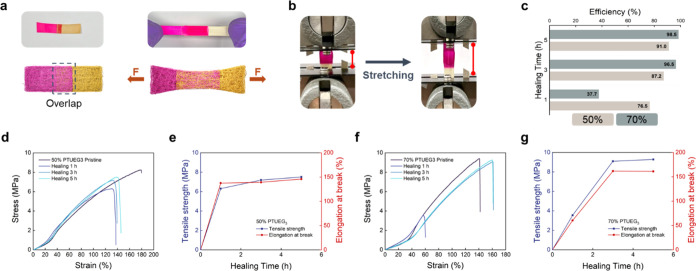
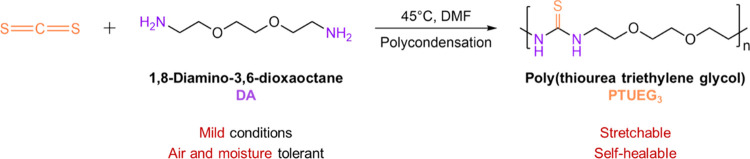
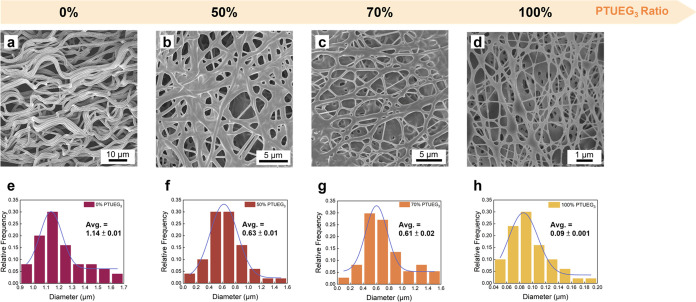
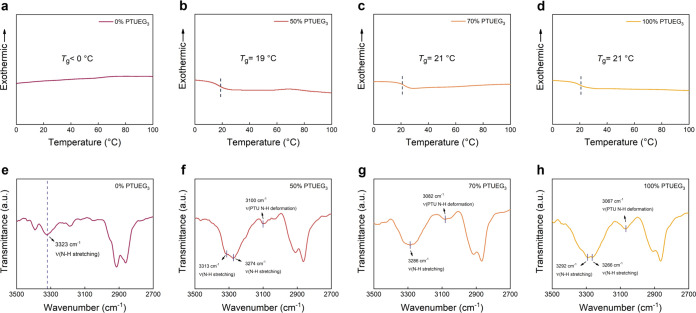
The development of healable polymers represents a significant advancement in materials science, addressing the need for sustainable solutions that can reduce waste and prolong the lifespan of various products. For the development of healable polymer fabrics, however, there are still unsolved issues because of limited healing cycles and poor mechanical properties. In this work, we present intrinsically healable materials for the creation of stretchable, healable fabrics. Specifically, a blend of polyurethane (TPU) and poly(thiourea triethylene glycol) (PTUEG) is fabricated into fabrics utilizing the electrospinning method. The TPU/PTUEG fabrics demonstrate room-temperature self-healing capabilities over repeated cycles under external forces driven by dynamic hydrogen bonding interactions. Furthermore, their self-healing ability can be enhanced through heating. The tensile tests and differential scanning calorimetry (DSC) indicate that the healing capabilities and mechanical properties can be optimized by adjusting the TPU/PTUEG weight ratios. This research provides a practical approach for preparing intrinsically healable fabrics with excellent durability and flexibility, offering a sustainable solution to extend the functional life of textiles and reduce environmental impact, thereby promoting environmental sustainability.
可自愈聚合物的发展代表了材料科学的一项重大进步,满足了对可持续解决方案的需求,这些解决方案可以减少浪费并延长各种产品的使用寿命。然而,对于可自愈聚合物织物的开发,由于愈合循环有限和机械性能较差,仍然存在未解决的问题。在这项工作中,我们展示了用于制造可拉伸、可自愈织物的本征可自愈材料。具体而言,利用静电纺丝方法将聚氨酯(TPU)和聚(硫脲三甘醇)(PTUEG)的混合物制成织物。TPU/PTUEG织物在动态氢键相互作用驱动的外力作用下,在重复循环中表现出室温自愈能力。此外,通过加热可以增强它们的自愈能力。拉伸试验和差示扫描量热法(DSC)表明,通过调整TPU/PTUEG重量比可以优化愈合能力和机械性能。这项研究为制备具有优异耐久性和柔韧性的本征可自愈织物提供了一种实用方法,为延长纺织品的功能寿命和减少环境影响提供了可持续解决方案,从而促进环境可持续性。