Feng Da-Qian, Wang Shaofei, Yu Zhendi, Zhang Wenfeng, Liu Guoliang
School of Chemistry and Chemical Engineering, Yancheng Institute of Technology Jiangsu 224051 P. R. China
RSC Adv. 2025 Jan 2;15(1):199-206. doi: 10.1039/d4ra07209j.
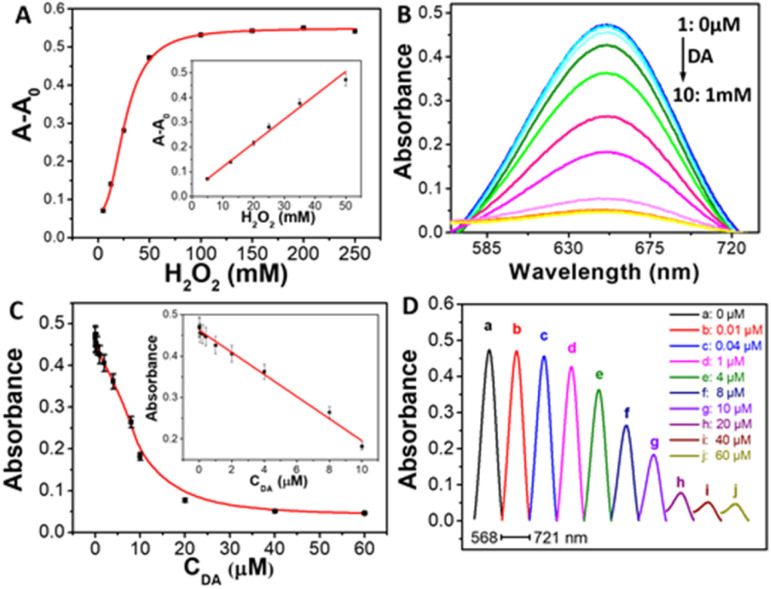
Developing a highly sensitive approach for neurotransmitter analysis is of vital significance due to their essential role in clinical diagnosis and treatment of disease. Herein, bovine serum albumin templated copper nanoparticles (BSA-Cu NPs) with peroxidase-mimicking activity are designed and synthesized for dopamine detection through the fluorometric/colorimetric dual-mode technique. The experimental results suggest that as-fabricated BSA-Cu NPs can strongly catalyze the decomposition of hydrogen peroxide to produce oxidized substances, accompanied by remarkable color changes of chromogenic agent 3,3',5,5'-tetramethylbenzidine from colorless to blue, revealing peroxidase-like activities of BSA-Cu NPs. However, owing to the strong binding affinity between dopamine (DA) and BSA-Cu NPs, the catalytic activities of synthesized BSA-Cu NPs are inhibited, leading to a significant decrement of absorption peak signal. Meanwhile, the strong fluorescence of BSA-Cu NPs exhibits remarkable quenching due to photo-induced electron transfer. Besides, by integrating paper strips and smartphone software analysis, an intelligent recognition of DA is also fabricated. On the basis of these phenomena, a fluorometric/colorimetric approach based on the BSA-Cu NP nanozyme combined with smartphone-assisted analysis is constructed for detecting dopamine with a detection limit of 5 nM, and 5 nM, respectively. Moreover, the recognition of dopamine in human serum samples is also successfully realized which is verified using high performance liquid chromatography, demonstrating its promising potential in bioanalysis and clinical disease diagnosis.
由于神经递质在疾病的临床诊断和治疗中起着至关重要的作用,因此开发一种高度灵敏的神经递质分析方法具有重要意义。在此,设计并合成了具有过氧化物酶模拟活性的牛血清白蛋白模板化铜纳米颗粒(BSA-Cu NPs),用于通过荧光/比色双模式技术检测多巴胺。实验结果表明,所制备的BSA-Cu NPs能强烈催化过氧化氢分解产生氧化物质,同时显色剂3,3',5,5'-四甲基联苯胺发生显著颜色变化,从无色变为蓝色,这表明BSA-Cu NPs具有过氧化物酶样活性。然而,由于多巴胺(DA)与BSA-Cu NPs之间具有很强的结合亲和力,合成的BSA-Cu NPs的催化活性受到抑制,导致吸收峰信号显著降低。同时,由于光诱导电子转移,BSA-Cu NPs的强荧光表现出显著猝灭。此外,通过将纸条与智能手机软件分析相结合,还构建了一种对DA的智能识别方法。基于这些现象,构建了一种基于BSA-Cu NP纳米酶结合智能手机辅助分析的荧光/比色方法,用于检测多巴胺,检测限分别为5 nM和5 nM。此外,还成功实现了对人血清样本中多巴胺的识别,并通过高效液相色谱进行了验证,证明了其在生物分析和临床疾病诊断中的潜在应用前景。