Nur Muhamad Maulana Azimatun, Murni Sri Wahyu, Setyoningrum Tutik Muji, Hadi Faizah, Widayati Tunjung Wahyu, Jaya Danang, Sulistyawati Raden Roro Endang, Puspitaningrum Dwi Aulia, Dewi Resti Nurmala, Hasanuzzaman M
Chemical Engineering Department, UPN Veteran Yogyakarta, Depok, Sleman, Yogyakarta, 55283, Indonesia.
Department of Agribusiness, UPN Veteran Yogyakarta, Depok, Sleman, Yogyakarta, 55283, Indonesia.
Biotechnol Rep (Amst). 2024 Dec 10;45:e00870. doi: 10.1016/j.btre.2024.e00870. eCollection 2025 Mar.
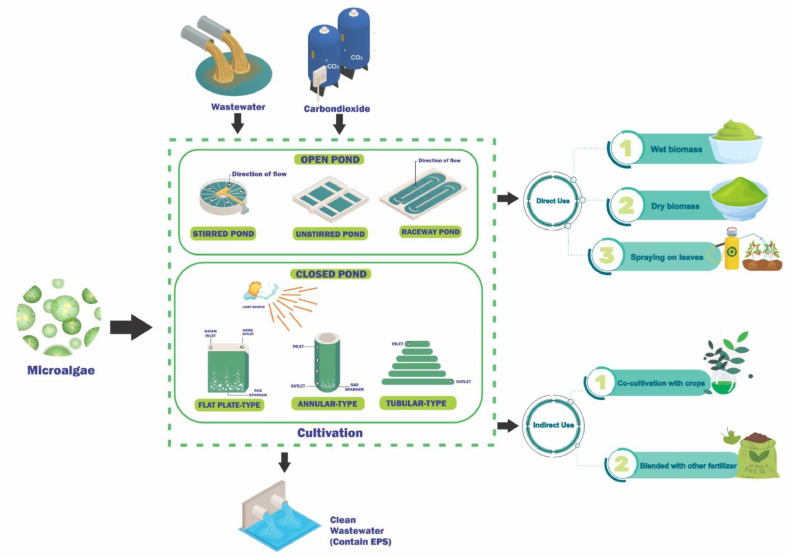
The increasing need for sustainable agricultural practices due to the overuse of chemical fertilizers has prompted interest in microalgae as biofertilizers. This review investigates the potential of microalgae as biofertilizers and phycoremediators within sustainable agroecosystems, addressing both soil fertility and wastewater management. Microalgae provide a dual benefit by absorbing excess nutrients and contaminants from wastewater, generating nutrient-rich biomass that can replace chemical fertilizers and support plant growth. Implementation strategies include cultivating microalgae in wastewater to offset production costs, using closed photobioreactor systems to enhance growth efficiency, and applying microalgal biomass directly to soil or crops. Additionally, microalgae extracts provide essential bioactive compounds, such as phytohormones and amino acids, that enhance plant growth and resilience. While microalgae offer an eco-friendly solution for nutrient recycling and crop productivity, challenges in scalability, production cost, and regulatory frameworks hinder widespread adoption. This review highlights the potential pathways and technological advancements necessary for integrating microalgae into sustainable agriculture, emphasizing the need for interdisciplinary collaboration and innovative approaches to overcome these barriers. Ultimately, microalgae biofertilizers represent a promising approach to reducing environmental impact and advancing sustainable farming practices.
由于化肥的过度使用,对可持续农业实践的需求日益增加,这引发了人们对微藻作为生物肥料的兴趣。本综述研究了微藻在可持续农业生态系统中作为生物肥料和藻类修复剂的潜力,涉及土壤肥力和废水管理两个方面。微藻通过吸收废水中的过量营养物质和污染物,产生富含营养的生物质,既能替代化肥又能支持植物生长,从而带来双重益处。实施策略包括在废水中培养微藻以抵消生产成本,使用封闭式光生物反应器系统提高生长效率,以及将微藻生物质直接施用于土壤或作物。此外,微藻提取物提供了重要的生物活性化合物,如植物激素和氨基酸,可促进植物生长并增强其恢复力。虽然微藻为养分循环利用和作物生产力提供了一种生态友好的解决方案,但在可扩展性、生产成本和监管框架方面的挑战阻碍了其广泛应用。本综述强调了将微藻整合到可持续农业中所需的潜在途径和技术进步,强调了跨学科合作和创新方法以克服这些障碍的必要性。最终,微藻生物肥料是减少环境影响和推进可持续农业实践的一种有前景的方法。