Prajapati Dinesh J, Patel Manoj, Patel Pankaj, Ganpule Arvind, Mistry Deepak
Department of Anaesthesiology, Muljibhai Patel Urological Hospital, Nr Dr. Virendra Desai Road, Nadiad, Gujarat, India.
Consultant Urologist, Department of Urology, India.
J Anaesthesiol Clin Pharmacol. 2024 Oct-Dec;40(4):612-618. doi: 10.4103/joacp.joacp_98_23. Epub 2024 Jul 19.
Enhanced recovery after surgery (ERAS) has been applied in various laparoscopic procedures. Intravenous lidocaine (IVL) infusion is used for laparoscopic procedures as a part of ERAS protocols. The study aimed to evaluate the role of IVL infusion in enhanced bowel recovery after laparoscopic renal surgeries.
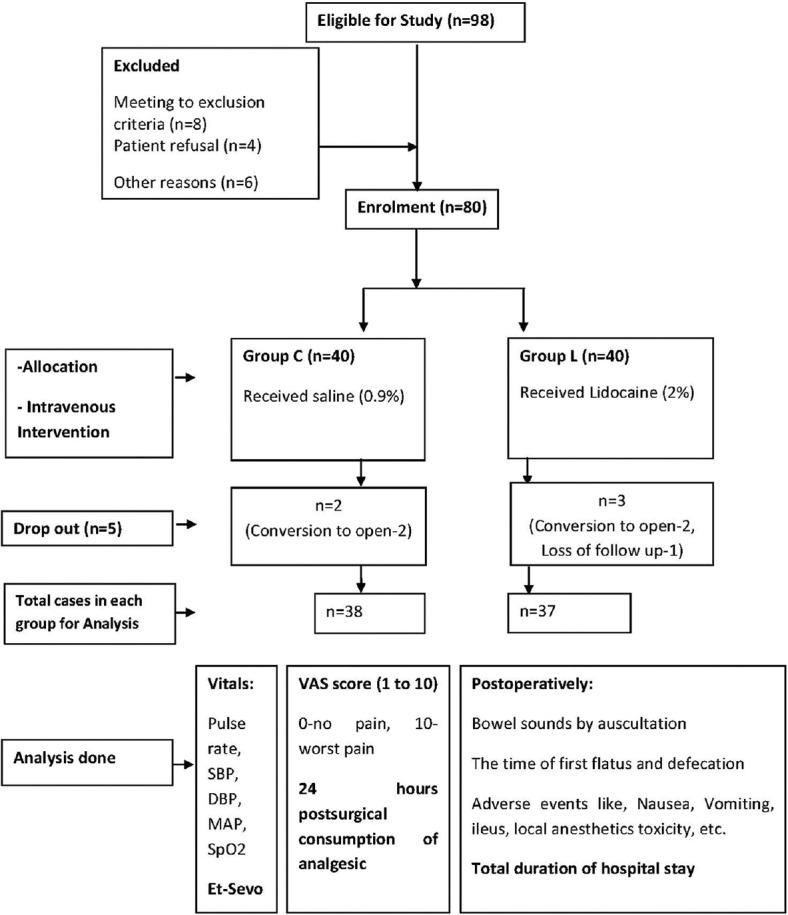
A randomized, double-blind, placebo-control trial was conducted on 80 patients (with American Society of Anesthesiologists physical status I-II) who presented for laparoscopic renal surgeries under general anesthesia. The study period was from Oct 2018 to Sept 2019. By computer-generated codes, patients were randomly divided into two groups: L (lidocaine) and C (control). Group L received an intravenous (IV) bolus (1.5 mg/kg) of 2% lidocaine over 2 min, followed by an IV lidocaine infusion at the rate of 1.5 mg/kg/h until skin closure. Group C received the same volume of bolus followed by normal saline infusion. Patients were monitored for bowel functions, total hospital stay, and total analgesic consumption. Student's -test and Chi-square test were used for quantitative data and occurrence of events, respectively. <0.05 was considered to be statistically significant.
First bowel sound, flatus, and defecation occurred in 16.4 ± 2.50, 26.7 ± 9.02, and 39.1 ± 6.31 h, respectively, in group L and 18.2 ± 2.90, 32.3 ± 3.11, and 43.3 ± 4.22 h, respectively, in group C ( = 0.006, 0.001, and 0.01, respectively). Total hospital stay was 4.0 ± 0.74 and 5.3±0.0.91 days in groups L and C, respectively ( < 0.001).
The present study concluded that IVL could enhance the bowel recovery and reduce total hospital stay after laparoscopic renal surgeries.
术后加速康复(ERAS)已应用于各种腹腔镜手术。静脉输注利多卡因(IVL)作为ERAS方案的一部分用于腹腔镜手术。本研究旨在评估IVL输注在腹腔镜肾手术后促进肠道恢复中的作用。
对80例(美国麻醉医师协会身体状况分级为I-II级)在全身麻醉下接受腹腔镜肾手术的患者进行了一项随机、双盲、安慰剂对照试验。研究时间为2018年10月至2019年9月。通过计算机生成的编码,将患者随机分为两组:L组(利多卡因组)和C组(对照组)。L组在2分钟内静脉推注2%利多卡因(1.5mg/kg),随后以1.5mg/kg/h的速率静脉输注利多卡因直至皮肤缝合。C组接受相同体积的推注,随后输注生理盐水。监测患者的肠道功能、总住院时间和总镇痛药物消耗量。定量数据和事件发生率分别采用学生t检验和卡方检验。P<0.05被认为具有统计学意义。
L组首次肠鸣音、排气和排便分别发生在16.4±2.50、26.7±9.02和39.1±6.31小时,C组分别发生在18.2±2.90、32.3±3.11和43.3±4.22小时(分别为P=0.006、0.001和0.01)。L组和C组的总住院时间分别为4.0±0.74天和5.3±0.91天(P<0.001)。
本研究得出结论,IVL可促进腹腔镜肾手术后的肠道恢复并缩短总住院时间。