Suhas P, Anand Rahul K, Baidya Dalim K, Dehran Maya
Department of Critical Care Medicine, PK Das Institute of Medical Sciences, Ottapalam, Kerala, India.
Department of Anesthesiology, Pain Medicine and Critical Care, All India Institute of Medical Sciences (AIIMS), New Delhi, India.
Indian J Crit Care Med. 2024 Dec;28(12):1107-1111. doi: 10.5005/jp-journals-10071-24862. Epub 2024 Nov 30.
Urine output (UO) in response to furosemide stress test (FST) can predict the progression of acute kidney injury (AKI). This study aimed to assess if changes in UO, urine spot sodium (USS), urine spot sodium creatinine ratio (USSCR) and changes in these parameters over 6 hours could differentiate between progressive and non-progressive AKI.
Fifty critically ill adults with AKI in acute kidney injury network (AKIN) stages I and II with volume overload were included in this prospective study. The FST was performed with 1 mg/kg intravenous bolus. Hourly UO, USS, USSCR, maximum USS difference (USSDMAX), and maximum USSCR difference (USSCRDMAX) were documented. Any progression of AKI was noted till day 3.
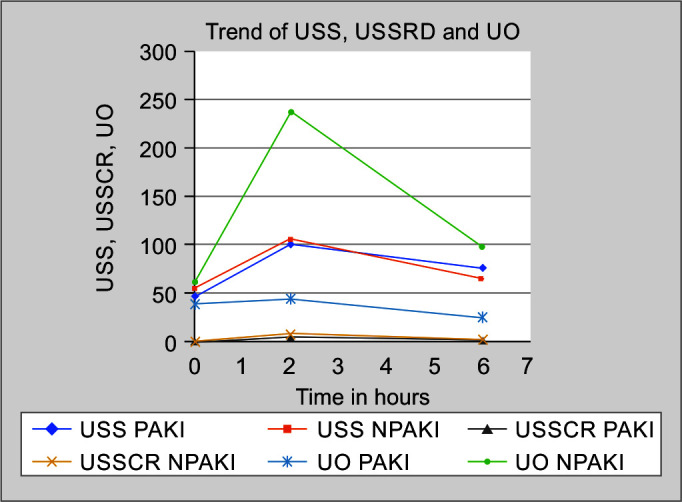
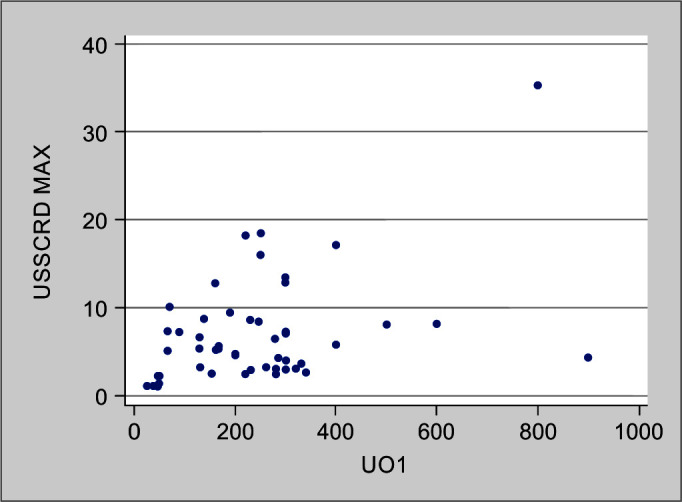
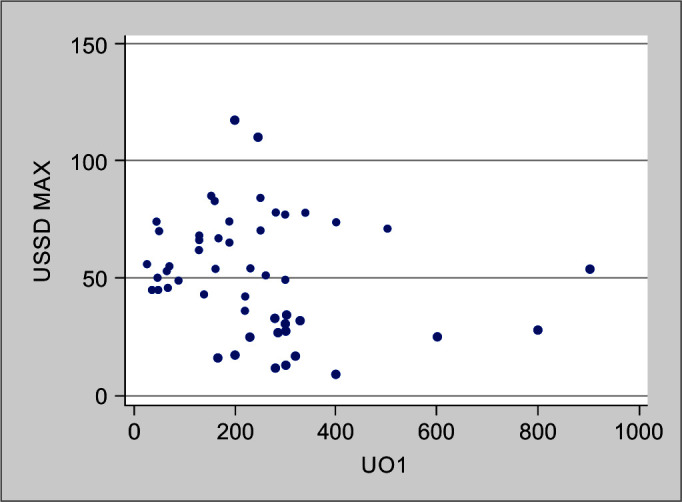
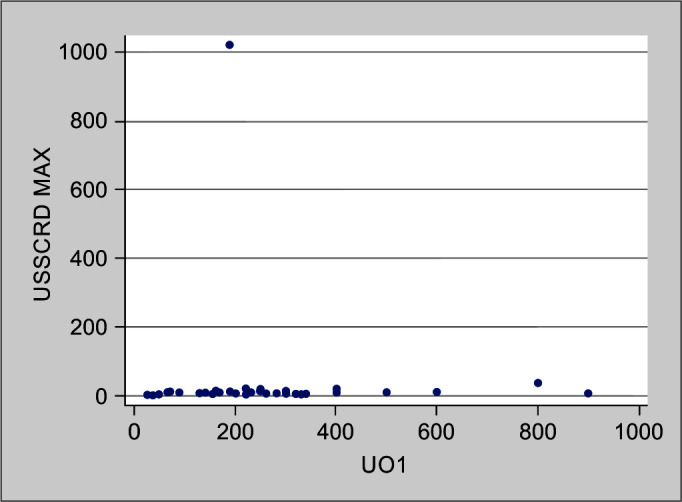
A total of 50 patients were recruited and = 10 had progressive AKI (PAKI) and = 40 had non-progressive AKI (NPAKI). Urine output at 1 and 2 h were significantly less in PAKI group. USS0, USS2, USS6, and USSDMAX were comparable between the groups. USSCR0 and USSCR6 were comparable between the groups whereas USSCR2 and USSCRDMAX were significantly less in PAKI group. USSDMAX did not correlate with UO1 (correlation coefficient 0.2, = 0.16). However, USSCRDMAX showed a poor but significant correlation with UO1 (correlation coefficient 0.3, = 0.03).
To conclude, hourly UO in the first two hours and maximum change in USSCR within 6 hours following the FST may have an important role in early differentiation of progressive AKI in critically ill patients.
Suhas P, Anand RK, Baidya DK, Dehran M. Role of Spot Urine Sodium in Furosemide Stress Test in Volume-overloaded Critically Ill Patients with Acute Kidney Injury. Indian J Crit Care Med 2024;28(12):1107-1111.
呋塞米应激试验(FST)后的尿量(UO)可预测急性肾损伤(AKI)的进展。本研究旨在评估尿量、尿钠即时值(USS)、尿钠肌酐比值即时值(USSCR)的变化以及这些参数在6小时内的变化是否能区分进展性和非进展性AKI。
本前瞻性研究纳入了50例急性肾损伤网络(AKIN)I期和II期且容量超负荷的成年重症AKI患者。FST采用1mg/kg静脉推注进行。记录每小时的尿量、尿钠即时值、尿钠肌酐比值即时值、最大尿钠差值(USSDMAX)和最大尿钠肌酐比值差值(USSCRDMAX)。记录至第3天AKI的任何进展情况。
共招募了50例患者,其中10例为进展性AKI(PAKI),40例为非进展性AKI(NPAKI)。PAKI组1小时和2小时的尿量明显较少。两组间的尿钠即时值0、尿钠即时值2、尿钠即时值6和最大尿钠差值相当。两组间的尿钠肌酐比值即时值0和尿钠肌酐比值即时值6相当,而PAKI组的尿钠肌酐比值即时值2和最大尿钠肌酐比值差值明显较低。最大尿钠差值与1小时尿量无相关性(相关系数0.2,P = 0.16)。然而,最大尿钠肌酐比值差值与1小时尿量呈弱但显著的相关性(相关系数0.3,P = 0.03)。
总之,FST后前两小时的每小时尿量以及6小时内尿钠肌酐比值的最大变化可能在重症患者进展性AKI的早期鉴别中起重要作用。
Suhas P, Anand RK, Baidya DK, Dehran M. Spot Urine Sodium在容量超负荷的急性肾损伤重症患者呋塞米应激试验中的作用。《印度重症医学杂志》2024;28(12):1107 - 1111。