Shi Liu, Liao Youxin, Chen Yue
Department of Critical Care Medicine, Jiangjin Central Hospital, Chongqing, 402260, People's Republic of China.
Department of Medical Administration, Jiangjin Central Hospital, Chongqing, 402260, People's Republic of China.
Int J Gen Med. 2024 Dec 30;17:6557-6565. doi: 10.2147/IJGM.S497268. eCollection 2024.
To analyze the independent associations of the Kidney Failure Risk Equation (KFRE) and neutrophil gelatinase-associated lipocalin (NGAL) with end-stage renal disease (ESRD) among patients with chronic kidney disease (CKD) stages 3-5 in China and evaluate their predictive values for ESRD.
A total of 716 patients with CKD stages 3-5 at the time of the initial renal medicine referral were retrospectively enrolled, and the study outcome was the observed incidence of ESRD at 2 years after the initial referral. Baseline characteristics were collected, and relevant laboratory indexes, including neutrophil gelatinase-associated lipocalin (NGAL), were detected. The binary regression model was used to analyze the independent associations, and the receiver operating characteristic (ROC) curve was used to assess the predictive values.
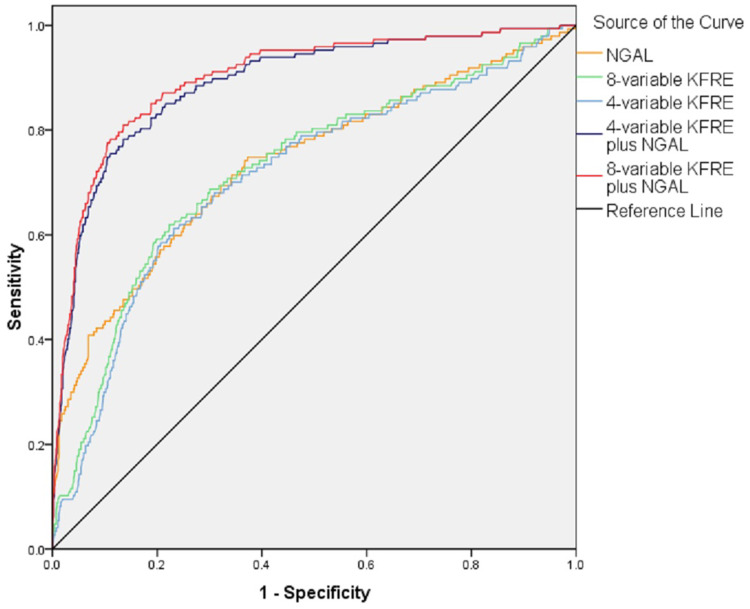
The 2-year incidence of ESRD was 20.5% (147/716). The 4-variable KFRE, 8-variable KFRE and NGAL were independently associated with ESRD after adjusting for potential confounding factors. The AUCs of the 4-variable KFRE, 8-variable KFRE and NGAL for predicting ESRD among patients with CKD stages 3-5 were 0.711 [standard error (): 0.026, 95% confidence interval (): 0.662-0.761], 0.725 (: 0.025, 95% : 0.677-0.774) and 0.736 (: 0.024, 95% : 0.686-0.785), respectively. The AUC of the 4-variable KFRE plus NGAL was significantly higher than those of the 4-variable KFRE and NGAL alone (0.900 vs 0.711, = 6.297, < 0.001; 0.900 vs 0.736, = 5.795, < 0.001), and the AUC of the 8-variable KFRE plus NGAL was also significantly higher than those of the 8-variable KFRE and NGAL alone (0.911 vs 0.725, = 6.491, < 0.001; 0.911 vs 0.736, = 6.298, < 0.001).
The KFRE was able to independently predict progression of CKD stage 3-5 to ESRD in Chinese population. The addition of NGAL to the KFRE was able to elevate the predictive value when applied in predicting 2-year ESRD.
分析在中国慢性肾脏病(CKD)3 - 5期患者中,肾衰竭风险方程(KFRE)和中性粒细胞明胶酶相关脂质运载蛋白(NGAL)与终末期肾病(ESRD)的独立相关性,并评估它们对ESRD的预测价值。
回顾性纳入716例初次肾内科转诊时处于CKD 3 - 5期的患者,研究结局为初次转诊后2年观察到的ESRD发病率。收集基线特征,并检测包括中性粒细胞明胶酶相关脂质运载蛋白(NGAL)在内的相关实验室指标。采用二元回归模型分析独立相关性,采用受试者工作特征(ROC)曲线评估预测价值。
ESRD的2年发病率为20.5%(147/716)。校正潜在混杂因素后,4变量KFRE、8变量KFRE和NGAL与ESRD独立相关。CKD 3 - 5期患者中,4变量KFRE、8变量KFRE和NGAL预测ESRD的曲线下面积(AUC)分别为0.711[标准误(SE):0.026,95%置信区间(CI):0.662 - 0.761]、0.725(SE:0.025,95%CI:0.677 - 0.774)和0.736(SE:0.024,95%CI:0.686 - 0.785)。4变量KFRE加NGAL的AUC显著高于单独的4变量KFRE和NGAL(0.900对0.711,Z = 6.297,P < 0.001;0.900对0.736,Z = 5.795,P < 0.001),8变量KFRE加NGAL的AUC也显著高于单独的8变量KFRE和NGAL(0.911对0.725,Z = 6.491,P < 0.001;0.911对0.736,Z = 6.298,P < 0.001)。
KFRE能够独立预测中国人群中CKD 3 - 5期进展至ESRD的情况。在预测2年ESRD时,将NGAL加入KFRE能够提高预测价值。