Daibo Susumu, Homma Yuki, Ohya Hiroki, Fukuoka Hironori, Miyake Kentaro, Ozawa Mayumi, Kumamoto Takafumi, Matsuyama Ryusei, Saigusa Yusuke, Endo Itaru
Department of Gastroenterological Surgery Yokohama City University Yokohama Kanagawa Japan.
Department of Surgery, Gastroenterological Center Yokohama City University Medical Center Yokohama Kanagawa Japan.
Ann Gastroenterol Surg. 2024 Jun 17;9(1):161-168. doi: 10.1002/ags3.12836. eCollection 2025 Jan.
Lymph node metastasis is an adverse prognostic factor in pancreatic ductal adenocarcinoma. However, it remains a challenge to predict lymph node metastasis using preoperative imaging alone. We used machine learning (combining preoperative imaging findings, tumor markers, and clinical information) to create a novel prediction model for lymph node metastasis in resectable pancreatic ductal adenocarcinoma.
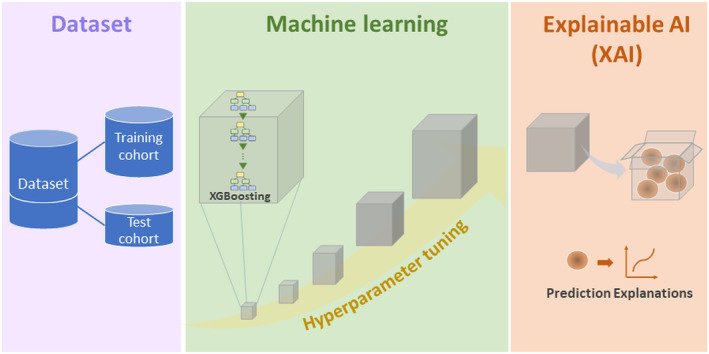
The data of patients with resectable pancreatic ductal adenocarcinoma who underwent surgery between September 1991 and October 2022 were retrospectively examined. Machine-learning software (Statistical Package for the Social Sciences Modeler) was used to create a prediction model, and parameter tuning was performed to improve the model's accuracy. We also analyzed the contribution of each feature to prediction using individual conditional expectation and partial dependence plots.
Of the 331 cases included in the study, 241 comprised the training cohort and 90 comprised the test cohort. After parameter tuning, the areas under the receiver operating characteristic curves for the training and test cohorts were 0.780 and 0.795, respectively. Individual conditional expectation and partial dependence plots showed that larger tumor size and carbohydrate antigen 19-9 and Duke pancreatic monoclonal antigen type 2 levels were associated with positive lymph node metastasis prediction in this model; neoadjuvant treatment was associated with negative lymph node metastasis prediction.
Machine learning may contribute to the creation of an effective predictive model of lymph node metastasis in pancreatic ductal adenocarcinoma. Prediction models using machine learning may contribute to the development of new treatment strategies in resectable pancreatic ductal adenocarcinoma.
淋巴结转移是胰腺导管腺癌的不良预后因素。然而,仅使用术前影像学来预测淋巴结转移仍然是一项挑战。我们使用机器学习(结合术前影像学检查结果、肿瘤标志物和临床信息)来创建一种用于可切除胰腺导管腺癌淋巴结转移的新型预测模型。
回顾性研究了1991年9月至2022年10月期间接受手术的可切除胰腺导管腺癌患者的数据。使用机器学习软件(社会科学统计软件包建模器)创建预测模型,并进行参数调整以提高模型的准确性。我们还使用个体条件期望和偏依赖图分析了每个特征对预测的贡献。
该研究纳入的331例病例中,241例组成训练队列,90例组成测试队列。经过参数调整后,训练队列和测试队列的受试者操作特征曲线下面积分别为0.780和0.795。个体条件期望和偏依赖图显示,在该模型中,较大的肿瘤大小、糖类抗原19-9和杜克胰腺单克隆抗原2型水平与阳性淋巴结转移预测相关;新辅助治疗与阴性淋巴结转移预测相关。
机器学习可能有助于创建一种有效的胰腺导管腺癌淋巴结转移预测模型。使用机器学习的预测模型可能有助于可切除胰腺导管腺癌新治疗策略的开发。