Pekľanská Miriama, van Heerwaarden Belinda, Hoffmann Ary A, Nouzová Marcela, Šíma Radek, Ross Perran A
Institute of Parasitology, Biology Centre of the Czech Academy of Sciences, 370 05 Ceske Budejovice, Czech Republic.
Faculty of Science, University of South Bohemia, 370 05 Ceske Budejovice, Czech Republic.
J Exp Biol. 2025 Feb 1;228(3). doi: 10.1242/jeb.249803. Epub 2025 Feb 7.
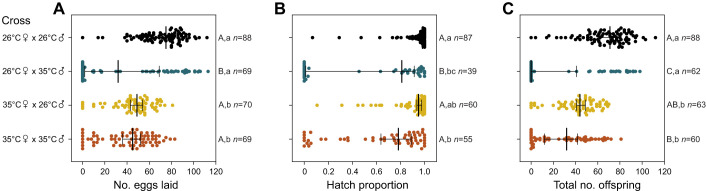
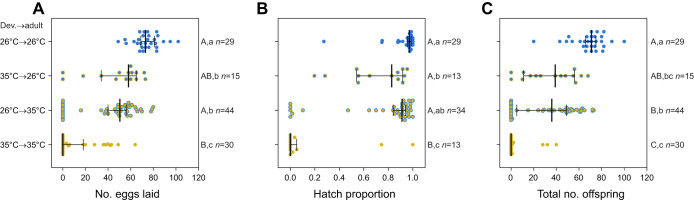
Aedes aegypti mosquitoes are the principal vectors of dengue and continue to pose a threat to human health, with ongoing urbanization, climate change and trade all impacting the distribution and abundance of this species. Hot periods are becoming increasingly common and their impacts on insect mortality have been well established, but they may have even greater impacts on insect fertility. In this study, we investigated the impacts of high temperatures on Ae. aegypti fertility both within and across generations. Mosquitoes developing under elevated temperatures exhibited higher critical thermal maxima (CTmax), reflecting developmental acclimation, but their fertility declined with increasing developmental temperature. In females, elevated developmental temperatures decreased fecundity while in males it tended to decrease the proportion of eggs that hatched and the proportion of individuals producing viable offspring. Rearing both sexes at 35°C increased fecundity in the subsequent generation but effects of elevated temperatures persisted across gonotrophic cycles within the same generation. Moreover, exposure of adults to 35°C further decreased fertility beyond the effects of developmental temperature alone. These findings highlight sub-lethal impacts of elevated temperatures on Ae. aegypti fertility and plastic responses to thermal stress within and across generations. This has significant implications for predicting the distribution and abundance of mosquito populations thriving in increasingly warmer environments.
埃及伊蚊是登革热的主要传播媒介,随着城市化进程的推进、气候变化以及贸易活动的开展,其分布和数量持续对人类健康构成威胁。炎热时期愈发常见,其对昆虫死亡率的影响已得到充分证实,但对昆虫繁殖力的影响可能更为显著。在本研究中,我们调查了高温对埃及伊蚊繁殖力在代内和代际间的影响。在高温环境下发育的蚊子表现出更高的临界热最大值(CTmax),这反映了发育适应,但它们的繁殖力随着发育温度的升高而下降。在雌性蚊子中,发育温度升高会降低繁殖力,而在雄性蚊子中,这往往会降低孵化的卵的比例以及产生有活力后代的个体比例。在35°C下饲养雌雄蚊子会增加下一代的繁殖力,但高温的影响在同一代的生殖营养周期中持续存在。此外,成虫暴露在35°C环境中会进一步降低繁殖力,其影响超过发育温度单独产生的影响。这些发现凸显了高温对埃及伊蚊繁殖力的亚致死影响以及代内和代际间对热应激的可塑性反应。这对于预测在日益温暖的环境中繁衍的蚊子种群的分布和数量具有重要意义。