Wu Qiongyu, He Lina
Department of Reproductive Health and Infertility, Zigong Maternal and Child Health Hospital, Zigong, Sichuan, China.
Front Endocrinol (Lausanne). 2024 Dec 23;15:1521734. doi: 10.3389/fendo.2024.1521734. eCollection 2024.
The polyspermy rate is a quality control indicator in the embryology laboratory, and factors affecting polyspermy are of great interest. The gonadotropin-releasing hormone (GnRH) antagonist protocol is currently the mainstream protocol in most reproductive centers. This study explored the factors influencing polyspermy in fertilization (IVF) using the GnRH antagonist protocol and considered corresponding improvement measures.
This retrospective case-control study analyzed 354 patients who underwent conventional IVF with a GnRH antagonist protocol at Zigong Maternal and Child Health Hospital from November 2019 to September 2023. Patients were divided into two groups based on the occurrence of polyspermy, and baseline characteristics and clinical data were compared between the groups. Variables with P<0.05 in univariate logistic regression were included in the multivariate logistic regression model. Cutoff values for variables with P<0.05 were calculated.
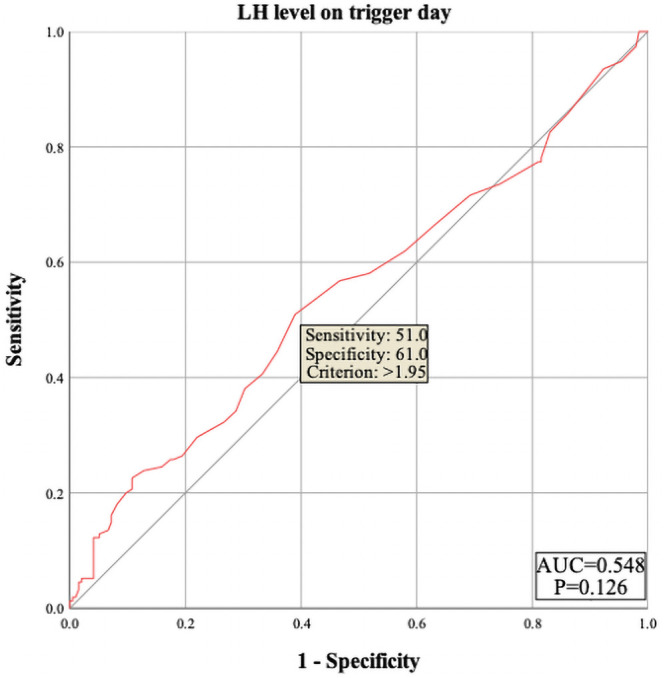
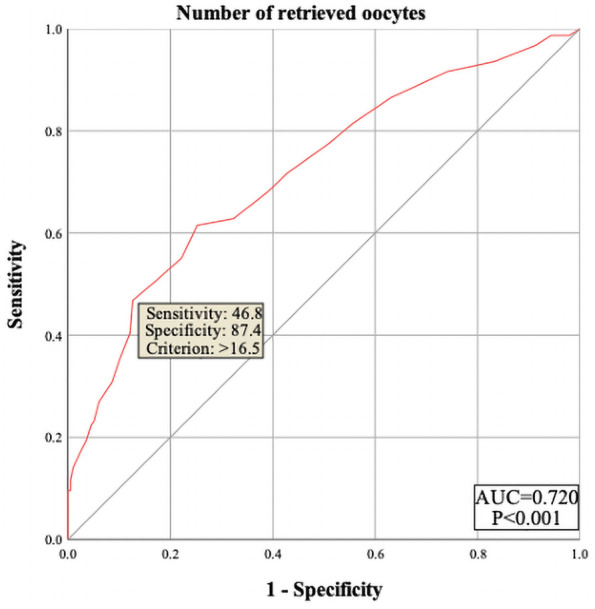
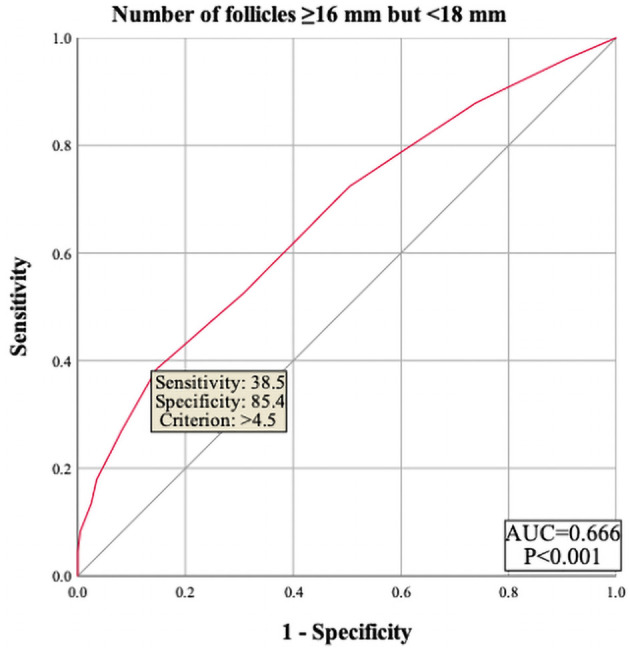
Multivariate logistic regression corrected for confounding factors identified that luteinizing hormone (LH) level on trigger day, the number of follicles ≥16 mm but <18 mm, and the number of retrieved oocytes were significantly associated with polyspermy (OR=1.305, P=0.005; OR=1.235, P=0.002; OR=1.101, P<0.001, respectively). The cutoff values were 1.95 IU/L, 4.5 follicles, and 16.5 oocytes, respectively.
In the GnRH antagonist cycle, LH level on trigger day, the number of follicles ≥16 mm but <18 mm, and the number of retrieved oocytes are independent risk factors for polyspermy. When LH level on trigger day exceeds 1.95 IU/L, the number of follicles ≥16 mm but <18 mm exceeds 4, and the number of oocytes retrieved exceeds 16, the risk of polyspermy increases significantly.
多精受精率是胚胎学实验室中的一项质量控制指标,影响多精受精的因素备受关注。促性腺激素释放激素(GnRH)拮抗剂方案目前是大多数生殖中心的主流方案。本研究探讨了使用GnRH拮抗剂方案进行体外受精(IVF)时影响多精受精的因素,并考虑了相应的改进措施。
本回顾性病例对照研究分析了2019年11月至2023年9月在自贡市妇幼保健院接受GnRH拮抗剂方案常规IVF的354例患者。根据多精受精的发生情况将患者分为两组,并比较两组的基线特征和临床数据。单因素逻辑回归中P<0.05的变量纳入多因素逻辑回归模型。计算P<0.05变量的截断值。
校正混杂因素后的多因素逻辑回归分析确定,扳机日促黄体生成素(LH)水平、≥16 mm但<18 mm的卵泡数量以及获卵数与多精受精显著相关(OR分别为1.305,P=0.005;OR为1.235,P=0.002;OR为1.101,P<0.001)。截断值分别为1.95 IU/L、4.5个卵泡和16.5个卵母细胞。
在GnRH拮抗剂周期中,扳机日LH水平、≥16 mm但<18 mm的卵泡数量以及获卵数是多精受精的独立危险因素。当扳机日LH水平超过1.95 IU/L、≥16 mm但<18 mm的卵泡数量超过4个且获卵数超过16个时,多精受精风险显著增加。