Goel Anjali, Das Matuli, Sen Saswati
Department of Ophthalmology, Kalinga Institute of Medical Sciences, Bhubaneswar, Bhubaneswar, IND.
Cureus. 2024 Dec 7;16(12):e75260. doi: 10.7759/cureus.75260. eCollection 2024 Dec.
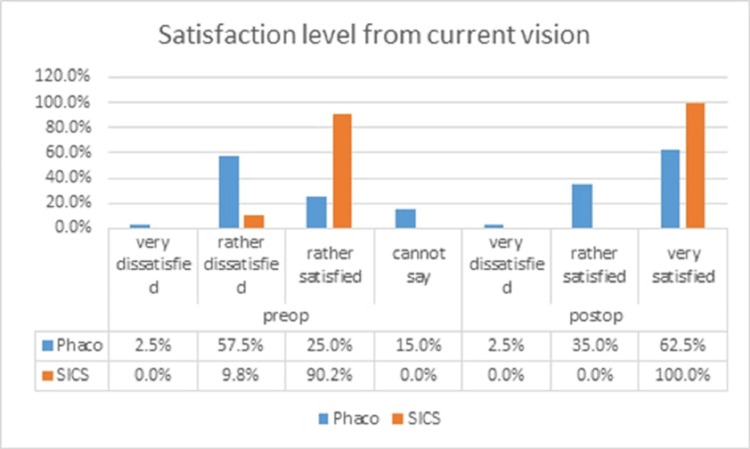
Objective The objective of this study is to compare patient-reported outcome measures using the Catquest Questionnaire in patients undergoing phacoemulsification (Phaco) versus manual small-incision cataract surgery (MSICS). Materials and methods This descriptive cross-sectional study included patients aged 40 years and older with cataracts classified as nuclear sclerosis (NS) grade 3 or higher. Demographic details were recorded and a comprehensive ophthalmological exam was done. All patients were operated on by the same surgeon, with 41 undergoing MSICS and 40 undergoing Phaco. Monofocal intraocular lenses were implanted in all cases. Responses to the Catquest questionnaire were collected preoperatively and at six weeks postoperatively. The questionnaire, validated in the Odia language, was provided to patients in both Odia and English. Results Out of 81 patients, 32 underwent their first eye surgery while 49 had their second eye surgery. Both Phaco and MSICS procedures showed significant visual acuity improvement. Mean visual acuity improved from 1.19 to 0.37 in the right eye and from 0.74 to 0.35 in the left eye, with p-values <0.001. Nearly all patients experienced better near vision postoperatively, with 45 (97.8%) of right eyes and 34 (100%) of left eyes achieving near vision between N6 and N8. One Phaco patient with age-related macular degeneration had near vision limited to N10. In a few areas, such as carrying out hobbies, doing needlework, and overall vision satisfaction, patients in the MSICS group patients did better than Phaco group. Response to other questions showed similar responses in both the Phaco and MSICS groups. Conclusion Cataract surgery irrespective of procedure improves overall vision-specific functioning and quality of life. MSICS is often preferred over Phaco for its speed, cost-effectiveness, and lower technological dependence, especially for brown cataracts and bulk surgeries. The choice between MSICS and Phaco should depend on patient needs, preoperative counseling, surgeon expertise, and resources.
目的 本研究的目的是比较使用Catquest问卷对接受超声乳化白内障吸除术(Phaco)与手法小切口白内障手术(MSICS)的患者进行的患者报告结局指标。材料和方法 这项描述性横断面研究纳入了年龄在40岁及以上、白内障分级为3级或更高核硬化(NS)的患者。记录人口统计学细节并进行全面的眼科检查。所有患者均由同一位外科医生进行手术,41例接受MSICS,40例接受Phaco。所有病例均植入单焦点人工晶状体。术前和术后六周收集对Catquest问卷的回答。该问卷已用奥里亚语验证,以奥里亚语和英语提供给患者。结果 在81例患者中,32例接受了第一眼手术,49例接受了第二眼手术。Phaco和MSICS手术均显示视力有显著改善。右眼平均视力从1.19提高到0.37,左眼从0.74提高到0.35,p值<0.001。几乎所有患者术后近视力都有所改善,右眼45例(97.8%)和左眼34例(100%)的近视力达到N6至N8。一名患有年龄相关性黄斑变性的Phaco患者近视力限于N10。在一些方面,如开展业余爱好、做针线活和总体视力满意度方面,MSICS组患者比Phaco组患者表现更好。对其他问题的回答在Phaco组和MSICS组中显示出相似的反应。结论 无论采用何种手术方式,白内障手术均可改善整体视力相关功能和生活质量。由于其速度、成本效益和较低的技术依赖性,MSICS通常比Phaco更受青睐,尤其是对于棕色白内障和批量手术。MSICS和Phaco之间的选择应取决于患者需求、术前咨询、外科医生的专业知识和资源。