Pesenti Rossi Gaia, Dalla Costa Emanuela, Barbieri Sara, Minero Michela, Canali Elisabetta
Department of Veterinary Medicine and Animal Sciences, University of Milan, Lodi, Italy.
Front Vet Sci. 2024 Dec 23;11:1477731. doi: 10.3389/fvets.2024.1477731. eCollection 2024.
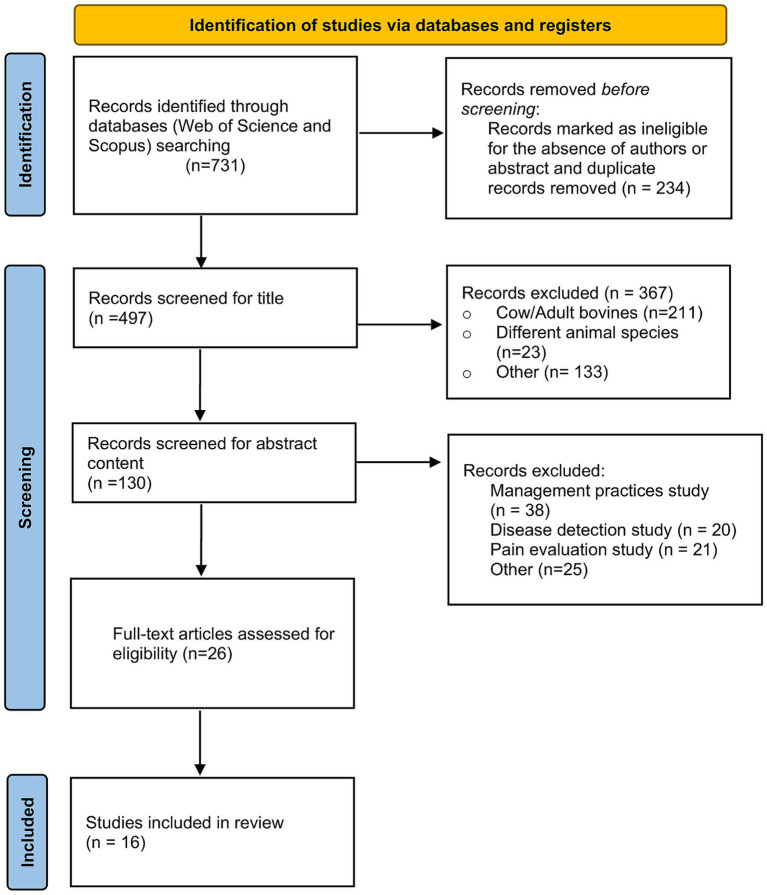
Welfare studies are increasingly involving the application of Precision Livestock Farming (PLF) sensors, rather than the use of animal-based indicators directly assessed. PLF technology has the advantage to constantly monitor behavior over a long period of time, thus enabling the assessor to identify changes in animal time budgets in real-time. In calves, lying behavior is essential: new-borns have been reported to spend 70-80% of their daily time lying. Growing up, calves progressively reduce the time spent lying; at 3 months, lying behavior occupies around the 50% of their day. Several studies emphasize how lying behavior can be considered as a potential indicator of positive welfare in ruminants, including calves. The aim of this study was to critically revise scientific literature regarding the application of precision livestock farming technologies to measure lying, rest and sleep behaviors in dairy calves. A systematic literature search based on the Preferred Reporting Items for Systematic Reviews and Meta-Analyses (PRISMA) methodology was conducted through Scopus and Web of Science databases to retrieve full peer-reviewed papers written in English on different PLF technologies applied to measure lying behavior in dairy calves. Literature search retrieved 731 records. After duplicate removal and the application of inclusion criteria, a total of 16 papers were considered eligible for the evaluation. Different PLF technologies and approaches were reported to be used: triaxial accelerometers, machine learning with accelerometer data, computer vision with video cameras, wearable cameras and real-time locating system. Most of the papers (10 out of 16) reported the use of accelerometers, placed on different parts of body of the animal (hind leg, neck, head, ear). Considering the importance that lying behavior has for maintaining homeostasis and development of calves, the possibility to monitor it constantly and reliably with PLF technology would certainly provide a better understanding of calves' behavior and positive welfare. However, our findings underline PLF technologies still show some practical limitations. Therefore, we must ensure that the sensors are valid and reliable before applying them in practice to detect changes that can be linked with welfare status of calves.
福利研究越来越多地涉及精准畜牧养殖(PLF)传感器的应用,而非直接评估基于动物的指标。PLF技术的优势在于能够长时间持续监测行为,从而使评估者能够实时识别动物时间分配的变化。在犊牛中,躺卧行为至关重要:据报道,新生犊牛每天有70 - 80%的时间用于躺卧。随着犊牛成长,它们躺卧的时间逐渐减少;到3个月大时,躺卧行为约占其一天时间的50%。多项研究强调,躺卧行为可被视为反刍动物(包括犊牛)积极福利的潜在指标。本研究的目的是批判性地审视关于应用精准畜牧养殖技术来测量奶牛犊躺卧、休息和睡眠行为的科学文献。通过Scopus和Web of Science数据库,依据系统评价和Meta分析的首选报告项目(PRISMA)方法进行了系统的文献检索,以获取用英文撰写的、经同行评审的关于应用不同PLF技术测量奶牛犊躺卧行为的完整论文。文献检索共获得731条记录。在去除重复记录并应用纳入标准后,共有16篇论文被认为符合评估条件。据报道,使用了不同的PLF技术和方法:三轴加速度计、基于加速度计数据的机器学习、摄像机的计算机视觉、可穿戴摄像机和实时定位系统。大多数论文(16篇中的10篇)报告了加速度计的使用情况,加速度计放置在动物身体的不同部位(后腿、颈部、头部、耳朵)。考虑到躺卧行为对犊牛维持体内平衡和发育的重要性,利用PLF技术持续且可靠地监测躺卧行为无疑将有助于更好地理解犊牛的行为和积极福利。然而,我们的研究结果表明PLF技术仍存在一些实际局限性。因此,在实际应用传感器检测与犊牛福利状况相关的变化之前,我们必须确保传感器的有效性和可靠性。