Maggi Jordi, Feil Silke, Gloggnitzer Jiradet, Maggi Kevin, Hanson James V M, Koller Samuel, Gerth-Kahlert Christina, Berger Wolfgang
Institute of Medical Molecular Genetics, University of Zurich, 8952 Schlieren, Switzerland.
Department of Ophthalmology, University Hospital Zurich and University of Zurich, 8091 Zurich, Switzerland.
Genes (Basel). 2024 Nov 23;15(12):1503. doi: 10.3390/genes15121503.
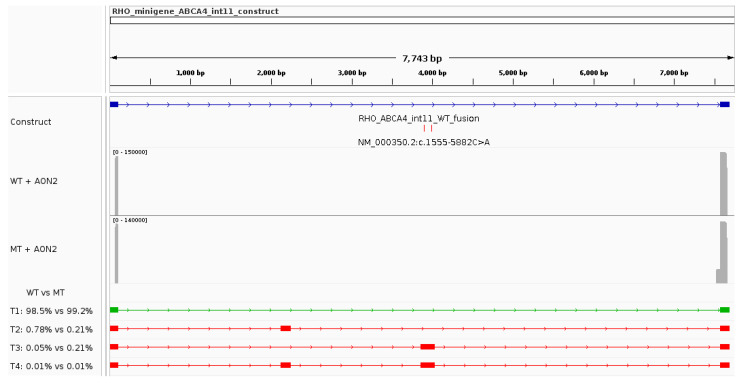
Stargardt disease (STGD1) is an autosomal recessive disorder caused by pathogenic variants in that affects the retina and is characterised by progressive central vision loss. The onset of disease manifestations varies from childhood to early adulthood. Whole exome (WES), whole gene, and whole genome sequencing (WGS) were performed for a patient with STGD1. WES revealed a heterozygous pathogenic missense variant in , but no second pathogenic variant was found. whole-gene sequencing, subsequent WGS, and segregation analysis identified a complex deep-intronic allele (NM_000350.2(ABCA4):c.[1555-5882C>A;1555-5784C>G]) to the missense variant. Minigene assays combined with nanopore sequencing were performed to characterise this deep-intronic complex allele in more detail. Surprisingly, the reference minigene revealed the existence of two pseudoexons in intron 11 of the gene that are included in low-abundance (<1%) transcripts. Both pseudoexons could be confirmed in cDNA derived from wildtype retinal organoids. Despite mild splicing predictions, the variant minigene revealed that the complex deep-intronic allele substantially increased the abundance of transcripts that included the pseudoexon overlapping with the variants. Two antisense oligonucleotides (AONs) were designed to rescue the aberrant splicing events. Both AONs increased the proportion of correctly spliced transcripts, and one of them rescued correct splicing to reference levels. Minigene assays combined with nanopore sequencing proved instrumental in identifying low-abundance transcripts including pseudoexons from wildtype intron 11, one of which was substantially increased by the complex allele.
斯塔加特病(STGD1)是一种常染色体隐性疾病,由影响视网膜的致病变异引起,其特征是进行性中心视力丧失。疾病表现的发作从儿童期到成年早期各不相同。对一名患有STGD1的患者进行了全外显子组(WES)、全基因和全基因组测序(WGS)。WES在 中发现了一个杂合的致病错义变异,但未发现第二个致病变异。全基因测序、随后的WGS和分离分析确定了一个与错义变异相关的复杂的内含子深处等位基因(NM_000350.2(ABCA4):c.[1555 - 5882C>A;1555 - 5784C>G])。进行了小基因分析并结合纳米孔测序以更详细地表征这个内含子深处的复杂等位基因。令人惊讶的是,参考小基因揭示了该基因第11号内含子中存在两个假外显子,它们包含在低丰度(<1%)转录本中。这两个假外显子都可以在源自野生型视网膜类器官的cDNA中得到证实。尽管剪接预测结果较轻,但变异小基因显示,这个复杂的内含子深处等位基因显著增加了包含与变异重叠的假外显子的转录本丰度。设计了两种反义寡核苷酸(AON)来挽救异常剪接事件。两种AON都增加了正确剪接转录本的比例,其中一种将正确剪接挽救到了参考水平。小基因分析结合纳米孔测序被证明有助于识别包括来自野生型第11号内含子假外显子的低丰度转录本,其中一个转录本因复杂等位基因而大幅增加。