Li Ruihan, Hasan Md Mahadhi, Wang Dan
Department of Chinese Medicine and Pharmacy, School of Pharmacy, Jiangsu University, Zhenjiang 212013, China.
Division of Chemistry and Structural Biology, Institute for Molecular Bioscience, The University of Queensland, Brisbane, QLD 4072, Australia.
Molecules. 2024 Dec 23;29(24):6061. doi: 10.3390/molecules29246061.
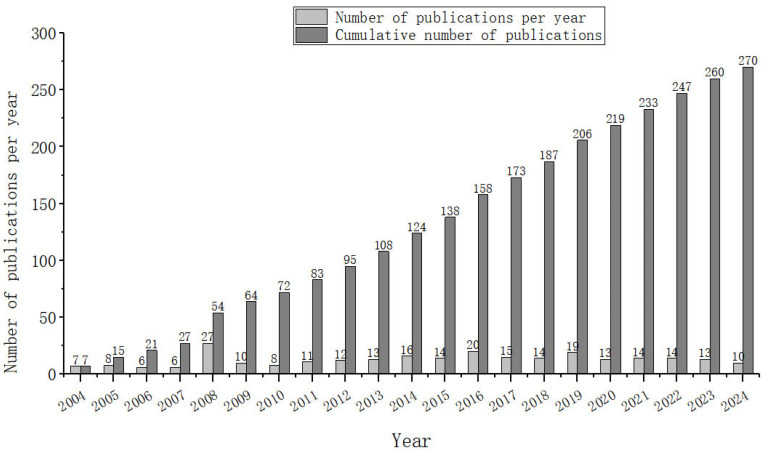
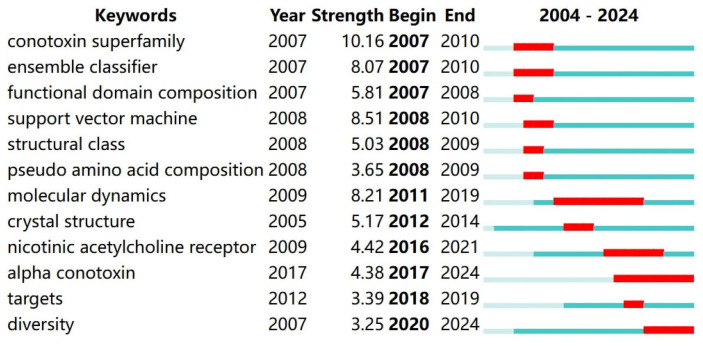
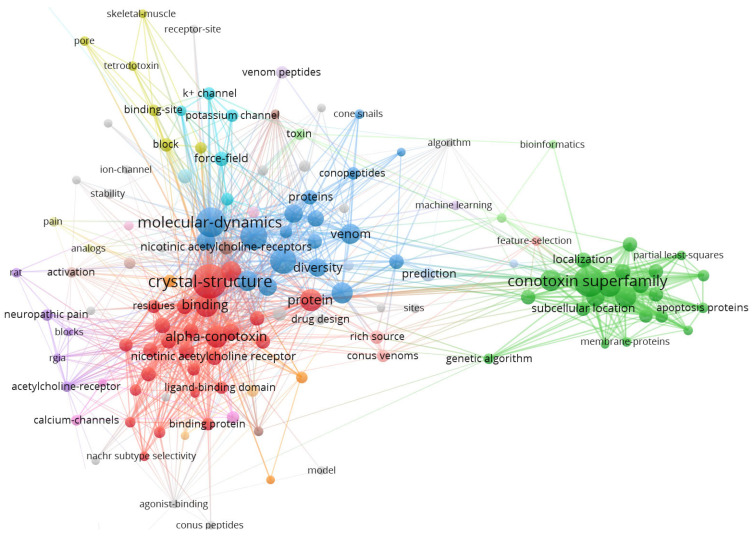
Cone snails of the genus have evolved to produce structurally distinct and functionally diverse venom peptides for defensive and predatory purposes. This nature-devised delicacy enlightened drug discovery and for decades, the bioactive cone snail venom peptides, known as conotoxins, have been widely explored for their therapeutic potential, yet we know very little about them. With the augmentation of computational algorithms from the realms of bioinformatics and machine learning, in silico strategies have made substantial contributions to facilitate conotoxin studies although still with certain limitations. In this review, we made a bibliometric analysis of in silico conotoxin studies from 2004 to 2024 and then discussed in silico strategies to not only efficiently classify conotoxin superfamilies but also speed up drug discovery from conotoxins, reveal binding modes of known conotoxin-ion channel interactions at a microscopic level and relate the mechanisms of ion channel modulation to its underlying molecular structure. We summarized the current progress of studies in this field and gave an outlook on prospects.
属的芋螺已经进化出结构独特且功能多样的毒液肽,用于防御和捕食目的。这种大自然设计的精妙物质启发了药物发现,几十年来,作为芋螺毒素的具有生物活性的芋螺毒液肽因其治疗潜力而受到广泛探索,但我们对它们的了解却非常少。随着生物信息学和机器学习领域计算算法的增强,计算机模拟策略为促进芋螺毒素研究做出了重大贡献,尽管仍存在一定局限性。在本综述中,我们对2004年至2024年计算机模拟芋螺毒素研究进行了文献计量分析,然后讨论了计算机模拟策略,这些策略不仅能有效地对芋螺毒素超家族进行分类,还能加速从芋螺毒素中发现药物,在微观层面揭示已知芋螺毒素 - 离子通道相互作用的结合模式,并将离子通道调节机制与其潜在分子结构联系起来。我们总结了该领域研究的当前进展并展望了前景。