Selemani Mwajabu, Makundi Rhodes H, Massawe Apia W, Katakweba Abdul S
Institute of Pest Management, Sokoine University of Agriculture (SUA), Morogoro 67101, Tanzania.
Department of Wildlife Management, Sokoine University of Agriculture (SUA), Morogoro 67101, Tanzania.
Pathogens. 2024 Dec 1;13(12):1059. doi: 10.3390/pathogens13121059.
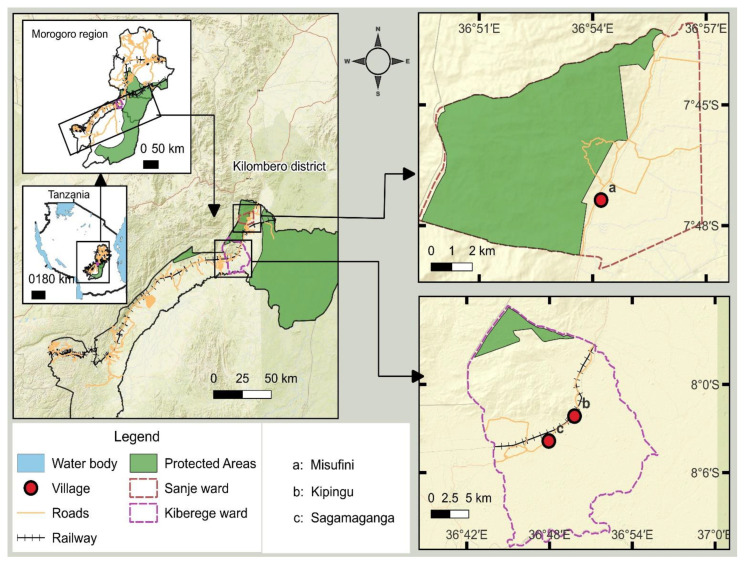
The circulation of has been linked to various occupational activities globally. This study investigated the seroprevalence of spp. in rodents and livestock (cattle and goats) in three settlements/villages involved in agriculture, livestock keeping, and mixed agriculture and livestock in the Kilombero district, Tanzania.
Data were collected during the wet and dry seasons. A total of 179 rodents were live-captured from selected habitats. Livestock samples were collected from 80 cattle in a livestock settlement and 120 goats from both livestock and mixed agricultural-livestock settlements. The microscopic agglutination test was utilized to identify serovars.
The seroprevalence of spp. was 17.3% in rodents (21.7% in and 3.9% in ) and 8.3% in livestock (13.5% in cattle and 12.6% in goats). The prevalence among rodents and livestock differed between settlements ( = 0.01). A higher prevalence was observed among rodents in the agricultural settlement relative to the other settlements. A higher prevalence of antibodies in livestock was observed in the livestock settlement compared with the mixed agricultural-livestock settlement. The serovars Sokoine (serogroup Icterohaemorrhagiae) and Hebdomadis (serogroup Hebdomadis) were detected in both rodents and livestock. The serovars Hardjo (serogroup Sejroe) and Gripothyphosa (serogroup Gripothyphosa) were found exclusively in cattle, whereas the serovars Pomona (serogroup Pomona) and Lora (serogroup Australis) were identified in rodents. antibodies were found to be elevated during the rainy season compared with the dry season ( = 0.05) in all settlements, with the exception of rodents in the mixed agricultural-livestock settlement.
This study demonstrates the presence of anti- antibodies in rodents and livestock related to occupational activities in human settlements. It further demonstrates that wild animals (rodents) and livestock are reservoirs of and are important in the epidemiology of leptospirosis. Management and control strategies should target both rodents and livestock.
在全球范围内,[病原体名称]的传播与各种职业活动有关。本研究调查了坦桑尼亚基洛姆贝罗区三个从事农业、畜牧业以及农牧业混合经营的定居点/村庄中啮齿动物和家畜(牛和山羊)感染[病原体名称]属的血清流行率。
在雨季和旱季收集数据。从选定栖息地活体捕获了总共179只啮齿动物。从一个畜牧定居点的80头牛以及畜牧和农牧业混合定居点的120只山羊采集了家畜样本。采用显微镜凝集试验鉴定[病原体名称]血清型。
[病原体名称]属在啮齿动物中的血清流行率为17.3%([具体种类1]中为21.7%,[具体种类2]中为3.9%),在家畜中为8.3%(牛中为13.5%,山羊中为12.6%)。啮齿动物和家畜中的流行率在不同定居点之间存在差异(P = 0.01)。与其他定居点相比,农业定居点的啮齿动物中流行率更高。与农牧业混合定居点相比,畜牧定居点家畜中的抗体流行率更高。在啮齿动物和家畜中均检测到[病原体名称]血清型索科因(出血性黄疸血清群)和七日热(七日热血清群)。血清型哈德乔(波摩那血清群)和格氏疏螺旋体(格氏疏螺旋体血清群)仅在牛中发现,而血清型波摩那(波摩那血清群)和洛拉(澳大利亚血清群)在啮齿动物中鉴定出。除了农牧业混合定居点的啮齿动物外,所有定居点在雨季时[病原体名称]抗体水平均高于旱季(P = 0.05)。
本研究表明在人类定居点与职业活动相关的啮齿动物和家畜中存在抗[病原体名称]抗体。它进一步表明野生动物(啮齿动物)和家畜是[病原体名称]的储存宿主,在钩端螺旋体病流行病学中很重要。管理和控制策略应针对啮齿动物和家畜。