Lee Hwayoung, Elkamhawy Ahmed, Rakhalskaya Polina, Lu Qili, Nada Hossam, Quan Guofeng, Lee Kyeong
BK21 FOUR Team and Integrated Research, Institute for Drug Development, College of Pharmacy, Dongguk University-Seoul, Goyang 10326, Republic of Korea.
Department of Chemistry, School of Sciences and Humanities, Nazarbayev University, Astana 010000, Kazakhstan.
Pharmaceuticals (Basel). 2024 Dec 14;17(12):1688. doi: 10.3390/ph17121688.
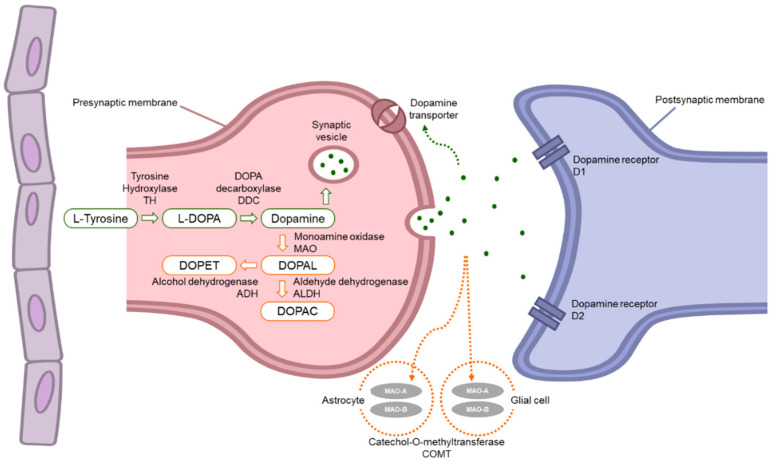
Parkinson's disease (PD) is a chronic, progressive neurological disorder affecting approximately 10 million people worldwide, with prevalence expected to rise as the global population ages. It is characterized by the degeneration of dopamine-producing neurons in the substantia nigra pars compacta, leading to motor symptoms such as tremor, rigidity, bradykinesia, postural instability, and gait disturbances, as well as non-motor symptoms including olfactory disturbances, sleep disorders, and depression. Currently, no cure exists for PD, and most available therapies focus on symptom alleviation. This dopamine deficiency impairs motor control, and since dopamine itself cannot cross the blood-brain barrier (BBB), the precursor L-Dopa is commonly used in treatment. L-Dopa is administered with enzyme inhibitors to prevent premature conversion outside the brain, allowing it to cross the BBB and convert to dopamine within the central nervous system. Although these therapies have improved symptom management, recent research has revealed additional molecular factors in PD pathology, such as α-synuclein aggregation, mitochondrial dysfunction, and lysosomal abnormalities, contributing to its complexity. These discoveries open up possibilities for neuroprotective therapies that could slow disease progression. In this review, we categorize PD therapeutic targets into two main groups: currently used therapies and targets under active research. We also introduce promising small-molecule compounds studied between 2019 and 2023, which may represent future treatment options. By examining both established and emerging targets, we aim to highlight effective strategies and potential directions for future drug development in Parkinson's disease therapy.
帕金森病(PD)是一种慢性进行性神经疾病,全球约有1000万人受其影响,随着全球人口老龄化,患病率预计还会上升。其特征是黑质致密部中产生多巴胺的神经元发生退化,导致震颤、僵硬、运动迟缓、姿势不稳和步态障碍等运动症状,以及嗅觉障碍、睡眠障碍和抑郁等非运动症状。目前,帕金森病无法治愈,大多数现有疗法都侧重于缓解症状。这种多巴胺缺乏会损害运动控制,由于多巴胺本身无法穿过血脑屏障(BBB),因此通常使用前体左旋多巴进行治疗。左旋多巴与酶抑制剂一起给药,以防止其在脑外过早转化,使其能够穿过血脑屏障并在中枢神经系统内转化为多巴胺。尽管这些疗法改善了症状管理,但最近的研究揭示了帕金森病病理学中的其他分子因素,如α-突触核蛋白聚集、线粒体功能障碍和溶酶体异常,这使得病情更加复杂。这些发现为可能减缓疾病进展的神经保护疗法开辟了可能性。在这篇综述中,我们将帕金森病的治疗靶点分为两大类:目前使用的疗法和正在积极研究的靶点。我们还介绍了2019年至2023年间研究的有前景的小分子化合物,它们可能代表未来的治疗选择。通过研究既定靶点和新兴靶点,我们旨在突出帕金森病治疗中未来药物开发的有效策略和潜在方向。