Maldonado-Ruiz Paulina
Department of Entomology, College of Agriculture, Life and Environmental Sciences, University of Arizona, Tucson, AZ 85719, USA.
Microorganisms. 2024 Nov 28;12(12):2451. doi: 10.3390/microorganisms12122451.
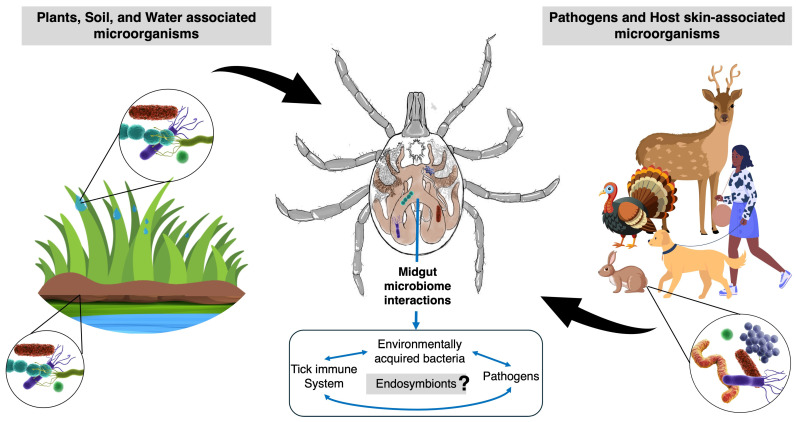
Hard ticks (family Ixodidae) are one of the most predominant arthropod disease vectors worldwide, second only to mosquitoes. In addition to harboring animal and human pathogens, ticks are known to carry a microbial community constituted of non-pathogenic organisms, which includes maternally inherited intracellular endosymbionts and other environmentally acquired extracellular microorganisms. These microbial communities, which include bacteria, viruses, protozoans, and fungi-with often commensal, mutualistic, or parasitic associations with the tick-comprise the tick microbiome, bacteria being the most studied community. Many bacterial taxa frequently reported in ticks include soil, plant, and animal-associated microbes, suggesting many are environmentally acquired, including members with known entomopathogenic potential, such as , spp., and spp. It has been reported that microbial community composition can impact pathogen persistence, dissemination, and fitness in ticks. In the United States, (northeast) and (west) are the predominant vectors of , the causal agent of Lyme disease. is another important tick vector in the U.S. and is becoming an increasing concern as it is the leading cause of alpha-gal syndrome (AGS, or red meat allergy). This condition is caused by tick bites containing the galactose alpha 1,3 galactose (alpha-gal) epitope in their saliva. In this paper, we present a summary of the tick microbiome, including the endosymbiotic bacteria and the environmentally acquired (here referred to as the community). We will focus on the bacteria from spp. and and discuss their potential for novel biocontrol strategies.
硬蜱(蜱科)是全球最主要的节肢动物疾病传播媒介之一,仅次于蚊子。蜱虫除了携带动物和人类病原体外,还携带有由非致病生物组成的微生物群落,其中包括母系遗传的细胞内共生菌和其他环境中获取的细胞外微生物。这些微生物群落,包括细菌、病毒、原生动物和真菌,它们与蜱虫通常存在共生、互利或寄生关系,构成了蜱虫微生物组,其中细菌是研究最多的群落。蜱虫中经常报道的许多细菌类群包括与土壤、植物和动物相关的微生物,这表明许多细菌是从环境中获取的,包括具有已知昆虫致病潜力的成员,如 、 属和 属。据报道,微生物群落组成会影响病原体在蜱虫中的持久性、传播和适应性。在美国, (东北部)和 (西部)是莱姆病病原体 的主要传播媒介。 是美国另一种重要的蜱虫传播媒介,由于它是α-半乳糖综合征(AGS,即红肉过敏)的主要病因,因此越来越受到关注。这种病症是由蜱虫叮咬引起的,蜱虫唾液中含有半乳糖α-1,3-半乳糖(α-半乳糖)表位。在本文中,我们总结了蜱虫微生物组,包括内共生细菌和环境中获取的(这里称为 群落)。我们将重点关注来自 属和 的 细菌,并讨论它们在新型生物防治策略中的潜力。