Park Soo-Hyun, Lee Jung-Hwan, Lee Suhjoon, Shin Jongbeom, Cha Boram, Hong Ji-Taek, Kwon Kye Sook
Department of Neurology, Soon Chun Hyang University Hospital Seoul, Seoul 05355, Republic of Korea.
Division of Gastroenterology, Department of Internal Medicine, Inha University Hospital, Inha University School of Medicine, Incheon 22332, Republic of Korea.
Microorganisms. 2024 Dec 9;12(12):2539. doi: 10.3390/microorganisms12122539.
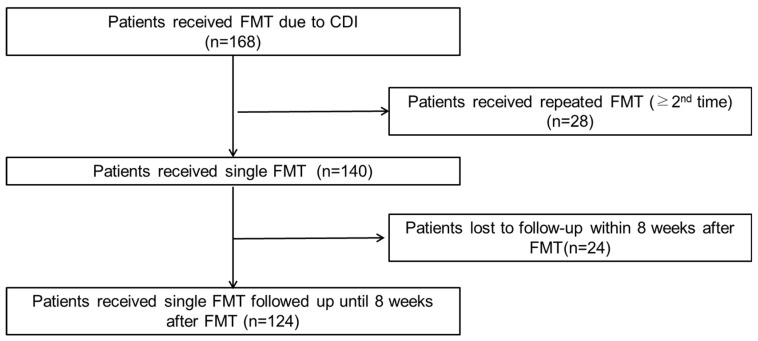
Recently, fecal microbiota transplantation (FMT) has been introduced as an effective treatment option for infection (CDI). However, the risk factors associated with FMT treatment failure have not been well demonstrated. Therefore, we aimed to investigate the risk factors of treatment failure or recurrence after FMT for CDI. This retrospective study included 124 patients with CDI who underwent FMT at Inha University Hospital between November 2017 and August 2021 and were followed up for 8 weeks after FMT for symptoms of CDI. FMT failure was defined as diarrhea recurrence or a positive stool test. We assessed the risk factors for treatment failure, including comorbidities, antibiotic use pre- and post-FMT, and the number of CDI episodes before FMT. Ninety-three patients (75%) experienced symptom improvement <7 days after FMT, while treatment failure occurred in 40 patients (32.3%). Multivariate analysis revealed that males had a lower symptom improvement rate <7 days after FMT ( = 0.049). Patients using antibiotics after FMT showed a higher rate of recurrence or treatment failure in <8 weeks ( = 0.032). Patients requiring antibiotics after FMT should be considered at higher risk of treatment failure. Careful antibiotic stewardship, particularly minimizing non-essential antibiotic use before and after FMT, may significantly enhance treatment outcomes. Further large-scale prospective studies are warranted to confirm these findings and develop targeted antibiotic management protocols for improving the efficacy of FMT in CDI treatment.
最近,粪便微生物群移植(FMT)已被引入作为艰难梭菌感染(CDI)的一种有效治疗选择。然而,与FMT治疗失败相关的危险因素尚未得到充分证实。因此,我们旨在调查CDI患者接受FMT治疗失败或复发的危险因素。这项回顾性研究纳入了2017年11月至2021年8月期间在仁荷大学医院接受FMT的124例CDI患者,并在FMT后随访8周以观察CDI症状。FMT失败定义为腹泻复发或粪便检测呈阳性。我们评估了治疗失败的危险因素,包括合并症、FMT前后的抗生素使用情况以及FMT前的CDI发作次数。93例患者(75%)在FMT后<7天症状改善,而40例患者(32.3%)治疗失败。多变量分析显示,男性在FMT后<7天的症状改善率较低(P = 0.049)。FMT后使用抗生素的患者在<8周内复发或治疗失败的发生率较高(P = 0.032)。FMT后需要使用抗生素的患者应被视为治疗失败风险较高。谨慎的抗生素管理,特别是尽量减少FMT前后非必要的抗生素使用,可能会显著提高治疗效果。有必要进行进一步的大规模前瞻性研究以证实这些发现,并制定有针对性的抗生素管理方案,以提高FMT在CDI治疗中的疗效。