Mora-Ortiz Marina, Yubero-Serrano Elena M, Priego-Capote Feliciano, Gutierrez-Mariscal Francisco M, Alcala-Diaz Juan F, Torres-Peña José D, Arenas de-Larriva Antonio P, Delgado-Lista Javier, Perez-Martinez Pablo, Roche Helen M, López-Miranda José
Lipids and Atherosclerosis Unit, Internal Medicine Unit, Reina Sofia University Hospital, 14004 Cordoba, Spain.
Maimonides Biomedical Research Institute of Cordoba (IMIBIC), 14004 Cordoba, Spain.
Nutrients. 2024 Dec 11;16(24):4267. doi: 10.3390/nu16244267.
The literature on the postprandial metabolic changes in individuals with Metabolic Syndrome (MetS) remains limited, despite the fact that postprandial states represent the most common physiological condition in Western societies.
BACKGROUND/OBJECTIVES: The objective of this study was to investigate the plasma metabolomics profile in both fasting and postprandial states following a high-fat challenge in individuals with MetS who consumed diets with varying quantities and qualities of dietary fat over 12 weeks.
Seventy-five patients with MetS (28 males and 47 females) from the Spanish LIPGENE cohort were included in the study. MetS patients were randomly stratified to follow one of four dietary interventions (isoenergetic diets) for a 12-week long-term study. The four diets were high in saturated fatty acids and high in monounsaturated fatty acids (HSFA and HMUFA), low-fat high-complex carbohydrates (LFHCC), and LFHCC supplemented with -3. The metabolomics analysis of plasma samples was carried out using Liquid Chromatography Time-of-Flight Mass Spectrometry (LC-TOF/MS).
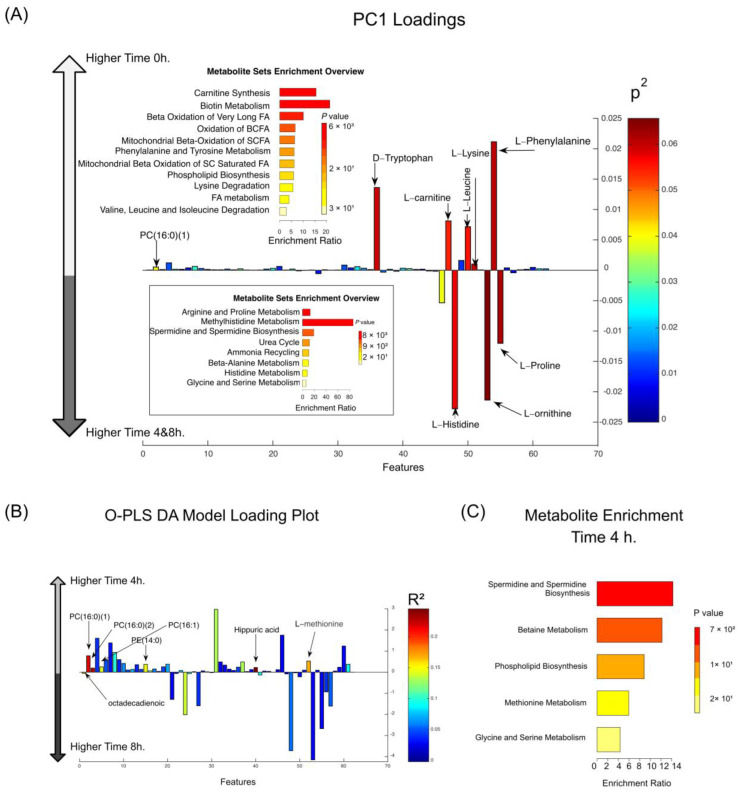
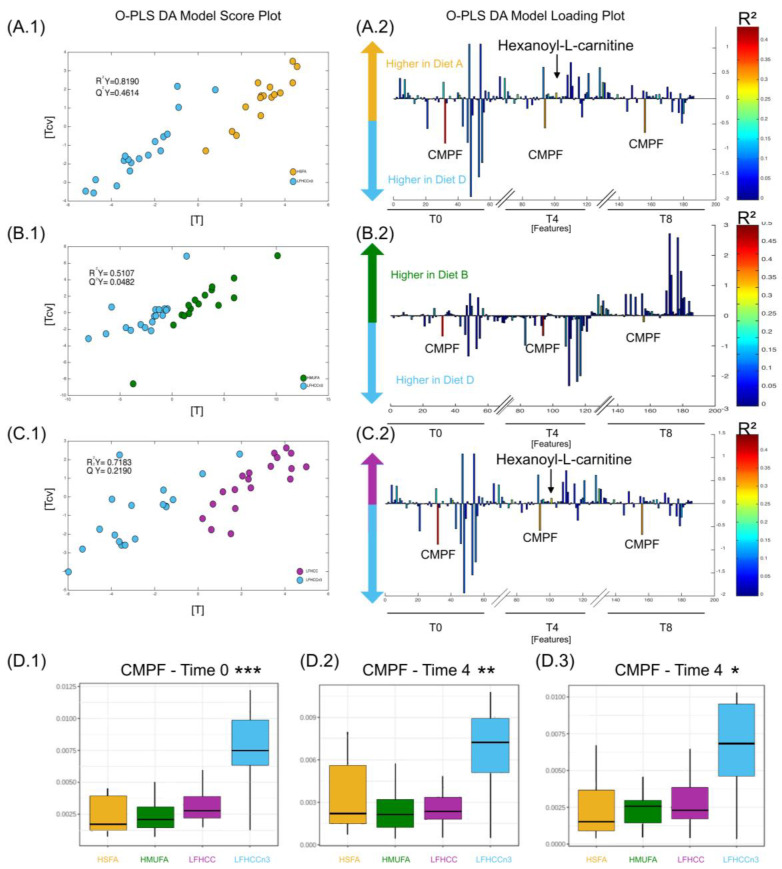
We observed a decrease in inflammation biomarkers, including acetylcarnitine and L-carnitine during the fasting state and hexanoyl-L-carnitine and isobutyryl-L-carnitine during the postprandial period, mediated by the replacement of HSFA with HMUFA. Additionally, antioxidant compounds such as 4-hydroxybenzaldehyde and L-valine were expressed at higher levels after consumption of the HMUFA diet compared to the HSFA diet. HSFA also presented altered levels of phosphatidylcholine, a metabolite previously linked with insulin resistance.
These findings suggest that replacing HSFA with HMUFA may reduce inflammation and improve antioxidant profiles, supporting the potential for tailored dietary interventions in individuals with MetS.
尽管餐后状态是西方社会最常见的生理状况,但关于代谢综合征(MetS)个体餐后代谢变化的文献仍然有限。
背景/目的:本研究的目的是调查患有MetS的个体在12周内食用不同数量和质量膳食脂肪的饮食后,在空腹和餐后状态下的血浆代谢组学特征。
纳入了来自西班牙LIPGENE队列的75名MetS患者(28名男性和47名女性)。将MetS患者随机分层,以遵循四种饮食干预措施(等能量饮食)之一进行为期12周的长期研究。这四种饮食分别是高饱和脂肪酸和高单不饱和脂肪酸(HSFA和HMUFA)、低脂高复合碳水化合物(LFHCC)以及补充了ω-3的LFHCC。使用液相色谱飞行时间质谱(LC-TOF/MS)对血浆样本进行代谢组学分析。
我们观察到,用HMUFA替代HSFA可使炎症生物标志物减少,包括空腹状态下的乙酰肉碱和左旋肉碱,以及餐后的己酰左旋肉碱和异丁酰左旋肉碱。此外,与HSFA饮食相比,食用HMUFA饮食后,抗氧化化合物如4-羟基苯甲醛和L-缬氨酸的表达水平更高。HSFA还使磷脂酰胆碱水平发生改变,磷脂酰胆碱是一种先前与胰岛素抵抗相关的代谢物。
这些发现表明,用HMUFA替代HSFA可能会减轻炎症并改善抗氧化特征,这支持了对患有MetS的个体进行个性化饮食干预的潜力。