Tran Hoang Thi, Nguyen Tuan Thanh, Nguyen Oanh Thi Xuan, Huynh Le Thi, Mathisen Roger
Neonatal Unit and Human Milk Bank, Da Nang Hospital for Women and Children, Da Nang 50506, Vietnam.
Department of Pediatrics, School of Medicine and Pharmacy, The University of Da Nang, Da Nang 50206, Vietnam.
Nutrients. 2024 Dec 22;16(24):4402. doi: 10.3390/nu16244402.
Donor human milk (DHM) from a human milk bank (HMB) is used to feed low-birthweight (LBW) and preterm infants when mothers cannot provide their own breastmilk. The misuse of DHM could interfere with mothers' breastmilk and weaken breastfeeding efforts. This study aimed to identify factors behind prolonged DHM usage during the first six years of Vietnam's first HMB.
Data were extracted from the Da Nang HMB's digital monitoring system. We defined prolonged DHM use as four or more days in the neonatal unit and two or more days in postnatal wards.
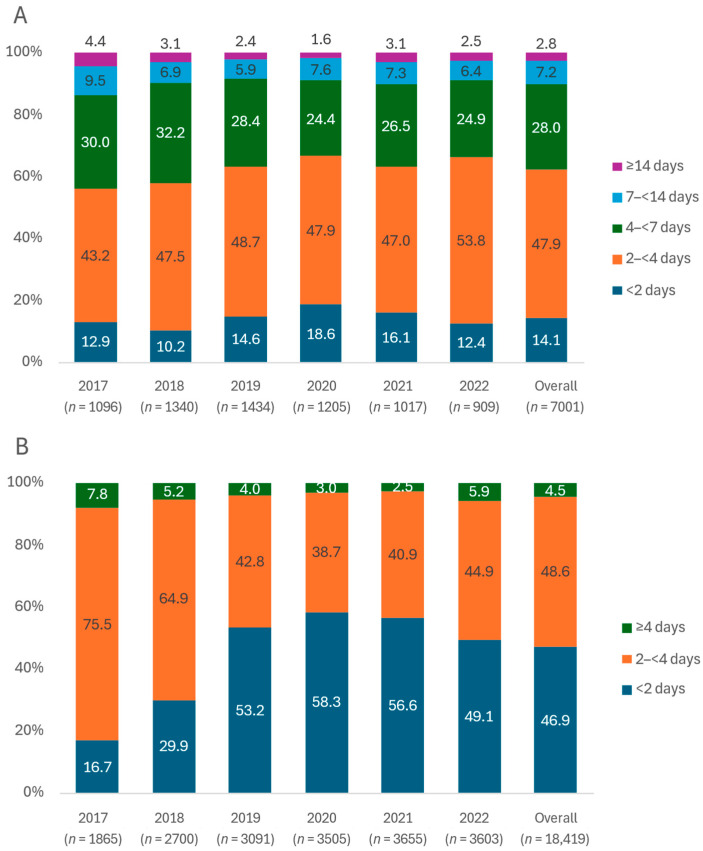
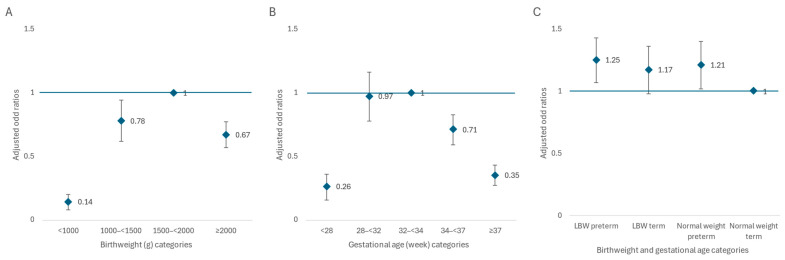
Over six years, 25,420 infants received DHM, with 45.3% of the infants being female, 54.7% being male, 70.0% being born via cesarean section, and 77.2% being full-term. In the neonatal unit ( = 7001), 38.0% of infants used DHM for ≥4 days. Adjusted odds ratios (aORs) for prolonged use were 0.14 for infants weighing <1000 g, 0.78 for infants weighing 1000-<1500 g, and 0.67 for infants weighing ≥2000 g ( < 0.01), compared to those weighing 1500-<2000 g. Compared to gestational ages of 32-<34 weeks, the aORs were 0.26 for <28 weeks, 0.71 for 34-<37 weeks, and 0.35 for ≥37 weeks ( < 0.01). In postnatal wards ( = 18,419), 53.1% of infants used DHM for ≥2 days. Compared to term, normal-weight infants, the aORs were 1.25 for LBW-preterm, 1.17 for LBW-term, and 1.21 for normal-weight-preterm infants ( < 0.05). Prolonged DHM use was associated with cesarean births in neonatal units (aOR 2.24, < 0.01) and postnatal wards (aOR 1.44, < 0.01).
DHM is used briefly to bridge nutritional gaps and transition to mothers' breastmilk, but LBW, preterm births, and cesarean births are linked to prolonged use. Healthcare providers should support those at risk of prolonged DHM use and prioritize reducing unnecessary cesarean births.
当母亲无法提供自身母乳时,人乳库(HMB)的捐赠人乳(DHM)用于喂养低体重(LBW)和早产婴儿。滥用DHM可能会干扰母亲的母乳喂养并削弱母乳喂养的努力。本研究旨在确定越南首个HMB成立的头六年中DHM长期使用背后的因素。
数据从岘港HMB的数字监测系统中提取。我们将DHM的长期使用定义为在新生儿病房使用四天或更长时间,在产后病房使用两天或更长时间。
在六年期间,25420名婴儿接受了DHM,其中45.3%为女性,54.7%为男性,70.0%通过剖宫产出生,77.2%为足月儿。在新生儿病房(n = 7001),38.0%的婴儿使用DHM≥4天。与体重在1500 - <2000克的婴儿相比,体重<1000克的婴儿长期使用的调整优势比(aORs)为0.14,体重在1000 - <1500克的婴儿为0.78,体重≥2000克的婴儿为0.67(P < 0.01)。与胎龄32 - <34周相比,胎龄<28周的aORs为0.26,34 - <37周的为0.71,≥37周的为0.35(P < 0.01)。在产后病房(n = 18419),53.1%的婴儿使用DHM≥2天。与足月、正常体重的婴儿相比,低体重 - 早产婴儿的aORs为1.25,低体重 - 足月儿为1.17,正常体重 - 早产婴儿为1.21(P < 0.05)。在新生儿病房(aOR 2.24,P < 0.01)和产后病房(aOR 1.44,P < 0.01),DHM的长期使用与剖宫产分娩有关。
DHM被短暂用于填补营养缺口并过渡到母亲的母乳,但低体重、早产和剖宫产与长期使用有关。医疗保健提供者应支持那些有DHM长期使用风险的人群,并优先减少不必要的剖宫产分娩。