Zhao Chuanlong, Wang Jinfeng, Mu Youying, Yao Weihao, Wang Hui, Shi Peijian
Co-Innovation Center for Sustainable Forestry in Southern China, Bamboo Research Institute, Nanjing Forestry University, #159 Longpan Road, Nanjing 210037, China.
College of Landscape Architecture, Nanjing Forestry University, #159 Longpan Road, Nanjing 210037, China.
Plants (Basel). 2024 Dec 15;13(24):3499. doi: 10.3390/plants13243499.
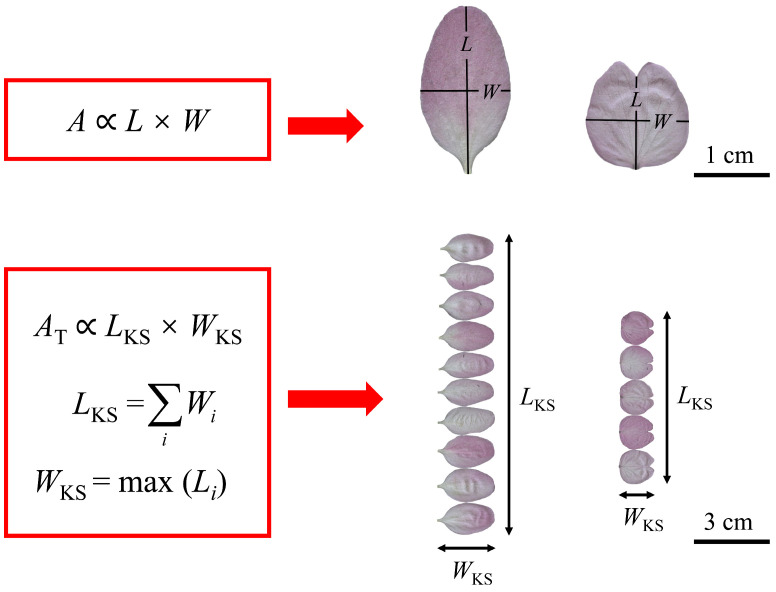
The size of floral organs is closely related to the successful reproduction of plants, and corolla size is, to some extent, indicative of the size of floral organs. Petals are considered to be homologous to leaves, so we also attempted to estimate the area of a single petal using the method that is typically employed for estimating single leaf area (i.e., the Montgomery equation). Additionally, we estimated the total petal area per flower (; i.e., the whole corolla area) using the method designed for estimating the total leaf area per shoot (i.e., the Montgomery-Koyama-Smith equation). The Montgomery equation (ME) estimates the leaf area by assuming that the leaf area is proportional to the product of leaf length and width. The Montgomery-Koyama-Smith equation (MKSE) assumes that the total leaf area per shoot is proportional to the product of the sum of individual leaf widths and the maximum individual leaf length. To test the validity of the ME for predicting petal area, a total of 1005 petals from 123 flowers of two Rosaceae species, which exhibit a certain variation in petal shape, were used to fit the relationship between the petal area () and the product of petal length () and width (). Two equations, including the MKSE and a power-law equation (PLE), were used to describe the relationship between the total petal area per flower and the product of the sum of individual petal widths and the maximum individual petal length. The root-mean-square error (RMSE) and the Akaike information criterion (AIC) were used to measure the goodness of fit and the trade-off between the goodness of fit and model's structural complexity for each equation. The results show that the ME has a low RMSE value and a high correlation coefficient when fitting the relationship between and for either of the two species. Additionally, the MKSE and the PLE exhibit low RMSEs and AICs for estimating the of both Rosaceae species. These results indicate that the ME, MKSE, and PLE are effective in predicting individual petal area and total corolla area, respectively.
花器官的大小与植物的成功繁殖密切相关,花冠大小在一定程度上指示了花器官的大小。花瓣被认为与叶子同源,因此我们也尝试使用通常用于估算单叶面积的方法(即蒙哥马利方程)来估算单个花瓣的面积。此外,我们使用为估算每枝总叶面积而设计的方法(即蒙哥马利 - 小山 - 史密斯方程)来估算每朵花的总花瓣面积(即整个花冠面积)。蒙哥马利方程(ME)通过假设叶面积与叶长和叶宽的乘积成正比来估算叶面积。蒙哥马利 - 小山 - 史密斯方程(MKSE)假设每枝总叶面积与单个叶宽之和与单个最大叶长的乘积成正比。为了检验ME预测花瓣面积的有效性,我们使用了来自两个蔷薇科物种的123朵花的总共1005片花瓣,这些花瓣在花瓣形状上表现出一定的变化,以拟合花瓣面积()与花瓣长度()和宽度()的乘积之间的关系。包括MKSE和幂律方程(PLE)在内的两个方程被用于描述每朵花的总花瓣面积与单个花瓣宽度之和与单个最大花瓣长度的乘积之间的关系。均方根误差(RMSE)和赤池信息准则(AIC)被用于衡量每个方程的拟合优度以及拟合优度与模型结构复杂性之间的权衡。结果表明,在拟合两个物种中任一个的与的关系时,ME具有较低的RMSE值和较高的相关系数。此外,对于估算两个蔷薇科物种的,MKSE和PLE都表现出较低的RMSE和AIC。这些结果表明,ME、MKSE和PLE分别在预测单个花瓣面积和总花冠面积方面是有效的。