Shi Mingqin, Li Xinyao, Xing Liwei, Li Zhenmin, Zhou Sitong, Wang Zihui, Zou Xuelian, She Yuqing, Zhao Rong, Qin Dongdong
First Clinical Medical College, Yunnan University of Chinese Medicine, Kunming 650500, China.
School of Basic Medical Sciences, Yunnan University of Chinese Medicine, Kunming 650500, China.
Pharmaceutics. 2024 Dec 4;16(12):1556. doi: 10.3390/pharmaceutics16121556.
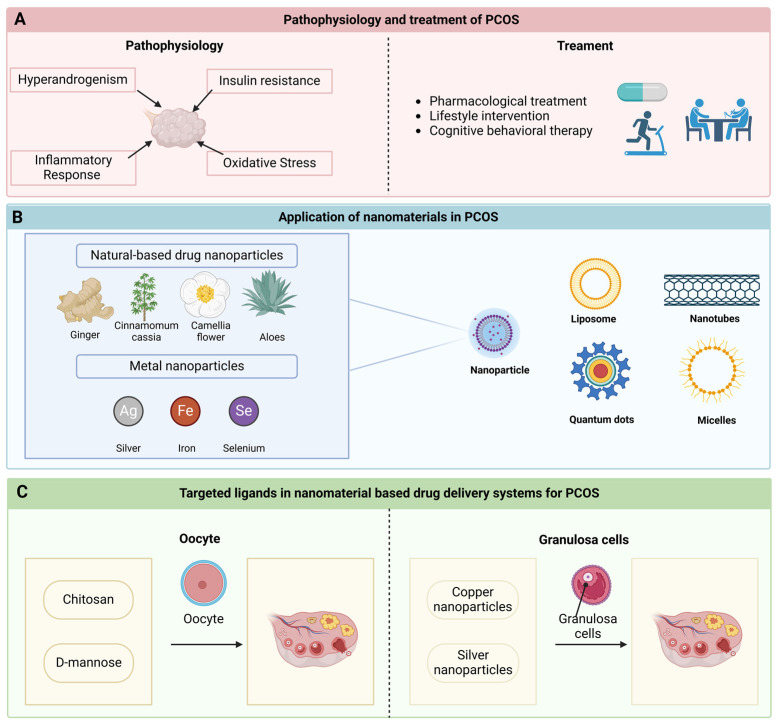
Polycystic ovary syndrome (PCOS) is the predominant endocrine disorder among women of reproductive age and represents the leading cause of anovulatory infertility, which imposes a considerable health and economic burden. Currently, medications used to treat PCOS can lead to certain adverse reactions, such as affecting fertility and increasing the risk of venous thrombosis. Drug delivery systems utilizing nanomaterials, characterized by prolonged half-life, precision-targeted delivery, enhanced bioavailability, and reduced toxicity, are currently being employed in the management of PCOS. This innovative approach is gaining traction as a favored strategy for augmenting the therapeutic efficacy of medications. Consequently, this paper discusses the roles of nanoparticles, nanocarriers, and targeted ligands within nanomaterial-based drug delivery systems, aiming to identify optimal methodologies for treating PCOS using nanomaterials. Additionally, prospective research avenues concerning nanomaterial-based delivery systems in the context of PCOS, as well as the implications of existing insights on the advancement of novel therapies for PCOS, are highlighted.
多囊卵巢综合征(PCOS)是育龄女性中主要的内分泌紊乱疾病,也是无排卵性不孕的主要原因,这带来了相当大的健康和经济负担。目前,用于治疗PCOS的药物会导致某些不良反应,如影响生育能力和增加静脉血栓形成的风险。利用纳米材料的药物递送系统具有半衰期延长、精准靶向递送、生物利用度提高和毒性降低等特点,目前正被用于PCOS的治疗。这种创新方法作为提高药物治疗效果的首选策略正越来越受到关注。因此,本文讨论了纳米颗粒、纳米载体和靶向配体在基于纳米材料的药物递送系统中的作用,旨在确定使用纳米材料治疗PCOS的最佳方法。此外,还强调了在PCOS背景下基于纳米材料的递送系统的前瞻性研究途径,以及现有见解对PCOS新疗法进展的影响。