Kodama Takahiro, Kuwahara Kiichiro, Kariya Ayumu, Ikuta Rikizo
Faculty of Engineering and Design, Kagawa University, 2217-20 Hayashi-cho, Takamatsu 761-0396, Kagawa, Japan.
Graduate School of Engineering Science, Osaka University, Toyonaka 560-8531, Osaka, Japan.
Sensors (Basel). 2024 Dec 21;24(24):8162. doi: 10.3390/s24248162.
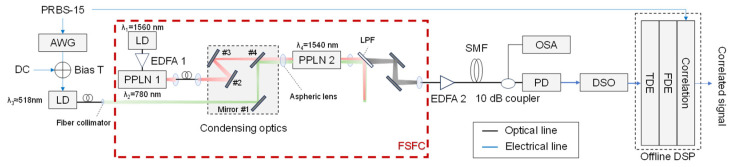
In this study, we experimentally demonstrate a PPLN-based free-space to SMF (single-mode fiber) conversion system capable of efficient long-wavelength down-conversion from 518 nm, optimized for minimal loss in highly turbid water, to 1540 nm, which is ideal for low-loss transmission in standard SMF. Leveraging the nonlinear optical properties of periodically poled lithium niobate (PPLN), we achieve a wavelength conversion efficiency of 1.6% through difference frequency generation while maintaining a received optical signal-to-noise ratio of 10.4 dB. Our findings underscore the potential of integrating PPLN-based wavelength conversion with fiber optic networks, offering a viable solution for next-generation optical sensor systems that demand real-time, low-latency, and reliable data transmission. This work represents a significant advancement in developing robust and efficient optical sensor technologies, addressing the challenges associated with long-distance transmission and broad-linewidth light sources in optical remote sensing applications.
在本研究中,我们通过实验展示了一种基于周期极化铌酸锂(PPLN)的自由空间到单模光纤(SMF)的转换系统,该系统能够实现从518 nm进行高效的长波长下转换,此波长是针对高浑浊水中的最小损耗进行优化的,转换后的波长为1540 nm,这对于标准单模光纤中的低损耗传输而言是理想的。利用周期极化铌酸锂(PPLN)的非线性光学特性,我们通过差频产生实现了1.6%的波长转换效率,同时保持了10.4 dB的接收光信噪比。我们的研究结果强调了将基于PPLN的波长转换与光纤网络集成的潜力,为下一代需要实时、低延迟和可靠数据传输的光学传感器系统提供了可行的解决方案。这项工作代表了在开发强大且高效的光学传感器技术方面的重大进展,解决了光学遥感应用中与长距离传输和宽线宽光源相关的挑战。