Li Jia, Pan Ruowen, Yue Fengyi, Gao Tie, Wu Xiaohong, Shi Leitai, Wang Yunpeng, Zhao Danhua, Lan Zhaohui, Chen Hongxu, Ye Qiang, Cao Shouchun
National Institutes for Food and Drug Control, No. 31, Huatuo Road, Beijing 102629, China.
Hualan Biological Vaccine Inc., Jia No.1-1, Hualan Ave., Xinxiang 453003, China.
Vaccines (Basel). 2024 Dec 6;12(12):1379. doi: 10.3390/vaccines12121379.
The Vero cell rabies vaccine is currently the most widely used human rabies vaccine. However, owing to the presence of residual host cell DNA (HCD) in the final product and the potential tumorigenicity of the DNA of high-passage Vero cells, the WHO not only sets a limit on the number of times cells used in production can be passaged, but also imposes strict requirements on the amount of residual HCD in the final vaccine product.
To systematically reduce the HCD level in the final vaccine product, multiple purification steps are included in the vaccine production process. This study investigated the effectiveness of key production steps in antigen recovery and DNA removal.
The residual HCD fragment content and size distribution were detected using fluorescence quantitative PCR (qPCR) and capillary gel electrophoresis (CGE), and the rabies virus glycoprotein antigen content was detected using enzyme-linked immunosorbent assay (ELISA). The antigen recovery rate and HCD removal rate in each key process were calculated to evaluate the scientific basis and effectiveness of each production step. Additionally, the stability of the process was studied using multiple commercial batches of the product.
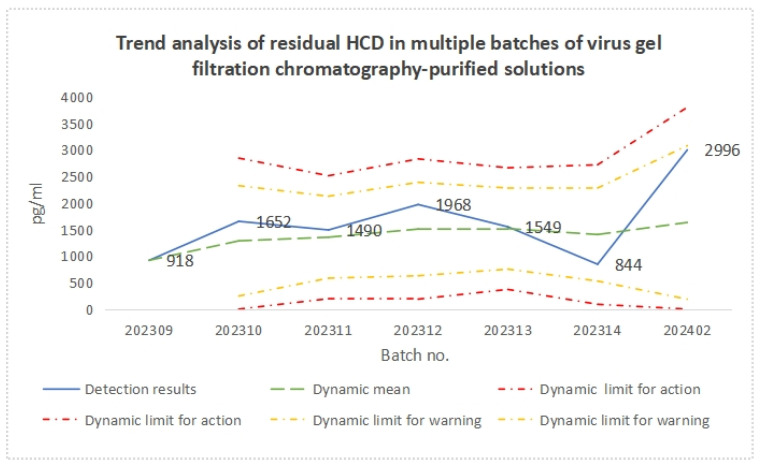
The results revealed that the total antigen recovery rate in the production process described in this report was no less than 8.5%, and the effective removal rate of residual HCD was not lower than 99.99%. Moreover, the amount of residual HCD in the final product was far below the quality standard of 2 ng/dose, and most of the residual HCD fragments were smaller than 200 bp. The results of the process stability studies on multiple commercial batches showed that the bulk human rabies vaccine produced by this process had excellent safety and efficacy and that the production process was stable and thus suitable for large-scale batch production.
The production process described in this study achieved effective recovery of viral antigens and efficient removal of residual HCD, and the process was stable and controllable, enabling the continuous and stable production of vaccine products that meet WHO recommendations and the relevant requirements of the current edition of the Chinese Pharmacopeia. In addition, this study provides theoretical guidance for optimizing the vaccine production process.
Vero细胞狂犬病疫苗是目前使用最广泛的人用狂犬病疫苗。然而,由于最终产品中存在残留宿主细胞DNA(HCD)以及高传代Vero细胞DNA的潜在致瘤性,世界卫生组织不仅对生产中使用的细胞传代次数设限,还对最终疫苗产品中的残留HCD量提出严格要求。
为了系统降低最终疫苗产品中的HCD水平,疫苗生产过程中包含了多个纯化步骤。本研究调查了关键生产步骤在抗原回收和DNA去除方面的有效性。
采用荧光定量PCR(qPCR)和毛细管凝胶电泳(CGE)检测残留HCD片段含量及大小分布,采用酶联免疫吸附测定(ELISA)检测狂犬病病毒糖蛋白抗原含量。计算各关键工艺中的抗原回收率和HCD去除率,以评估各生产步骤的科学性和有效性。此外,使用多个产品商业批次研究该工艺的稳定性。
结果显示,本报告所述生产工艺的总抗原回收率不低于8.5%,残留HCD的有效去除率不低于99.99%。而且,最终产品中的残留HCD量远低于2 ng/剂的质量标准,大多数残留HCD片段小于200 bp。多个商业批次的工艺稳定性研究结果表明,该工艺生产的人用狂犬病疫苗原液具有良好的安全性和有效性,生产工艺稳定,适合大规模批量生产。
本研究所述生产工艺实现了病毒抗原的有效回收和残留HCD的高效去除,且工艺稳定可控,能够持续稳定生产出符合世界卫生组织建议和现行版《中国药典》相关要求的疫苗产品。此外,本研究为优化疫苗生产工艺提供了理论指导。