Armstrong Grace Q, Aldossary Heba M, Bingham Jessica, Pino Lilia, Pohnert Anne, Dolansky Mary A, Schiltz Nicholas K
Case Western Reserve University, Frances Payne Bolton School of Nursing, Cleveland, OH, USA.
Prince Sultan Military College of Health Sciences, Department of Nursing, Dhahran, Saudi Arabia.
Inquiry. 2025 Jan-Dec;62:469580241309194. doi: 10.1177/00469580241309194.
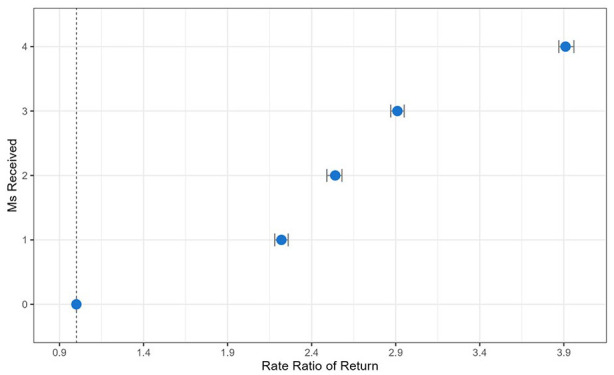
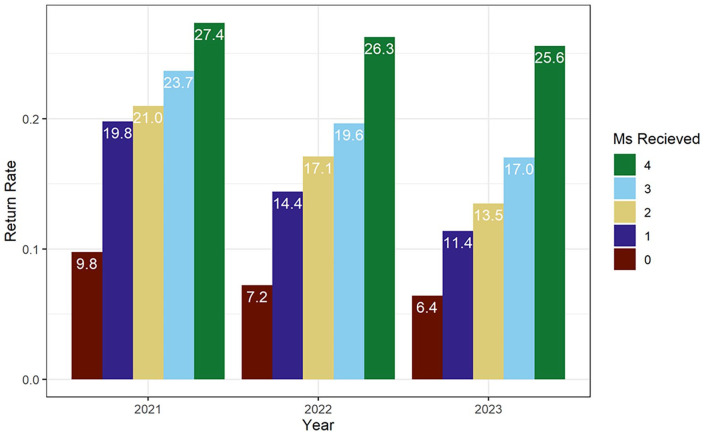
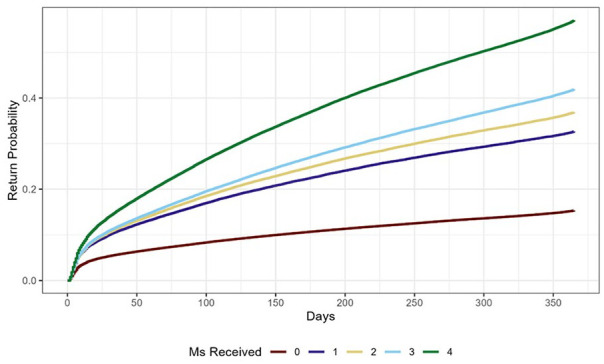
The Age-Friendly Health System (AFHS) movement continues to grow in the United States as more health systems implement the 4Ms framework. Despite this growth, there are relatively few studies that evaluate outcomes related to AFHS implementation. This study assessed patient satisfaction with AFHS by analyzing the rate at which patients returned to the clinic for future health care, serving as a measure of quality. A retrospective cohort design using electronic health record (EHR) data obtained from patients 65 years of age and older who received care at a large national network of convenient care clinics in the U.S. ( = 987,197) between January 2021 and March 2024. We assessed the level of AFHS 4Ms care received by these individuals in relation to their subsequent visit back to the clinic through descriptive statistics, a time-to-event analysis using the Kaplan-Meier cumulative incidence approach, and a Cox proportional Hazards model, adjusted for age, race, sex, prior appointments, and number of ICD-10 code diagnoses. Throughout the study period, patients who received complete AFHS 4Ms care exhibited greater rates of returning to the convenient care clinic compared to those who received partial or no 4Ms 4Ms care. Kaplan-Meier curves demonstrated that the cumulative probability of returning to the clinic was higher in patients that received 4Ms over time, compared to patients that did not receive 4Ms. Results from the Cox Proportional Hazards model demonstrated a risk ratio of 3.91 ( < .001) of returning to the clinic, after adjustment. The results indicate that patients are more likely to seek additional care in the future at the same health system when they receive complete 4Ms care, possibly due to increased satisfaction with care. As patient satisfaction is an indicator of quality care, this finding can further inform and spread the AFHS movement.
随着越来越多的医疗系统实施4M框架,美国的老年友好型医疗系统(AFHS)运动持续发展。尽管有这种发展,但评估与AFHS实施相关结果的研究相对较少。本研究通过分析患者返回诊所接受未来医疗保健的比率来评估患者对AFHS的满意度,以此作为质量衡量标准。采用回顾性队列设计,使用从2021年1月至2024年3月在美国一个大型全国性便捷护理诊所网络接受护理的65岁及以上患者(n = 987,197)的电子健康记录(EHR)数据。我们通过描述性统计、使用Kaplan-Meier累积发病率方法的事件发生时间分析以及Cox比例风险模型,评估了这些个体接受的AFHS 4M护理水平与其随后返回诊所之间的关系,并对年龄、种族、性别、既往预约和ICD-10编码诊断数量进行了调整。在整个研究期间,接受完整AFHS 4M护理的患者与接受部分或无4M护理的患者相比,返回便捷护理诊所的比率更高。Kaplan-Meier曲线表明,随着时间推移,接受4M护理的患者返回诊所的累积概率高于未接受4M护理的患者。Cox比例风险模型的结果显示,调整后返回诊所的风险比为3.91(P <.001)。结果表明,当患者接受完整的4M护理时,他们未来更有可能在同一医疗系统寻求额外护理,这可能是由于对护理的满意度提高。由于患者满意度是优质护理的指标,这一发现可为AFHS运动提供进一步信息并推动其传播。