Dube Sara, Asim Muhammad, Gonzalez Jennifer, Dala Gracia, Wright Michelle L, Gray Megan J, Kahn Linda G, Jacobvitz Deborah, Widen Elizabeth M
Department of Nutritional Sciences, School of Human Ecology, College of Natural Sciences, Department of Women's Health & Pediatrics, Dell Medical School, Dell Pediatric Research Institute, Population Research Center, The University of Texas at Austin, 1400 Barbara Jordan Blvd., Austin, TX, 78723, USA.
Department of Community Health Sciences (MA), Aga Kahn University, Karachi, Pakistan.
BMC Pregnancy Childbirth. 2025 Jan 7;25(1):9. doi: 10.1186/s12884-024-07011-y.
While the striking impact of the COVID-19 pandemic on mental health, heath care access and lifestyle behaviors, including perceived health, diet, physical activity, and sleep has been reported, few studies have examined these domains jointly among pregnant and postpartum people in the early stages of the COVID-19 pandemic.
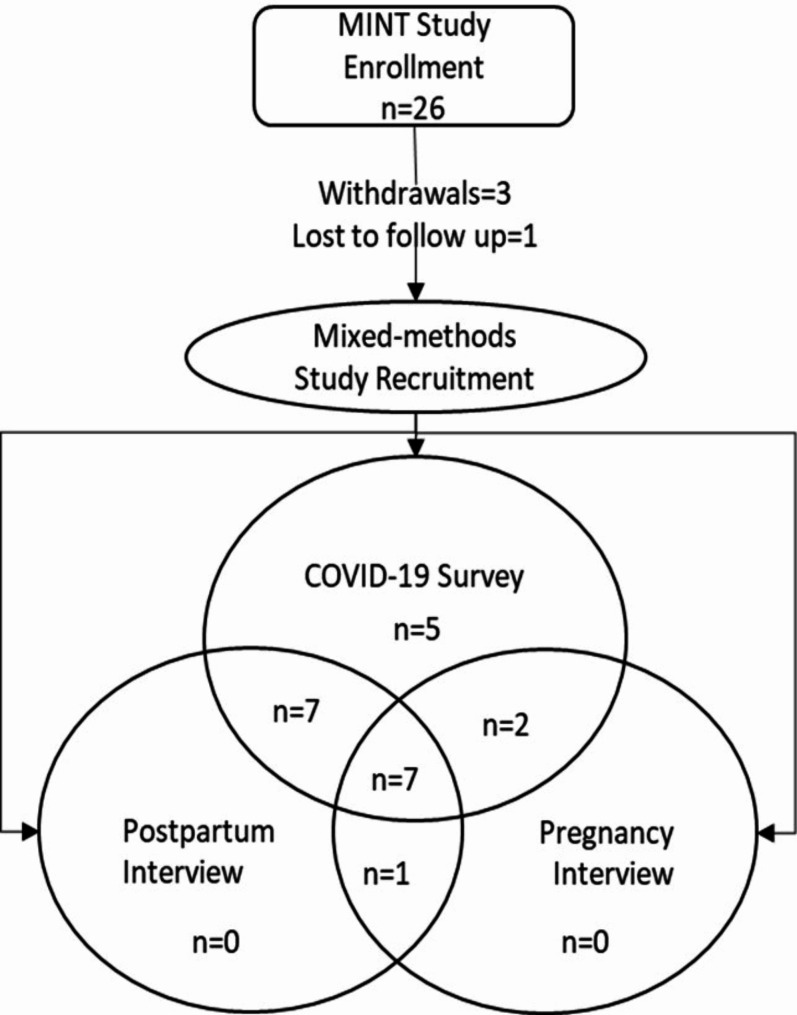
This mixed methods study was conducted among a subset of participants (n = 22) in a cohort study in Austin, Texas, who were pregnant or had recently delivered when the outbreak occurred. Measures were from the early second trimester up to 6 months postpartum. Findings from questionnaires were complemented by qualitative interviews during Spring/Summer 2020 regarding experiences during the early pandemic.
From our quantitative data (n = 22), most participants reported that the pandemic generally had a negative impact on their lives (81%), that they shifted to eating more at home (71%), and that they were less physically active (62%). Five major themes emerged in our qualitative interviews (n = 22): (1) adaptation to pandemic restrictions; (2) psychosocial experiences, such as feelings of anxiety, guilt, sadness, isolation, and frustration; (3) health behavior changes; (4) health care experiences; and (5) where they obtained general and perinatal related pandemic information. Of those who completed both pregnancy and postpartum interviews (n = 8), all reported anxiety during both periods; however, those who delivered in Spring 2020 experienced more anxiety surrounding delivery and less social support than those who delivered in Summer 2020, who reported less anxiety surrounding hospital birth and greater social support, particularly after delivery.
Overall, our findings confirm prior evidence that the COVID-19 pandemic had a marked impact on stress, anxiety, and worries, as well as lifestyle behaviors among pregnant and postpartum people. Our work provides lessons for health care practitioners about support need for pregnant and postpartum persons amid societal disruption.
虽然已有报道称新冠疫情对心理健康、医疗保健可及性以及生活方式行为(包括感知健康、饮食、身体活动和睡眠)产生了显著影响,但很少有研究在新冠疫情早期阶段对孕妇和产后人群的这些领域进行联合考察。
这项混合方法研究是在德克萨斯州奥斯汀市一项队列研究的部分参与者(n = 22)中进行的,这些参与者在疫情爆发时处于怀孕状态或刚分娩不久。测量时间从孕中期早期一直到产后6个月。2020年春/夏期间通过定性访谈对问卷结果进行补充,访谈内容涉及疫情早期的经历。
从我们的定量数据(n = 22)来看,大多数参与者表示疫情总体上对他们的生活产生了负面影响(81%),他们转而更多地在家中进食(71%),并且身体活动减少(62%)。我们的定性访谈(n = 22)中出现了五个主要主题:(1)适应疫情限制;(2)心理社会经历,如焦虑、内疚、悲伤、孤独和沮丧感;(3)健康行为变化;(4)医疗保健经历;(5)他们获取一般和围产期相关疫情信息的渠道。在完成孕期和产后访谈的人群中(n = 8),所有人在两个时期都报告有焦虑情绪;然而,2020年春季分娩的人在分娩期间经历的焦虑更多,且获得的社会支持比2020年夏季分娩的人少,后者报告在医院分娩时的焦虑较少,且获得的社会支持更多,尤其是在产后。
总体而言,我们的研究结果证实了先前的证据,即新冠疫情对孕妇和产后人群的压力、焦虑和担忧以及生活方式行为产生了显著影响。我们的工作为医疗保健从业者在社会动荡期间为孕妇和产后人群提供支持需求方面提供了经验教训。