Wang Juncheng, Li Housaiyin, Kulkarni Aditi, Anderson Jennifer L, Upadhyay Pragati, Onyekachi Onyedikachi Victor, Arantes Lidia M R B, Banerjee Hridesh, Kane Lawrence P, Zhang Xin, Bruno Tullia C, Bao Riyue, Ferris Robert L, Vujanovic Lazar
Otolaryngology, University of Pittsburgh, Pittsburgh, Pennsylvania, USA.
UPMC Hillman Cancer Center, Pittsburgh, Pennsylvania, USA.
J Immunother Cancer. 2025 Jan 7;13(1):e010618. doi: 10.1136/jitc-2024-010618.
The transmembrane protein T-cell immunoglobulin and mucin-domain containing molecule 3 (TIM-3) is an immune checkpoint receptor that is expressed by a variety of leukocyte subsets, particularly in the tumor microenvironment. An effective TIM-3-targeting therapy should account for multiple biological factors, including the disease setting, the specific cell types involved and their varying sensitivities to the four putative TIM-3 ligands (galectin-9, phosphatidylserine, high mobility group protein B1 and carcinoembryonic antigen cell adhesion molecule 1), each of which engages a unique binding site on the receptor's variable immunoglobulin domain. The primary objectives of this study were to assess the prevalence and function of TIM-3 natural killer (NK) cells in patients with head and neck squamous cell carcinoma (HNSCC), determine whether the four TIM-3 ligands differentially affect TIM-3 NK cell functions, identify the most immunosuppressive ligand, and evaluate whether targeting ligand-mediated TIM-3 signaling enhances NK cell effector functions.
Single-cell RNA sequencing and flow cytometry were used to study the prevalence, phenotypes and function of TIM-3 NK cells in HNSCC patient tumors and blood. In vitro killing, proliferation and cytokine production assays were implemented to evaluate whether the four TIM-3 ligands differentially modulate TIM-3 NK cell functions, and whether disruption of TIM-3/ligand interaction can enhance NK cell-mediated antitumor effector mechanisms. Finally, The Cancer Genome Atlas survival analysis and digital spatial profiling were employed to study the potential impact of etiology-associated differences on patients with HNSCC outcomes.
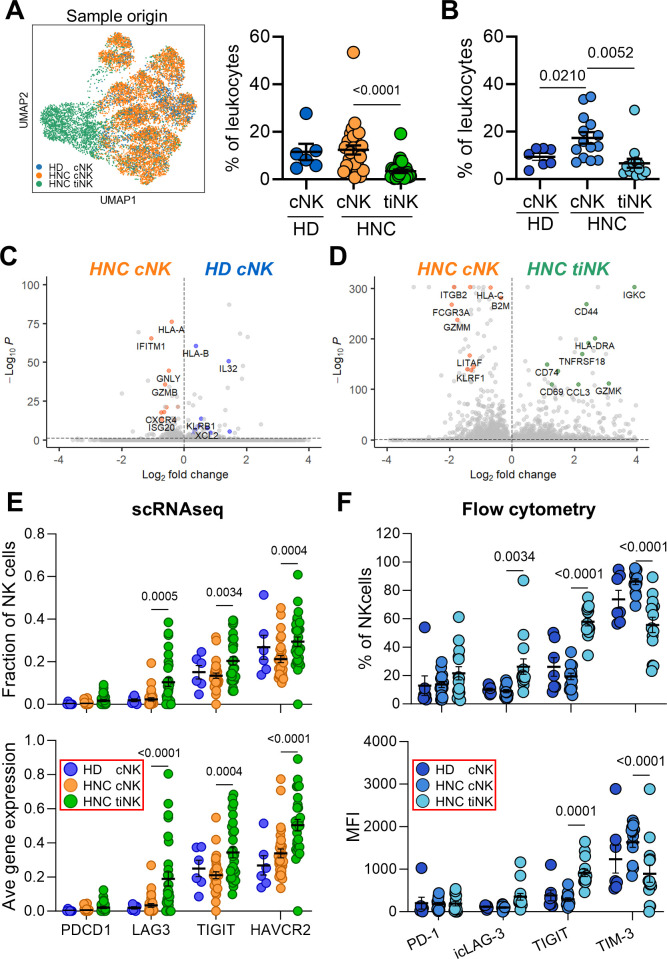
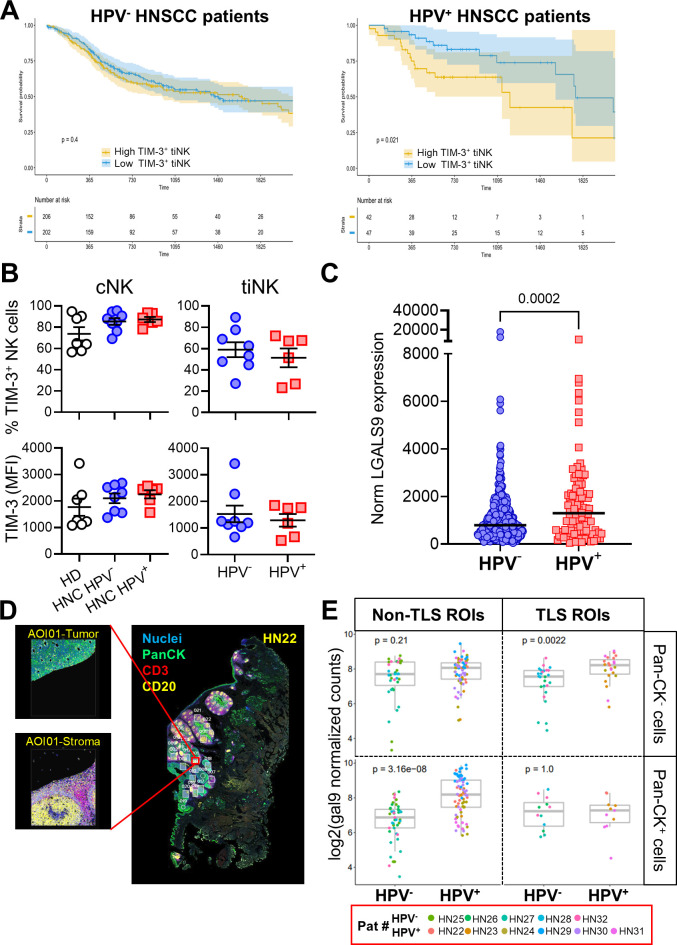
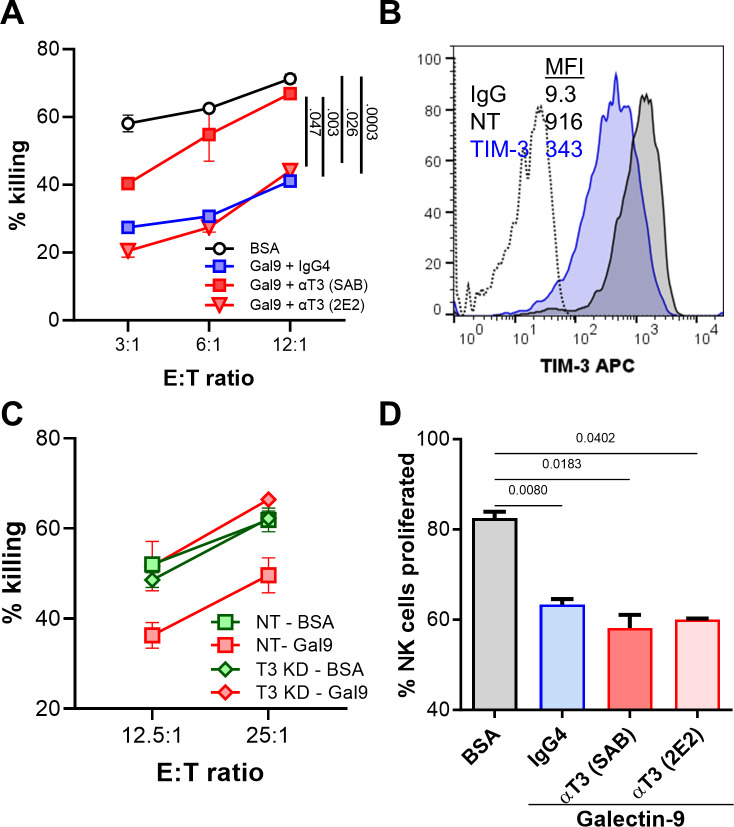
We demonstrate that TIM-3 is highly prevalent on circulating and tumor-infiltrating NK cells. It co-expresses with CD44 and marks NK cells with heightened effector potential. Among the four putative TIM-3 ligands, galectin-9 most consistently suppresses NK cell-mediated cytotoxicity and proliferation through TIM-3 and CD44 signaling, respectively, but promotes IFN-γ release in a TIM-3-dependent manner. Among patients with HNSCC, an elevated intratumoral TIM-3 NK cell gene signature associates with worse outcomes, specifically in those with human papillomavirus (HPV) disease, potentially attributable to higher galectin-9 levels in HPV versus HPV patients.
Our findings underscore the complex functional impact of TIM-3 ligand signaling, which is consistent with recent clinical trials suggesting that targeting TIM-3 alone is suboptimal as an immunotherapeutic approach for treating malignancies.
跨膜蛋白T细胞免疫球蛋白和粘蛋白结构域包含分子3(TIM-3)是一种免疫检查点受体,由多种白细胞亚群表达,特别是在肿瘤微环境中。一种有效的靶向TIM-3的疗法应考虑多种生物学因素,包括疾病背景、所涉及的特定细胞类型及其对四种假定的TIM-3配体(半乳糖凝集素-9、磷脂酰丝氨酸、高迁移率族蛋白B1和癌胚抗原细胞粘附分子1)的不同敏感性,每种配体与受体可变免疫球蛋白结构域上的独特结合位点结合。本研究的主要目的是评估头颈部鳞状细胞癌(HNSCC)患者中TIM-3自然杀伤(NK)细胞的患病率和功能,确定四种TIM-3配体是否对TIM-3 NK细胞功能有不同影响,识别最具免疫抑制作用的配体,并评估靶向配体介导的TIM-3信号传导是否增强NK细胞效应功能。
采用单细胞RNA测序和流式细胞术研究HNSCC患者肿瘤和血液中TIM-3 NK细胞的患病率、表型和功能。实施体外杀伤、增殖和细胞因子产生试验,以评估四种TIM-3配体是否对TIM-3 NK细胞功能有不同调节作用,以及TIM-3/配体相互作用的破坏是否能增强NK细胞介导的抗肿瘤效应机制。最后,利用癌症基因组图谱生存分析和数字空间分析研究病因相关差异对HNSCC患者预后的潜在影响。
我们证明TIM-3在循环和肿瘤浸润性NK细胞上高度普遍。它与CD44共表达,并标记具有更高效应潜能的NK细胞。在四种假定的TIM-3配体中,半乳糖凝集素-9最一致地分别通过TIM-3和CD44信号传导抑制NK细胞介导的细胞毒性和增殖,但以TIM-3依赖的方式促进IFN-γ释放。在HNSCC患者中,肿瘤内TIM-3 NK细胞基因特征升高与较差的预后相关,特别是在人乳头瘤病毒(HPV)相关疾病患者中,这可能归因于HPV阳性患者中较高的半乳糖凝集素-9水平。
我们的研究结果强调了TIM-3配体信号传导的复杂功能影响,这与最近的临床试验结果一致,即单独靶向TIM-3作为治疗恶性肿瘤的免疫治疗方法并不理想。