Gillesberg Frederik S, Pehrsson Martin, Bay-Jensen Anne-Christine, Frederiksen Peder, Karsdal Morten, Deleuran Bent W, Kragstrup Tue W, Kubo Satoshi, Tanaka Yoshiya, Mortensen Joachim H
Nordic Bioscience, Immunoscience, Herlev Hovedgade 205-207, Herlev, 2730, Denmark.
Department of Biomedicine, Aarhus University, Høegh-Guldbergs Gade 10, Aarhus C, 8000, Denmark.
Sci Rep. 2025 Jan 7;15(1):1087. doi: 10.1038/s41598-024-84151-3.
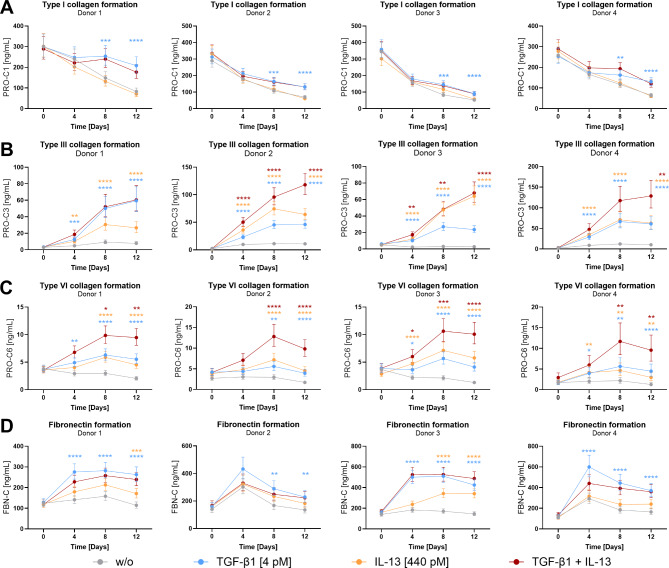
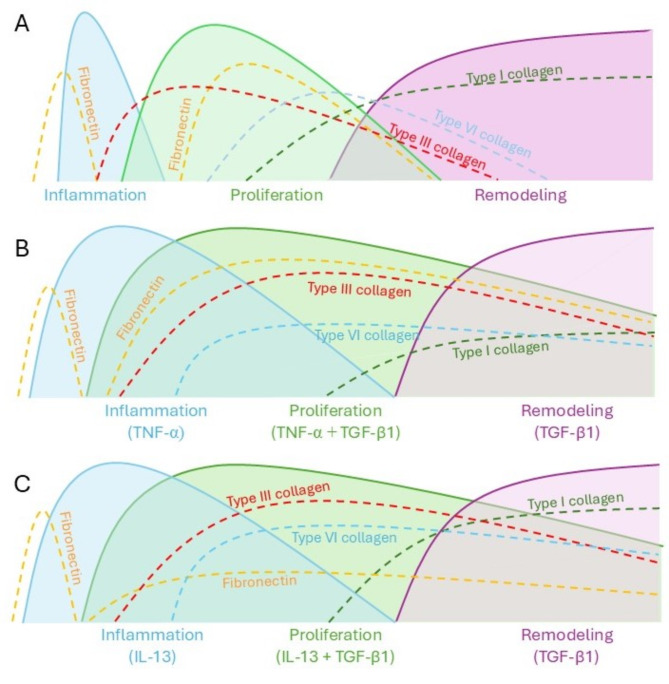
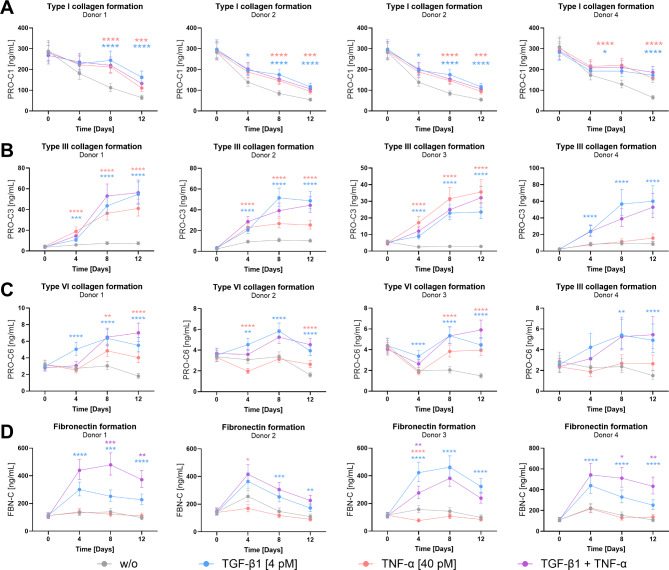
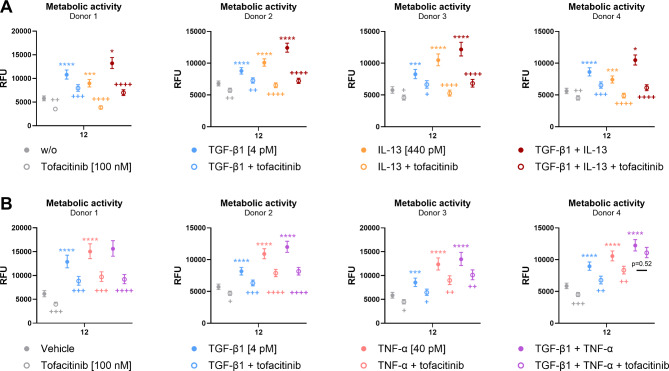
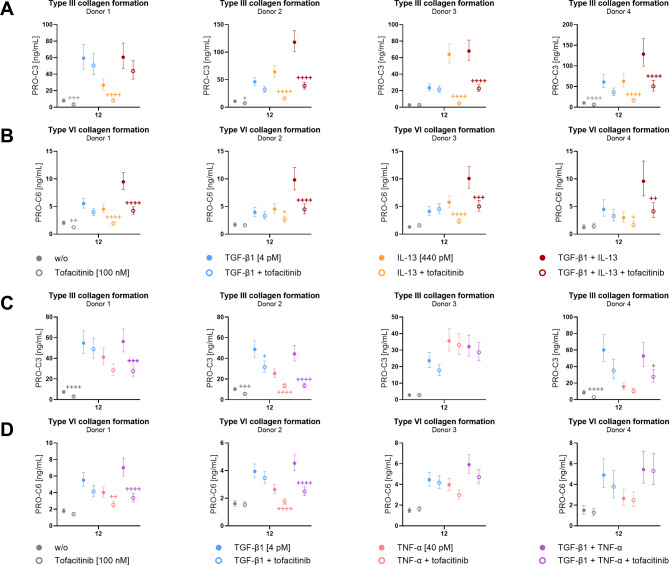
Understanding how inflammatory cytokines influence profibrogenic wound healing responses in fibroblasts is important for understanding the pathogenesis of fibrosis. TNF-α and IL-13 are key cytokines in Th1 and Th2 immune responses, respectively, while TGF-β1 is the principal pro-fibrotic mediator. We show that 12-day fibroblast culture with TNF-α or IL-13 induces fibrogenesis, marked by progressively increasing type III and VI collagen formation, and that TGF-β1 co-stimulation amplifies these effects. Tofacitinib substantially reduced the formation of ECM proteins in response to IL-13, while fibrogenesis in response to TNF-α or TGF-β1 was marginally inhibited. The in vitro findings were supported by clinical observations in patients with active rheumatoid arthritis, which had elevated serum type III collagen formation, indicating ongoing fibrogenesis during inflammation. After 48-60 weeks of tofacitinib treatment, type III collagen degradation, aswell as formation, were significantly decreased compared to baseline, highlighting dual anti-inflammatory and anti-fibrogenic effects of tofacitinib. In contrast, other anti-inflammatory treatments including methotrexate, adalimumab and tocilizumab demonstrated anti-inflammatory effects only. Our results highlight fibro-inflammatory profiles associated with TNF-α or IL-13 stimulation, both alone and in combination with TGF-β1, and support the use of tofacitinib as an anti-fibrogenic treatment in chronic inflammatory conditions.
了解炎性细胞因子如何影响成纤维细胞中促纤维化伤口愈合反应对于理解纤维化的发病机制至关重要。TNF-α和IL-13分别是Th1和Th2免疫反应中的关键细胞因子,而TGF-β1是主要的促纤维化介质。我们发现,用TNF-α或IL-13对成纤维细胞进行12天培养可诱导纤维化,其特征为III型和VI型胶原蛋白形成逐渐增加,并且TGF-β1共刺激会放大这些作用。托法替布可显著减少IL-13刺激引起的细胞外基质蛋白形成,而对TNF-α或TGF-β1刺激引起的纤维化仅有轻微抑制作用。类风湿性关节炎患者的临床观察结果支持了体外研究结果,这些患者血清III型胶原蛋白形成升高,表明炎症期间存在持续的纤维化。托法替布治疗48 - 60周后,与基线相比,III型胶原蛋白的降解以及形成均显著降低,突出了托法替布的双重抗炎和抗纤维化作用。相比之下,包括甲氨蝶呤、阿达木单抗和托珠单抗在内的其他抗炎治疗仅表现出抗炎作用。我们的结果突出了与TNF-α或IL-13刺激相关的纤维炎症特征,包括单独刺激以及与TGF-β1联合刺激的情况,并支持将托法替布用作慢性炎症性疾病的抗纤维化治疗药物。