Gustafsson Finn, Uriel Nir, Netuka Ivan, Katz Jason N, Pagani Francis D, Connors Jean M, Jorde Ulrich P, Zimpfer Daniel, Pya Yuriy, Conway Jennifer, Anyanwu Anelechi, Scandroglio Anna Mara, Sulemanjee Nasir, Atluri Pavan, Keebler Mary, Selzman Craig H, Alexis Jeffrey D, Hayward Christopher, Henderson John, Dirckx Nicholas, Gazzola Carlo, Mehra Mandeep R
Rigshospitalet, University of Copenhagen, Copenhagen, Denmark.
Columbia University College of Physicians and Surgeons and New York Presbyterian Hospital, New York.
JAMA Cardiol. 2025 Mar 1;10(3):235-242. doi: 10.1001/jamacardio.2024.4849.
The Aspirin and Hemocompatibility Events With a Left Ventricular Assist Device in Advanced Heart Failure (ARIES-HM3) study demonstrated that aspirin may be safely eliminated from the antithrombotic regimen after HeartMate 3 (HM3 [Abbott Cardiovascular]) left ventricular assist device (LVAD) implantation. This prespecified analysis explored whether conditions requiring aspirin (prior percutaneous coronary intervention [PCI], coronary artery bypass grafting [CABG], stroke, or peripheral vascular disease [PVD]) would influence outcomes differentially with aspirin avoidance.
To analyze aspirin avoidance on hemocompatibility-related adverse events (HRAEs) at 1 year after implant in patients with a history of CABG, PCI, stroke, or PVD.
DESIGN, SETTING, AND PARTICIPANTS: This was an international, multicenter, prospective, double-blind, placebo-controlled, randomized clinical trial including patients implanted with a de novo HM3 LVAD across 51 centers. Data analysis was conducted from April to July 2024.
Patients were randomized in a 1:1 ratio to receive aspirin (100 mg per day) or placebo, in addition to a vitamin K antagonist (VKA) targeted to an international normalized ratio of 2 to 3 in both groups.
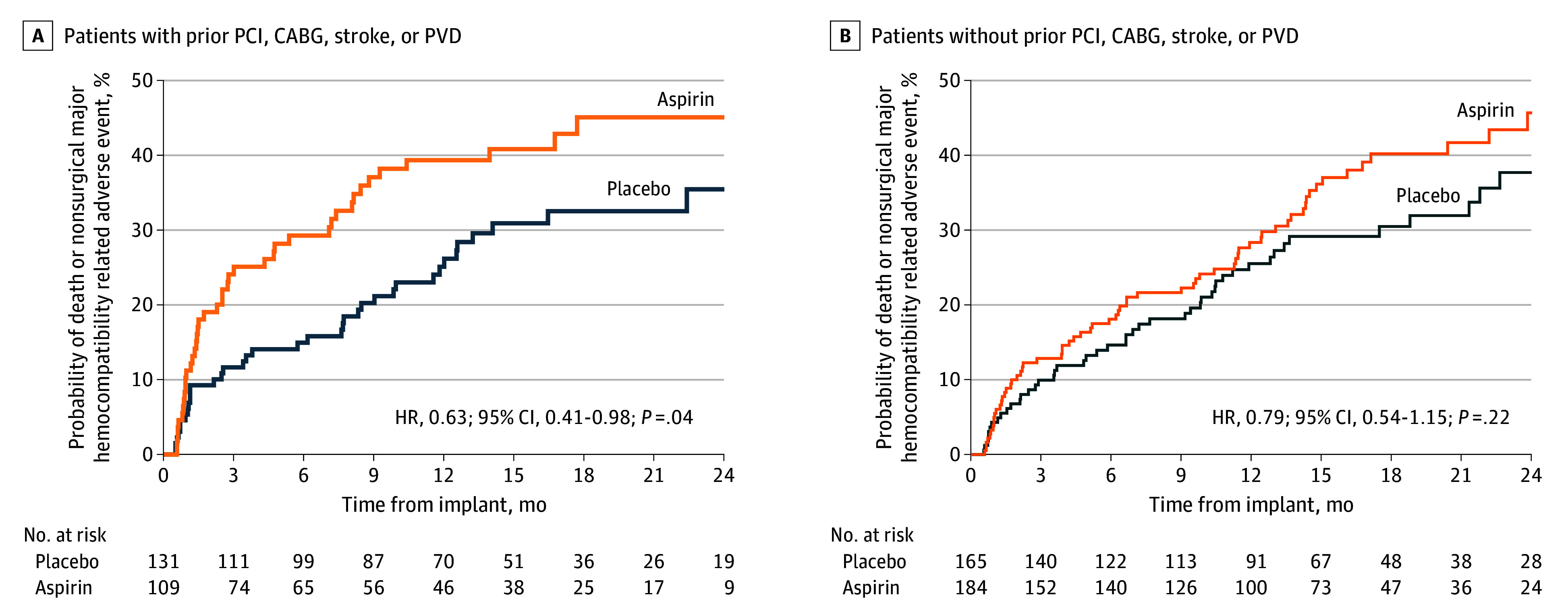
Primary end point (assessed for noninferiority) was a composite of survival free of any nonsurgical (>14 days after implant) HRAEs including stroke, pump thrombosis, bleeding, and arterial peripheral thromboembolism at 12 months. Secondary end points included nonsurgical bleeding, stroke, and pump thrombosis events.
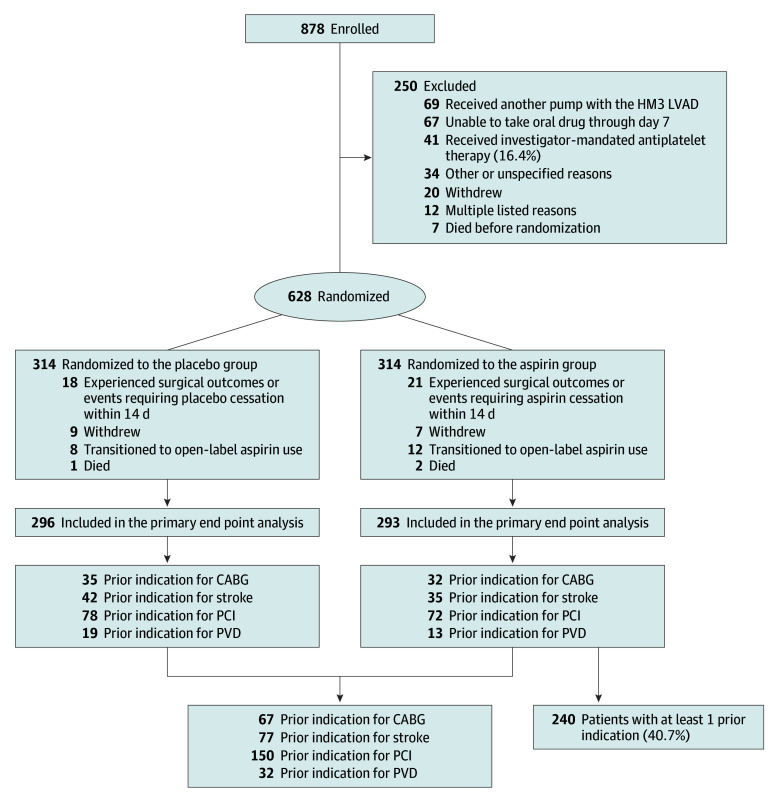
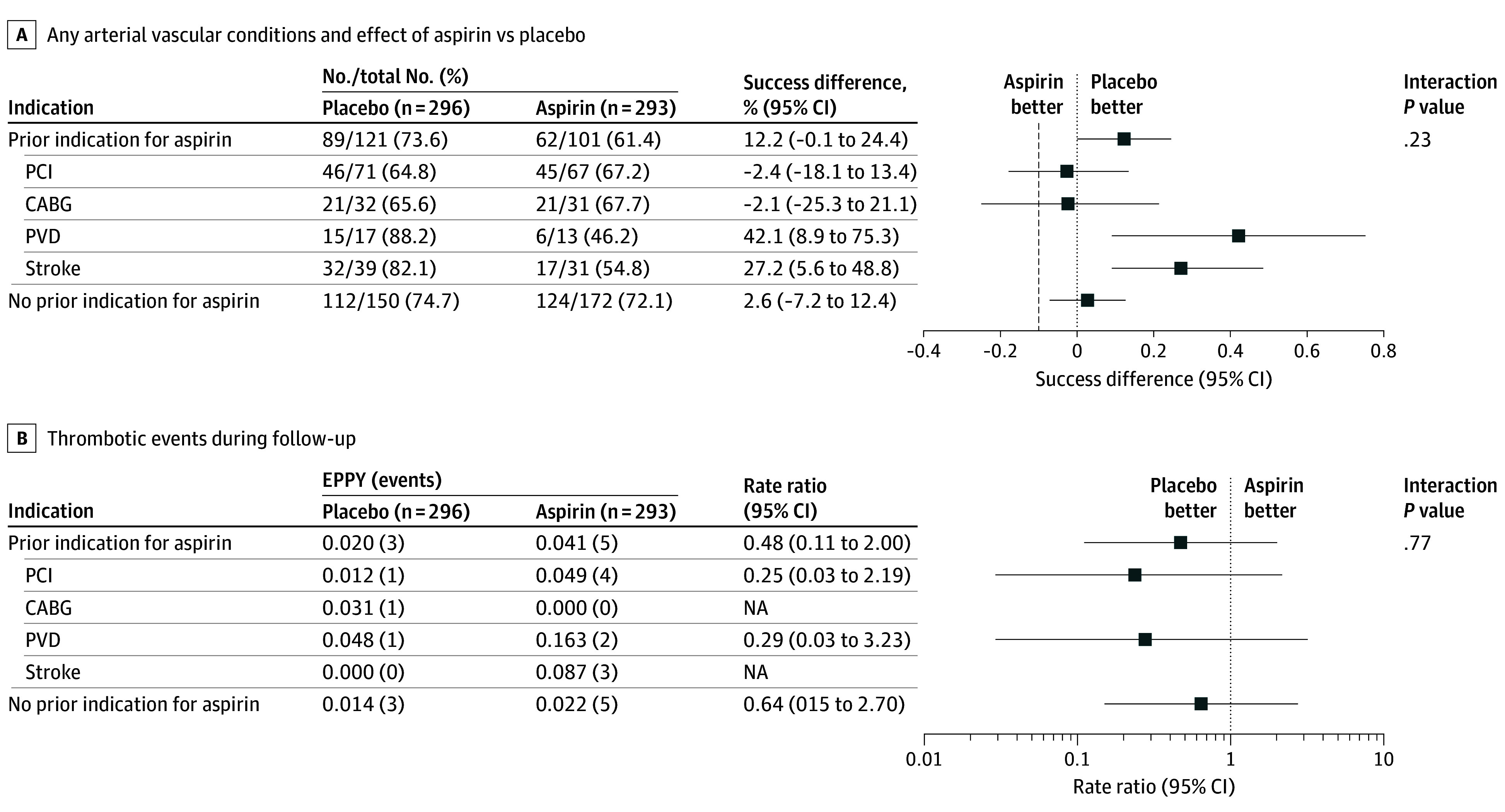
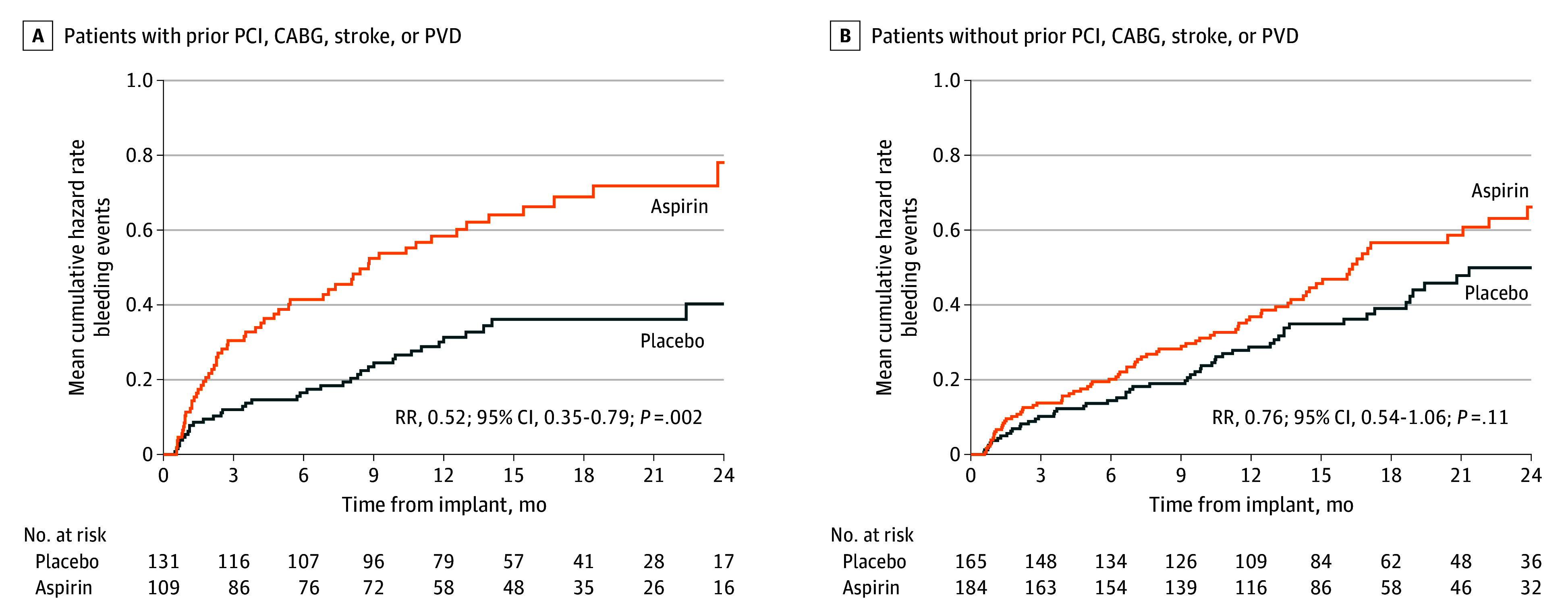
Among 589 of 628 patients (mean [SD] age, 57.1 [13.7] years; 456 male [77.4%]) who contributed to the primary end point analysis, a history of PCI, CABG, stroke, or PVD was present in 41% (240 of 589 patients). There was no interaction between the presence of an atherosclerotic vascular condition and effect of aspirin compared with placebo (P for interaction= .23). The preset 10% noninferiority margin was not crossed for the studied subgroup of patients. Thrombotic events were rare, with no differences between aspirin and placebo in patients with and without vascular disease (P for interaction = .77). Aspirin treatment was associated with a higher rate of nonsurgical major bleeding events in the group with prior vascular condition history compared with those without aspirin (rate ratio for placebo compared with aspirin, 0.52; 95% CI, 0.35-0.79).
Results of this prespecified analysis of the ARIES-HM3 randomized clinical trial demonstrate that in patients with advanced heart failure who have classical indications for antiplatelet therapy use at the time of LVAD implantation, aspirin avoidance was safe and not associated with increased thrombosis risk. Importantly, elimination of aspirin was associated with no increased thrombosis but a reduction in nonsurgical bleeding events in patients with a history of PCI, CABG, stroke, or PVD.
ClinicalTrials.gov Identifier: NCT04069156.
阿司匹林与晚期心力衰竭患者使用左心室辅助装置时的血液相容性事件(ARIES-HM3)研究表明,在植入HeartMate 3(HM3[雅培心血管公司])左心室辅助装置(LVAD)后,阿司匹林可以安全地从抗血栓治疗方案中停用。这项预先设定的分析探讨了需要使用阿司匹林的情况(既往经皮冠状动脉介入治疗[PCI]、冠状动脉旁路移植术[CABG]、中风或外周血管疾病[PVD])是否会因避免使用阿司匹林而对预后产生不同影响。
分析在有CABG、PCI、中风或PVD病史的患者植入装置1年后避免使用阿司匹林对血液相容性相关不良事件(HRAEs)的影响。
设计、设置和参与者:这是一项国际多中心前瞻性双盲安慰剂对照随机临床试验,纳入了51个中心新植入HM3 LVAD的患者。数据分析于2024年4月至7月进行。
患者按1:1比例随机分组,除两组均使用目标国际标准化比值为2至3的维生素K拮抗剂(VKA)外,一组接受阿司匹林(每日100毫克),另一组接受安慰剂。
主要终点(评估非劣效性)为12个月时无任何非手术性(植入后>14天)HRAEs(包括中风、泵血栓形成、出血和动脉外周血栓栓塞)存活的复合结局。次要终点包括非手术性出血、中风和泵血栓形成事件。
在对主要终点分析有贡献的628例患者中的589例(平均[标准差]年龄,57.1[13.7]岁;456例男性[77.4%])中,41%(589例患者中的240例)有PCI、CABG、中风或PVD病史。与安慰剂相比,动脉粥样硬化血管疾病的存在与阿司匹林的效果之间没有相互作用(交互作用P值=.23)。研究的患者亚组未达到预设的10%非劣效界值。血栓形成事件很少见,有血管疾病和无血管疾病的患者中阿司匹林组和安慰剂组之间无差异(交互作用P值=.77)相比无阿司匹林组,有既往血管疾病史的组中阿司匹林治疗与更高的非手术性大出血事件发生率相关(安慰剂与阿司匹林的率比,为0.52;95%CI,0.35-0.79)。
ARIES-HM3随机临床试验的这项预先设定分析结果表明,在植入LVAD时具有抗血小板治疗经典指征的晚期心力衰竭患者中,避免使用阿司匹林是安全的,且与血栓形成风险增加无关。重要的是,对于有PCI、CABG、中风或PVD病史的患者,停用阿司匹林不会增加血栓形成风险,但会减少非手术性出血事件。
ClinicalTrials.gov标识符:NCT04069156。