Bonnier Rafaël A, Beames Joanne R, Kiekens Glenn, van Aubel Evelyne, Schirmbeck Frederike, de Haan Lieuwe, Marcelis Machteld, van der Gaag Mark, van Winkel Ruud, van Amelsvoort Therese, Vaessen Thomas, Reininghaus Ulrich, Lafit Ginette, Myin-Germeys Inez
Department of Neurosciences, Research Group Psychiatry, Center for Contextual Psychiatry, KU Leuven, Leuven, Belgium.
Faculty of Psychology and Educational Sciences, KU Leuven, Leuven, Belgium.
Transl Psychiatry. 2025 Jan 7;15(1):3. doi: 10.1038/s41398-024-03214-1.
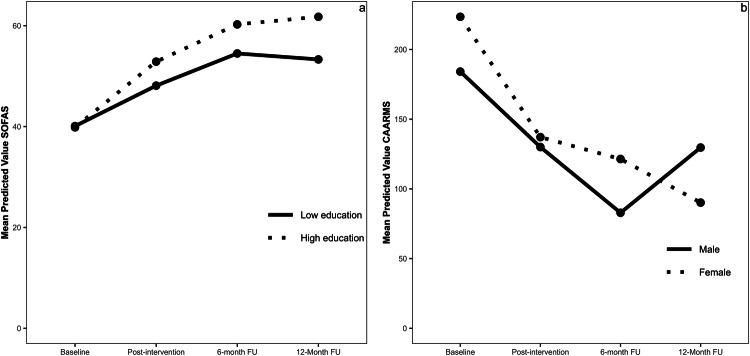
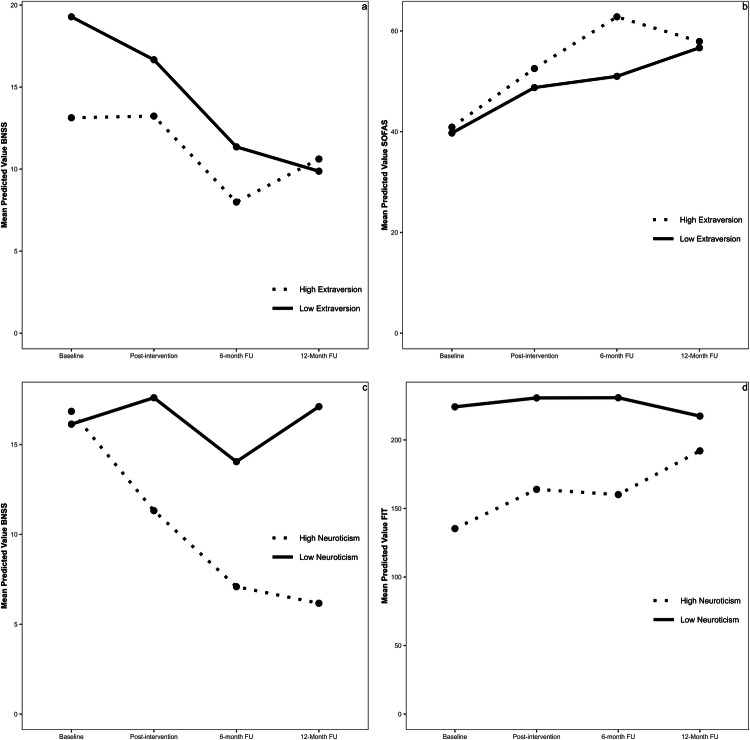
ACT in Daily Life (ACT-DL) is a blended-care Ecological Momentary Intervention that extends ACT into the daily life of individuals, improving psychotic distress, negative symptoms, and global functioning. However, it remains unclear whether ACT-DL works equally for everyone. We investigated whether moderators (i.e., sociodemographic information, personality, and trauma history) determine clinical outcomes in individuals with early psychosis receiving ACT-DL. Seventy-one participants from the INTERACT trial, using ACT-DL, were analyzed. Outcomes included psychotic distress, negative symptoms, global functioning, and psychological flexibility. Using multivariate-multilevel models, we evaluated the effects of sociodemographics, personality, and childhood trauma across baseline, post-intervention, and six- and 12-month follow-ups. Sociodemographic characteristics and personality predicted clinical outcomes. Higher education demonstrated more substantial improvement in global functioning at 6- (B = 7.43, p = 0.04) and 12-FU (B = 10.74, p = 0.002) compared to lower education. Higher extraversion showed less improvement in negative symptoms at 12-FU (B = 1.24, p = 0.01) and more improvement in global functioning at post-intervention (B = 0.39, p = 0.046) and 6-FU (B = 1.40, p = 0.02) compared to lower extraversion. Higher negative affectivity showed more improvement in negative symptoms at 12-FU (B = -1.59, p = 0.001) and higher psychological flexibility at 12-FU (B = 8.38, p = 0.001) compared to lower negative affectivity. Our findings suggest that while ACT-DL improves clinical outcomes in individuals with early psychosis, the improvement rate is dissimilar for individuals and predictable by baseline characteristics. If replicated, these findings enable precision medicine approaches in allocating ACT-DL for early psychosis.
日常生活中的接纳与承诺疗法(ACT-DL)是一种混合式照护的生态瞬时干预方法,它将接纳与承诺疗法扩展到个体的日常生活中,以改善精神病性痛苦、阴性症状和整体功能。然而,ACT-DL是否对每个人都同样有效仍不清楚。我们调查了调节因素(即社会人口学信息、人格和创伤史)是否能决定接受ACT-DL的早期精神病患者的临床结局。对来自INTERACT试验的71名使用ACT-DL的参与者进行了分析。结局指标包括精神病性痛苦、阴性症状、整体功能和心理灵活性。我们使用多变量多层次模型,评估了社会人口学、人格和童年创伤在基线、干预后以及6个月和12个月随访时的影响。社会人口学特征和人格可预测临床结局。与低学历者相比,高学历者在6个月随访时(B = 7.43,p = 0.04)和12个月随访时(B = 10.74,p = 0.002)的整体功能改善更为显著。与低外向性者相比,高外向性者在12个月随访时的阴性症状改善较少(B = 1.24,p = 0.01),而在干预后(B = 0.39,p = 0.046)和6个月随访时(B = 1.40,p = 0.02)的整体功能改善更多。与低消极情感性者相比,高消极情感性者在12个月随访时的阴性症状改善更多(B = -1.59,p = 0.001),在12个月随访时的心理灵活性更高(B = 8.38,p = 0.001)。我们的研究结果表明,虽然ACT-DL可改善早期精神病患者的临床结局,但个体的改善率不同,且可由基线特征预测。如果这些结果得到重复验证,那么这些发现将有助于在为早期精神病患者分配ACT-DL时采用精准医学方法。