Shi Mingguang, Li Xuefeng
School of Electrical Engineering and Automation, Hefei University of Technology, Hefei, Anhui, China.
Brief Bioinform. 2024 Nov 22;26(1). doi: 10.1093/bib/bbae703.
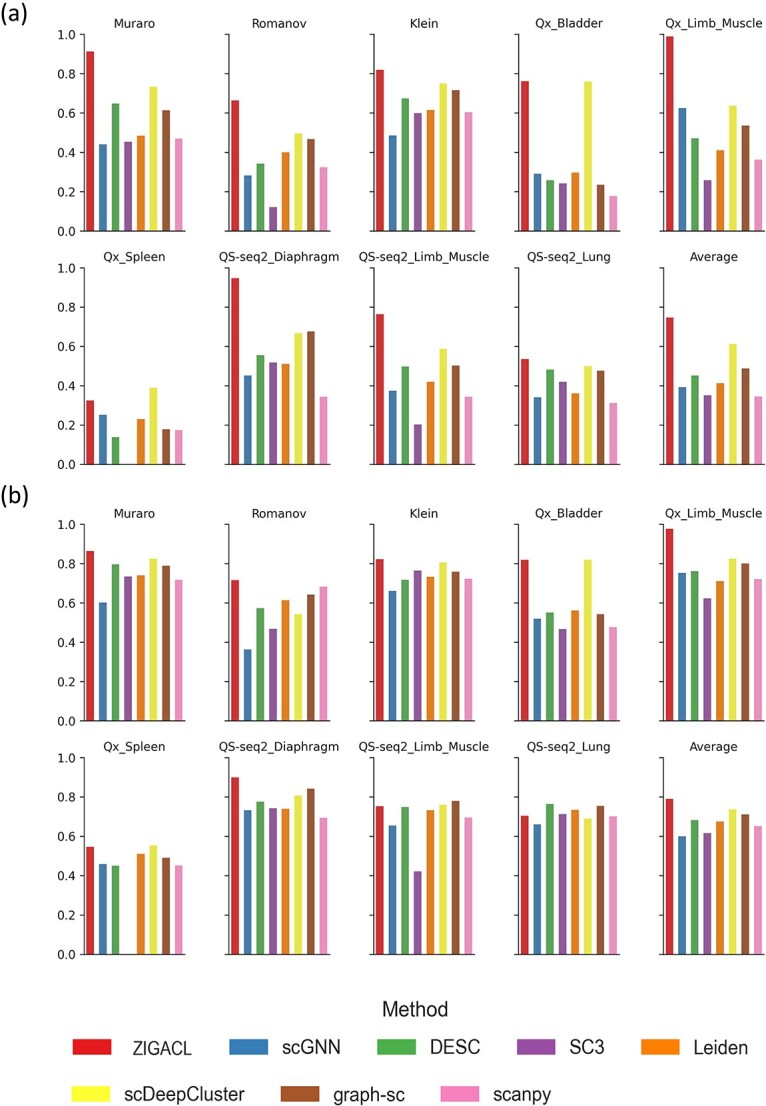
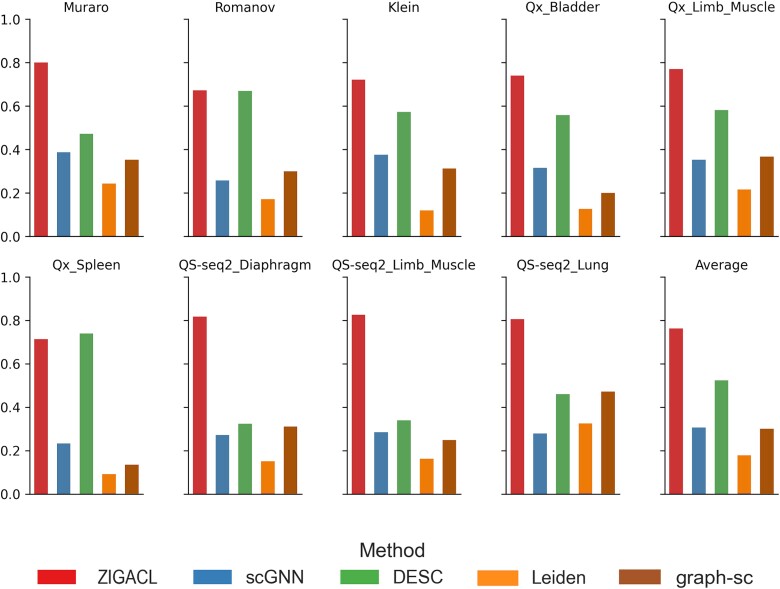
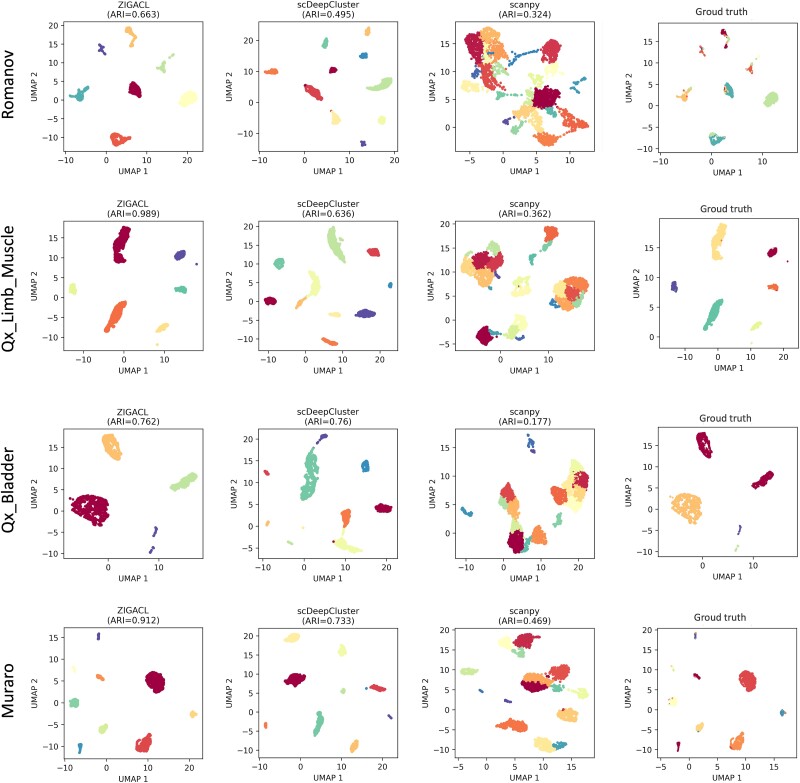
Despite significant advancements in single-cell representation learning, scalability and managing sparsity and dropout events continue to challenge the field as scRNA-seq datasets expand. While current computational tools struggle to maintain both efficiency and accuracy, the accurate connection of these dropout events to specific biological functions usually requires additional, complex experiments, often hampered by potential inaccuracies in cell-type annotation. To tackle these challenges, the Zero-Inflated Graph Attention Collaborative Learning (ZIGACL) method has been developed. This innovative approach combines a Zero-Inflated Negative Binomial model with a Graph Attention Network, leveraging mutual information from neighboring cells to enhance dimensionality reduction and apply dynamic adjustments to the learning process through a co-supervised deep graph clustering model. ZIGACL's integration of denoising and topological embedding significantly improves clustering accuracy and ensures similar cells are grouped closely in the latent space. Comparative analyses across nine real scRNA-seq datasets have shown that ZIGACL significantly enhances single-cell data analysis by offering superior clustering performance and improved stability in cell representations, effectively addressing scalability and managing sparsity and dropout events, thereby advancing our understanding of cellular heterogeneity.
尽管单细胞表征学习取得了显著进展,但随着单细胞RNA测序(scRNA-seq)数据集的扩大,可扩展性以及处理稀疏性和缺失事件仍然是该领域面临的挑战。虽然当前的计算工具难以同时保持效率和准确性,但将这些缺失事件与特定生物学功能准确关联通常需要额外的复杂实验,而这些实验往往受到细胞类型注释潜在不准确的阻碍。为应对这些挑战,开发了零膨胀图注意力协作学习(ZIGACL)方法。这种创新方法将零膨胀负二项式模型与图注意力网络相结合,利用相邻细胞的互信息来增强降维效果,并通过协同监督的深度图聚类模型对学习过程进行动态调整。ZIGACL的去噪和拓扑嵌入集成显著提高了聚类准确性,并确保相似细胞在潜在空间中紧密聚集。对九个真实scRNA-seq数据集的比较分析表明,ZIGACL通过提供卓越的聚类性能和改进的细胞表征稳定性,显著增强了单细胞数据分析,有效解决了可扩展性问题,并处理了稀疏性和缺失事件,从而推进了我们对细胞异质性的理解。