Ottaru Theresia A, Ngakongwa Fileuka C, Butt Zeeshan, Hawkins Claudia A, Kaaya Sylvia F, Metta Emmy O, Chillo Pilly, Siril Helen N, Hirschhorn Lisa R, Kwesigabo Gideon P
Department of Epidemiology and Biostatistics, Muhimbili University of Health and Allied Sciences, Dar es Salaam, Tanzania.
Department of Psychiatry and Mental Health, Muhimbili University of Health and Allied Sciences, Dar es Salaam, Tanzania.
Front Public Health. 2024 Dec 24;12:1483476. doi: 10.3389/fpubh.2024.1483476. eCollection 2024.
The increase in the dual burden of HIV and cardiovascular diseases (CVD), calls for the provision of integrated HIV/CVD care. This study aimed to explore barriers and facilitators to the integration of HIV/CVD care within HIV care and treatment clinics (CTCs) in urban, Tanzania.
Between March and April 2023, we conducted 12 key informant interviews with healthcare providers at six HIV CTCs in urban, Tanzania. Guided by the Consolidated Framework for Implementation Research (CFIR 1.0), we designed the interview guide and conducted a thematic analysis.
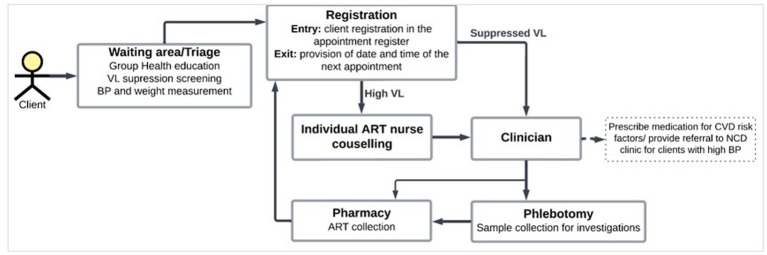
Out of the 11 CFIR constructs explored, three were barriers (cost, availability of resources, and access to information and knowledge), six were facilitators (complexity, relative advantage, patient needs, external policies and incentives, relative priority, and knowledge and belief about the intervention), and two (compatibility and self-efficacy) were both barriers and facilitators. Barriers to integration included a lack of equipment, such as BP machines, lack of space, unavailability of an electronic data-capturing tool at the HIV CTCs for monitoring CVD outcomes, and a shortage of trained healthcare workers, particularly in managing CVD comorbidities according to current recommendations. Providers acknowledged the increasing demand for CVD care among ALHIV and regarded integration as not a complex task. Providers reported that both services could be delivered simultaneously without disrupting client workflow and were determined to offer integrated care within HIV CTCs. Providers expressed concerns about medication costs and recommended that medications should be provided for free as part of the integrated care.
Effective and sustainable HIV/CVD integrated care requires an understating of the existing barriers and facilitators within the HIV CTCs. This study identifies key barriers at HIV CTCs that must be addressed and facilitators to be leveraged before CVD care is integrated into HIV CTCs to ensure that CVD care is delivered effectively within an integrated system.
艾滋病毒与心血管疾病双重负担的增加,要求提供综合的艾滋病毒/心血管疾病护理。本研究旨在探讨坦桑尼亚城市地区艾滋病毒护理和治疗诊所(CTCs)内整合艾滋病毒/心血管疾病护理的障碍和促进因素。
2023年3月至4月期间,我们对坦桑尼亚城市地区六家艾滋病毒CTCs的医疗服务提供者进行了12次关键信息访谈。在实施研究综合框架(CFIR 1.0)的指导下,我们设计了访谈指南并进行了主题分析。
在探索的11个CFIR结构中,三个是障碍(成本、资源可用性以及信息和知识获取),六个是促进因素(复杂性、相对优势、患者需求、外部政策和激励措施、相对优先级以及对干预措施的知识和信念),两个(兼容性和自我效能)既是障碍也是促进因素。整合的障碍包括缺乏设备,如血压计,空间不足,艾滋病毒CTCs没有用于监测心血管疾病结果的电子数据采集工具,以及缺乏训练有素的医护人员,特别是缺乏按照当前建议管理心血管疾病合并症的人员。提供者认识到艾滋病毒感染儿童和青少年对心血管疾病护理的需求不断增加,并认为整合并非复杂任务。提供者报告说,两种服务可以同时提供而不扰乱客户工作流程,并决心在艾滋病毒CTCs内提供综合护理。提供者对药物成本表示担忧,并建议作为综合护理的一部分免费提供药物。
有效且可持续的艾滋病毒/心血管疾病综合护理需要了解艾滋病毒CTCs内现有的障碍和促进因素。本研究确定了艾滋病毒CTCs在将心血管疾病护理整合到艾滋病毒CTCs之前必须解决的关键障碍和有待利用的促进因素,以确保在综合系统内有效提供心血管疾病护理。