Zhang Jianna, Yu Sijie, Zhu Kailu, Li Shibo, Huang Yu
Department of Nephrology, The First Affiliated Hospital of Wenzhou Medical University, Wenzhou, China.
Department of Infectious Diseases, Zhoushan Hospital, Wenzhou Medical University, Zhoushan, China.
Front Med (Lausanne). 2024 Dec 24;11:1464981. doi: 10.3389/fmed.2024.1464981. eCollection 2024.
To investigate the probability of hepatocellular carcinoma (HCC) in a large number of gray-zone (GZ) patients with chronic hepatitis B (CHB) in clinical practice.
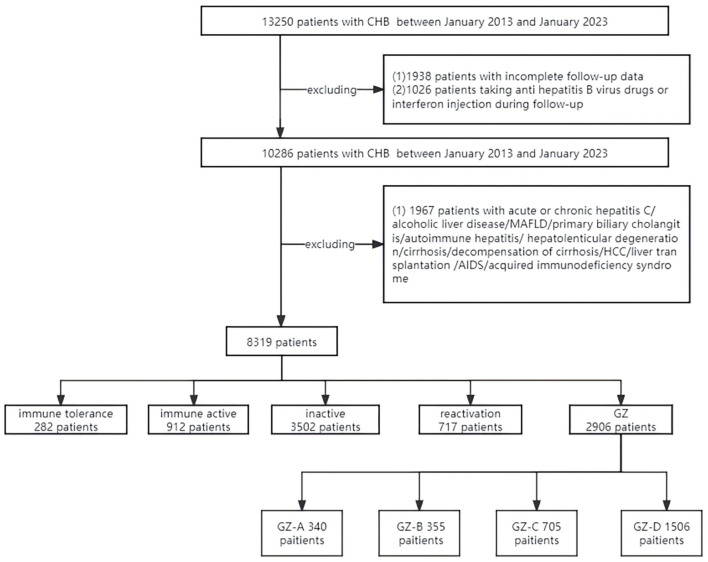
The patients with CHB who were diagnosed and treated in our hospital from January 2013 to January 2023 were analyzed retrospectively.
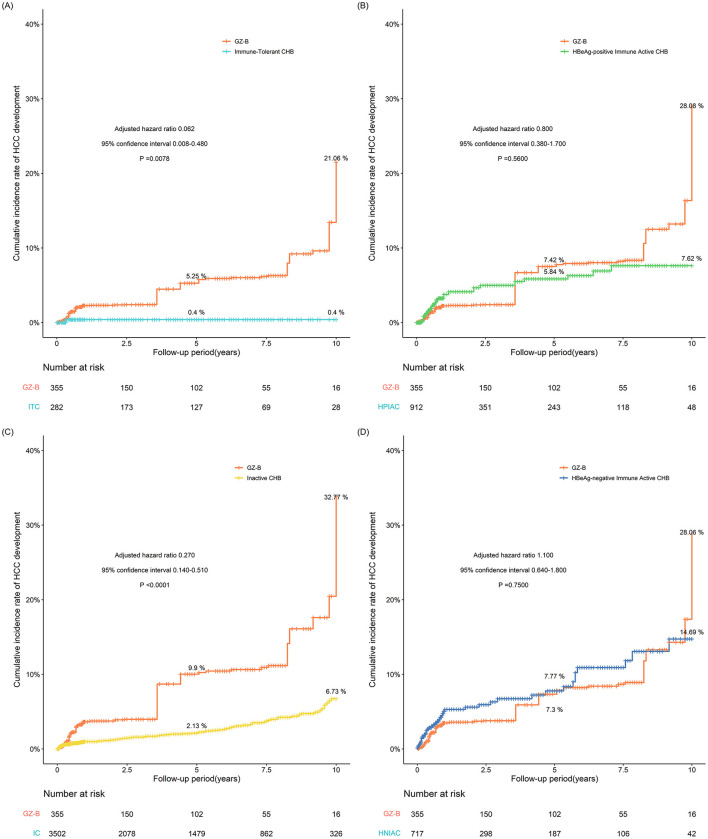
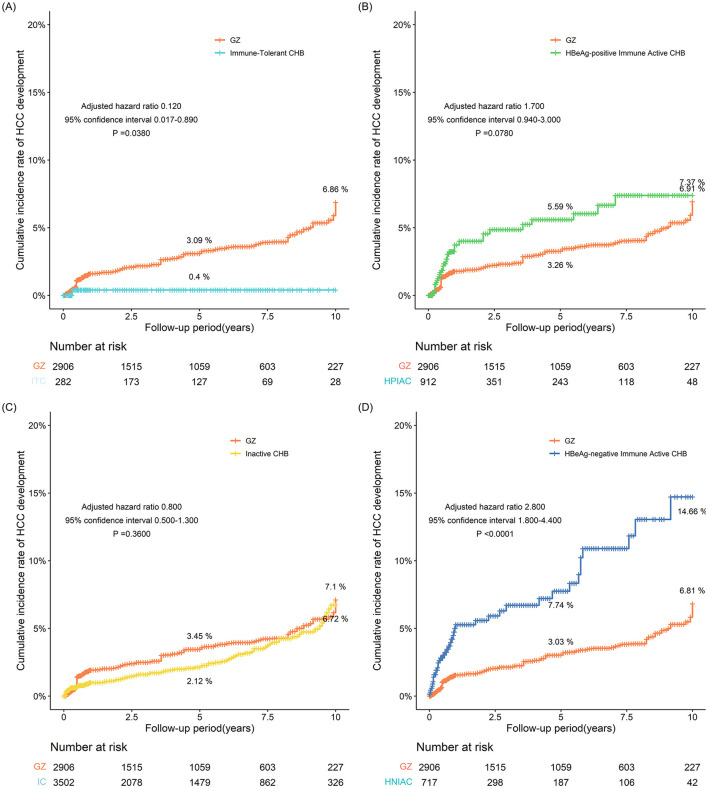
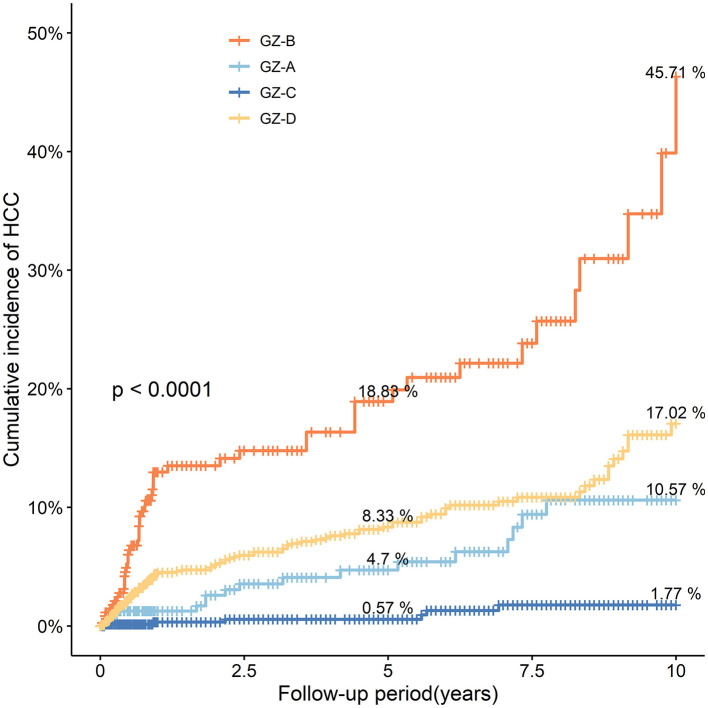
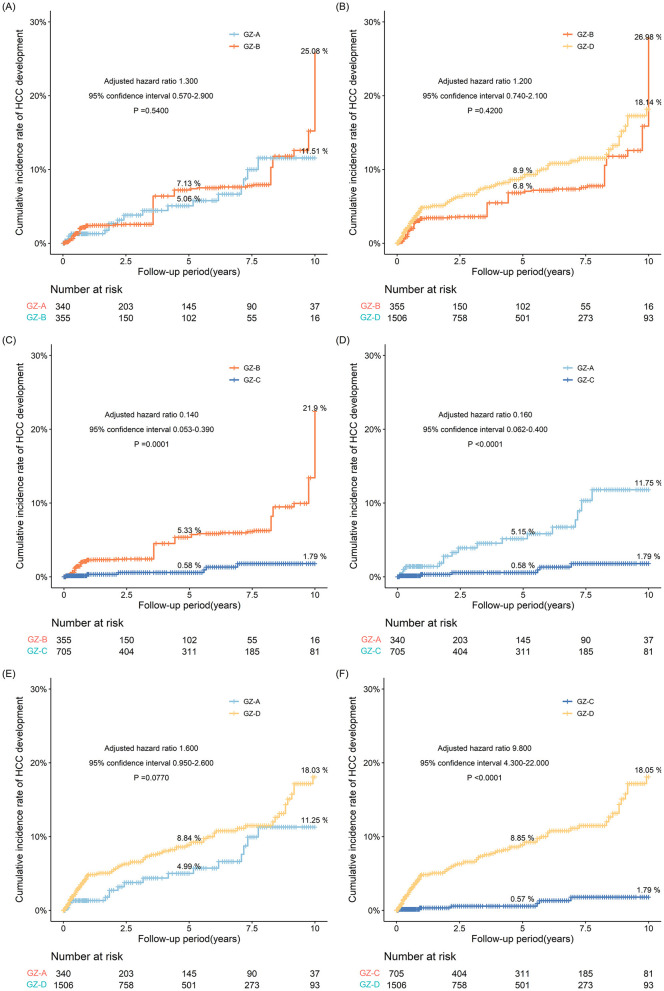
According to the different levels of HBeAg, ALT and HBV DNA, GZ patients were divided into four categories: (1) Gray zone A (GZ-A): HBeAg positive, normal ALT level, HBV DNA ≤ 10 IU/ml; (2) Gray zone B (GZ-B): HBeAg positive, ALT>ULN, HBV DNA ≤ 2 × 10 IU/ml; (3) Gray zone C (GZ-C): HBeAg negative, normal ALT level, HBV DNA ≥ 2 × 10 IU/ml; and (4) Gray zone D (GZ-D): HBeAg negative, ALT > ULN, serum HBV DNA ≤ 2 × 10 IU/ml. This observational study showed that after adjustment using inverse probability of treatment weighting (IPTW), the probability of developing HCC in the GZ group was similar to that in the immune-tolerant, HBeAg-positive immune active, and inactive groups. The IPTW-adjusted analysis revealed that the probability of developing HCC in the GZ-B subgroup was similar to that in the immune-active and HBeAg-negative immune-active groups.
The GZ group and GZ-B subgroup have a higher risk of HCC. Anti-hepatitis B virus therapy should be considered as early as possible for patients in the GZ group, especially in the GZ-B subgroup.
探讨临床实践中大量慢性乙型肝炎(CHB)灰色地带(GZ)患者发生肝细胞癌(HCC)的概率。
回顾性分析2013年1月至2023年1月在我院诊断和治疗的CHB患者。
根据HBeAg、ALT和HBV DNA的不同水平,GZ患者分为四类:(1)灰色地带A(GZ-A):HBeAg阳性,ALT水平正常,HBV DNA≤10 IU/ml;(2)灰色地带B(GZ-B):HBeAg阳性,ALT>ULN,HBV DNA≤2×10 IU/ml;(3)灰色地带C(GZ-C):HBeAg阴性,ALT水平正常,HBV DNA≥2×10 IU/ml;(4)灰色地带D(GZ-D):HBeAg阴性,ALT>ULN,血清HBV DNA≤2×10 IU/ml。这项观察性研究表明,使用治疗权重逆概率(IPTW)进行调整后,GZ组发生HCC的概率与免疫耐受、HBeAg阳性免疫活跃和非活跃组相似。IPTW调整分析显示,GZ-B亚组发生HCC的概率与免疫活跃和HBeAg阴性免疫活跃组相似。
GZ组和GZ-B亚组发生HCC的风险较高。对于GZ组患者,尤其是GZ-B亚组患者,应尽早考虑抗乙型肝炎病毒治疗。