Stevenson Anne, Girma Engida, Kitafuna Benon Kabale, Harerimana Boniface, Koenen Karestan C, Seedat Soraya
Department of Psychiatry, Faculty of Medicine and Health Sciences, Stellenbosch University, Cape Town, South Africa.
Department of Epidemiology, Harvard T. H. Chan School of Public Health, Boston, MA, USA.
Glob Ment Health (Camb). 2024 Nov 20;11:e112. doi: 10.1017/gmh.2024.123. eCollection 2024.
There is a strong link between trauma exposure and serious mental health conditions (SMHCs), such as schizophrenia and bipolar disorder. The majority of research in the field has focused on childhood trauma as a risk factor for developing an SMHC and on samples from high-income countries. There is less research on having an SMHC as a risk factor for exposure to traumatic events, and particularly on populations in low- and middle-income countries (LMICs).This scoping review aimed to synthesize the nature and extent of research on traumatic events that adults with SMHCs face in LMICs. It was conducted across five databases: PubMed, Embase, PsycINFO, Web of Science Core Collection and Africa-Wide Information/NiPad in December 2023 and by hand searching citation lists.
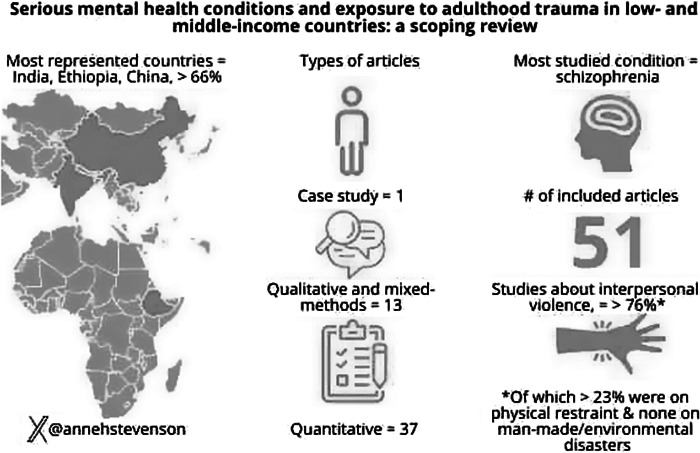
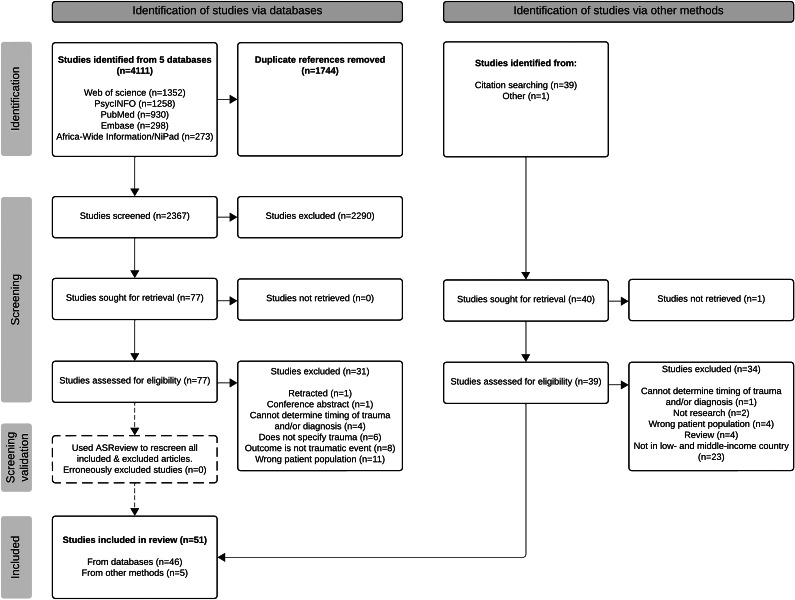
The database search returned 4,111 articles. After removing duplicates and following a rigorous screening process, 51 articles met criteria for inclusion. There was one case study, one mixed methods study, 12 qualitative studies and 37 quantitative studies. Ten countries were represented, with the most studies from India (n = 19), Ethiopia (n = 9) and China (n = 6). Schizophrenia was the most studied type of SMHC. Of the trauma exposures, more than 76% were on interpersonal violence, such as sexual and physical violence. Of the studies on interpersonal violence, more than 23% were on physical restraint (e.g., shackling) in the community or in hospital settings. There were no studies on man-made or natural disasters.
Much of our data in this population are informed by a small subset of countries and by certain types of interpersonal violence. Future research should aim to expand to additional countries in LMICs. Additional qualitative research would likely identify and contextualize other trauma types among adults with SMHCs in LMICs.
创伤暴露与严重精神健康状况(SMHCs)之间存在紧密联系,如精神分裂症和双相情感障碍。该领域的大多数研究都集中在童年创伤作为发展为SMHCs的风险因素以及高收入国家的样本上。关于患有SMHCs作为创伤性事件暴露的风险因素的研究较少,尤其是在低收入和中等收入国家(LMICs)。本范围综述旨在综合关于LMICs中患有SMHCs的成年人所面临的创伤性事件的研究性质和范围。该综述于2023年12月通过五个数据库进行:PubMed、Embase、PsycINFO、科学网核心合集和非洲范围信息/尼帕德,并通过手工搜索引文列表。
数据库搜索返回4111篇文章。在去除重复项并经过严格筛选过程后,51篇文章符合纳入标准。有1篇案例研究、1篇混合方法研究、12篇定性研究和37篇定量研究。涉及10个国家,其中印度的研究最多(n = 19),埃塞俄比亚(n = 9)和中国(n = 6)。精神分裂症是研究最多的SMHCs类型。在创伤暴露中,超过76%是人际暴力,如性暴力和身体暴力。在关于人际暴力的研究中,超过23%是关于社区或医院环境中的身体约束(如束缚)。没有关于人为或自然灾害的研究。
我们在这一人群中的许多数据来自一小部分国家和某些类型的人际暴力。未来的研究应旨在扩展到LMICs中的其他国家。更多的定性研究可能会识别并将LMICs中患有SMHCs的成年人中的其他创伤类型置于具体情境中。