Zhou Zhongbao, Li Yulong, Chai Yumeng, Zhang Yong, Yan Pu
Department of Urology, Beijing TianTan Hospital, Capital Medical University, No. 119 South 4 Ring West Road, Fengtai District, 100070, Beijing, China.
Discov Oncol. 2025 Jan 8;16(1):22. doi: 10.1007/s12672-025-01764-4.
Although pentatricopeptide repeat domain 1 (PTCD1) has been found to modulate mitochondrial metabolic and oxidative phosphorylation, its contribution in the growth of clear cell renal cell carcinoma (ccRCC) remains unknown.
The Cancer Genome Atlas (TCGA) dataset was utilized to examine the transcriptional alterations, patient characteristics, clinical outcomes, as well as pathway activation of PTCD1. The Weighted Gene Co-expression Network Analysis (WGCNA) was performed to investigate potential genes that associated with PTCD1. The researchers estimated the relationship between PTCD1, tumor immunology, and epithelial mesenchymal transition (EMT). Researchers studied how PTCD1 affects the functional behavior of tumor cells in vitro.
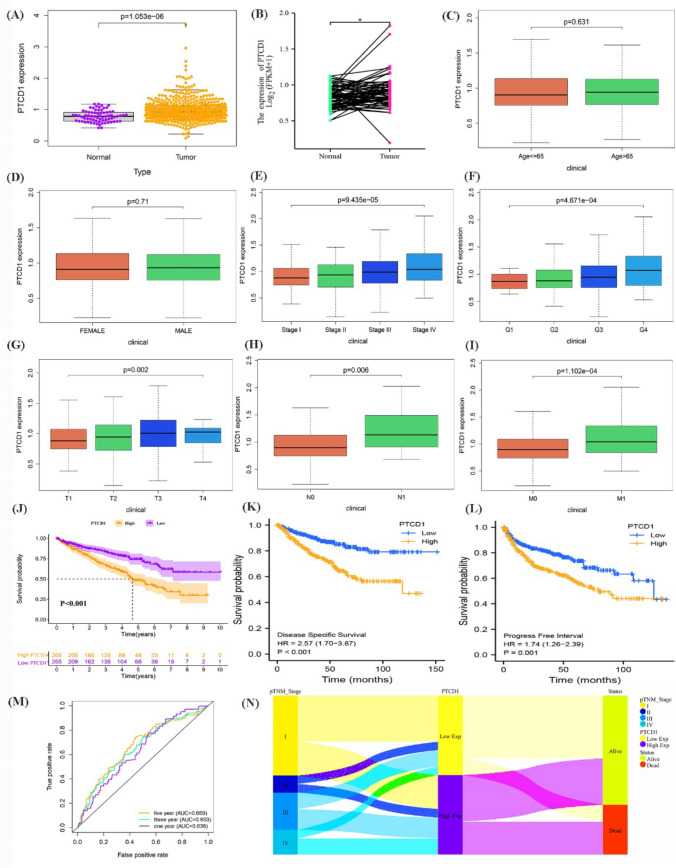
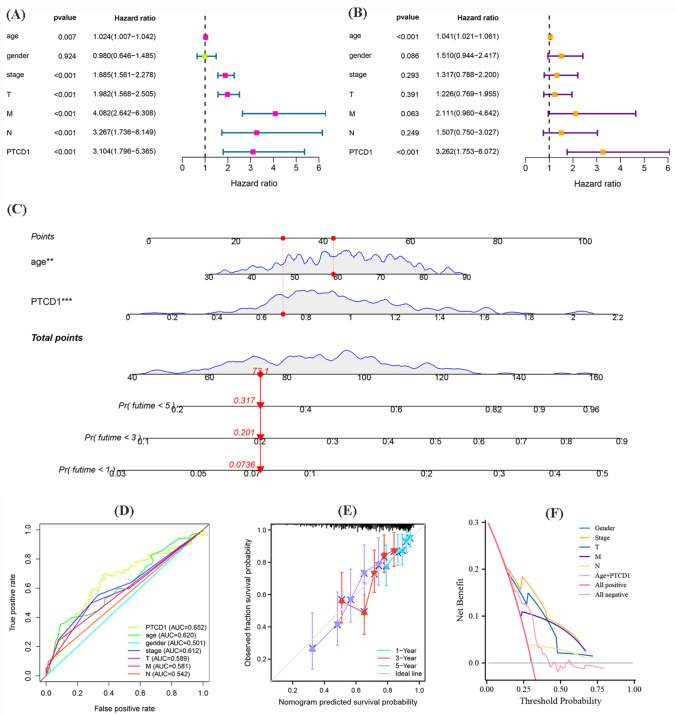
PTCD1 expression was greater in ccRCC samples than in normal samples, and expression increased gradually as the stage increased. In TCGA cohorts, higher PTCD1 expression was substantially associated with a poorer clinical stage, histological grading, T stage, N stage, M stage, and survival outcomes. The results of multivariate analysis showed that PTCD1 was an independent variable affecting the survival outcomes of ccRCC patients (p < 0.001). PTCD1 regulated ccRCC progression via various cancer mechanisms including PI3K-Akt signaling, focal adhesion, PD-L1 expression, and PD-1 checkpoints in cancer. WGCNA discovered a significant relationship between PTCD1 and IARS2, LRPPRC, MT-ND2, MT-CO1, MT-CO2, MT-CYB, MT-ATP6, and MT-ND4. Furthermore, PTCD1 expression levels was closely associated with immune infiltrating, immunological checkpoint, EMT, immunotherapy responsiveness, and anti-tumor medication sensitivities. Upregulation of PTCD1 in ccRCC cells resulted in considerably increased cellular invasion and migration. Mechanistically, the upregulation of PTCD1 increased the phosphorylation of AKT at Ser473 and GSK-3β at Ser9, as well as enhanced activation of Wnt/β-catenin pathway.
Elevated expression of PTCD1 was associated with malignant biological behaviors and poor outcomes of ccRCC patients, and PTCD1 may accelerate tumor cells proliferation and invasion via the Akt/GSK3β/β-catenin pathway. Our findings indicated that PTCD1 had the potential to become a new target for predicting prognosis and targeted therapy.
尽管已发现五肽重复序列结构域1(PTCD1)可调节线粒体代谢和氧化磷酸化,但其在透明细胞肾细胞癌(ccRCC)生长中的作用仍不清楚。
利用癌症基因组图谱(TCGA)数据集来检测PTCD1的转录改变、患者特征、临床结局以及通路激活情况。进行加权基因共表达网络分析(WGCNA)以研究与PTCD1相关的潜在基因。研究人员评估了PTCD1、肿瘤免疫学和上皮间质转化(EMT)之间的关系。研究人员研究了PTCD1在体外如何影响肿瘤细胞的功能行为。
PTCD1在ccRCC样本中的表达高于正常样本,且随着分期增加表达逐渐升高。在TCGA队列中,较高的PTCD1表达与较差的临床分期、组织学分级、T分期、N分期、M分期及生存结局显著相关。多因素分析结果显示PTCD1是影响ccRCC患者生存结局的独立变量(p < 0.001)。PTCD1通过多种癌症机制调节ccRCC进展,包括PI3K-Akt信号传导、粘着斑、PD-L1表达及癌症中的PD-1检查点等。WGCNA发现PTCD1与IARS2、LRPPRC、MT-ND2、MT-CO1、MT-CO2、MT-CYB、MT-ATP6和MT-ND4之间存在显著关系。此外,PTCD1表达水平与免疫浸润、免疫检查点、EMT、免疫治疗反应性及抗肿瘤药物敏感性密切相关。ccRCC细胞中PTCD1的上调导致细胞侵袭和迁移显著增加。机制上看,PTCD1的上调增加了AKT在Ser473和GSK-3β在Ser9的磷酸化,以及增强了Wnt/β-连环蛋白通路的激活。
PTCD1表达升高与ccRCC患者的恶性生物学行为和不良结局相关,且PTCD1可能通过Akt/GSK3β/β-连环蛋白通路加速肿瘤细胞增殖和侵袭。我们研究结果表明PTCD1有潜力成为预测预后和靶向治疗的新靶点。