Brown Christian E, Goldenberg William P, Hinds Olivia M, O'Donnell Mary Kate, Staub Nancy L
Department of Integrative Physiology and Neuroscience, Washington State University, Pullman, Washington, USA.
Goldenberg Film, Arcata, California, USA.
J Morphol. 2025 Jan;286(1):e70026. doi: 10.1002/jmor.70026.
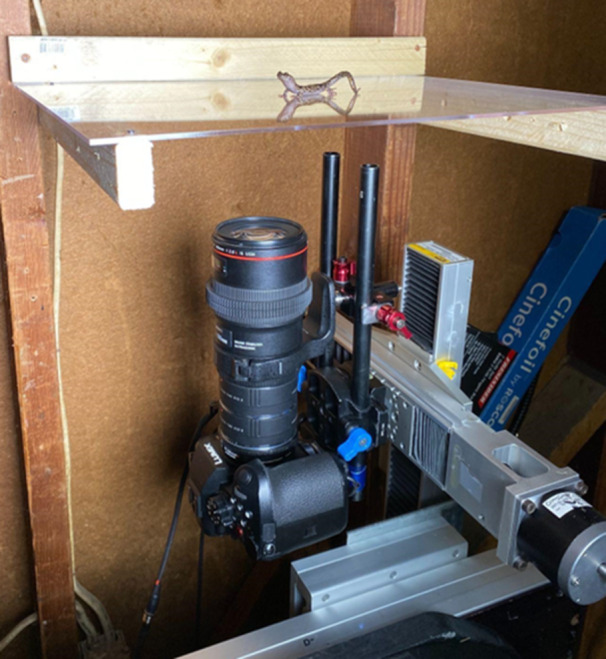
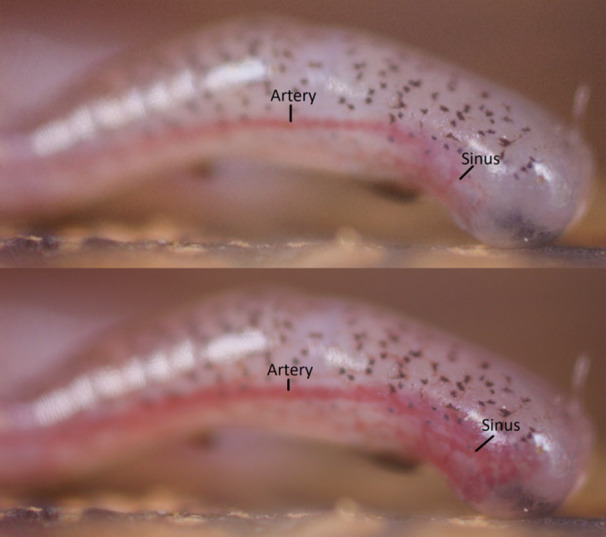
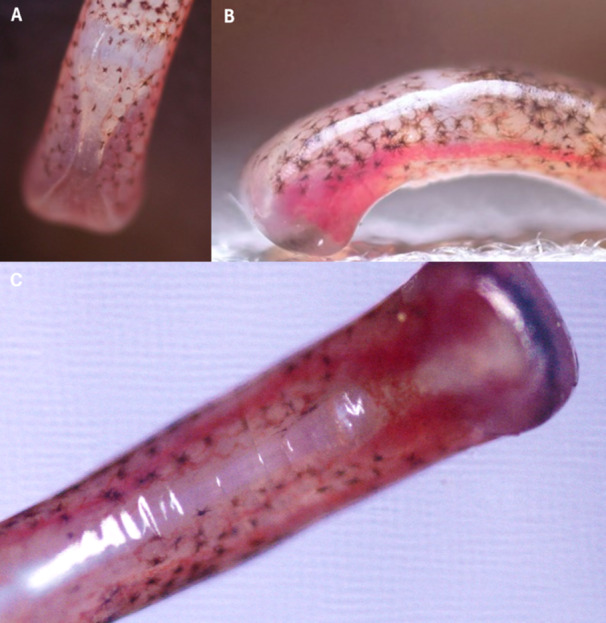
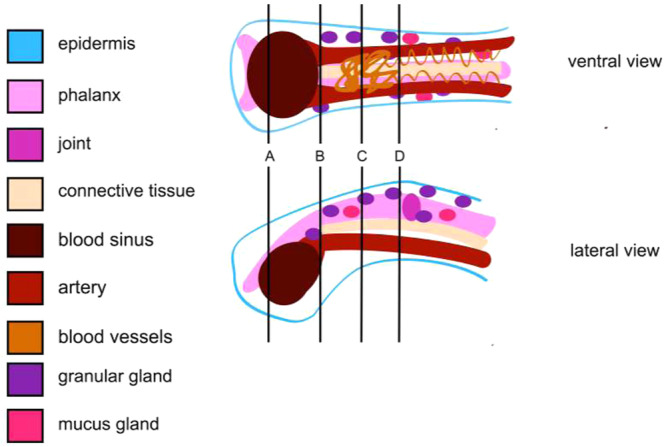
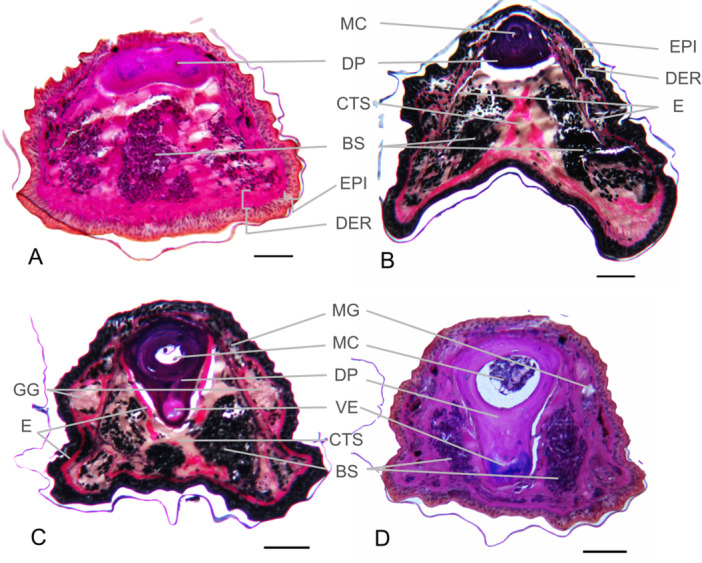
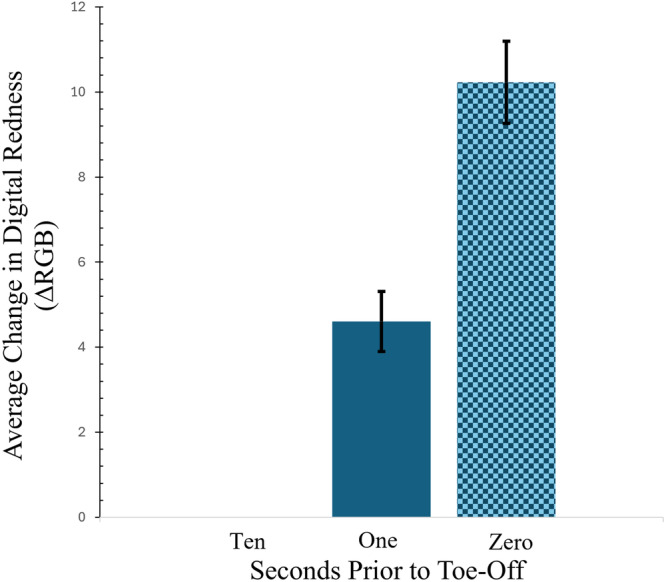
For over a century researchers have marveled at the square-shaped toe tips of several species of climbing salamanders (genus Aneides), speculating about the function of large blood sinuses therein. Wandering salamanders (Aneides vagrans) have been reported to exhibit exquisite locomotor control while climbing, jumping, and gliding high (88 m) within the redwood canopy; however, a detailed investigation of their digital vascular system has yet to be conducted. Here, we describe the vascular and osteological structure of, and blood circulation through, the distal regions of the toes of A. vagrans using histology in tandem with live-animal videos. Specifically, we sectioned a toe of A. vagrans at 0.90 μm, embedded it in Spurrs resin, and stained the tissue with toluidine blue. An additional three toes were sectioned at 10 μm, embedded in paraffin, and after sectioning and mounting, treated with Verhoeff and Quad stains. For living salamanders, we recorded real-time videos of blood flowing within individual toes upon a translucent surface oriented both horizontally (0°) and vertically (90°) to simulate both prostrate and vertical clinging scenarios, then analyzed the image sequences using ImageJ. We found that the vascularized toe tips have one large sinus cavity that is divided more proximally into two chambers via a septum, and there are mucous and granular glands in the dorsal and dorsolateral integument of the digit tips. Live-animal trials revealed variable sinus-filling both within and between toes, seemingly associated with variable pressure applied to the substrate when standing, stepping, clinging, and climbing. We conclude that A. vagrans, and likely other climbing salamanders, can functionally fill, trap, and drain the blood in their vascularized toe tips to optimize attachment, detachment, and complex arboreal locomotion (e.g., landing after gliding flight). Such an adaptation could provide insights for bioinspired designs.
一个多世纪以来,研究人员一直对几种攀缘蝾螈(Aneides属)方形的趾尖感到惊奇,猜测其中大血窦的功能。据报道,游荡蝾螈(Aneides vagrans)在红木树冠内攀爬、跳跃和高空滑翔(88米)时表现出精湛的运动控制能力;然而,尚未对其趾部数字血管系统进行详细研究。在这里,我们结合组织学和活体动物视频,描述了游荡蝾螈趾尖远端区域的血管和骨骼结构以及血液循环。具体来说,我们将一只游荡蝾螈的脚趾切成0.90微米厚的切片,嵌入Spurrs树脂中,并用甲苯胺蓝对组织进行染色。另外三只脚趾切成10微米厚的切片,嵌入石蜡中,切片并安装后,用Verhoeff和Quad染色剂处理。对于活体蝾螈,我们在水平(0°)和垂直(90°)取向的半透明表面上记录了单个脚趾内血液流动的实时视频,以模拟俯卧和垂直附着场景,然后使用ImageJ分析图像序列。我们发现,血管化的趾尖有一个大的窦腔,在近端通过一个隔膜分成两个腔室,并且在趾尖的背侧和背外侧体表有粘液腺和颗粒腺。活体动物试验显示,脚趾内部和之间的窦腔充盈情况各不相同,这似乎与站立、行走、附着和攀爬时施加在基质上的压力变化有关。我们得出结论,游荡蝾螈以及可能的其他攀缘蝾螈,可以在功能上填充、捕获和排出其血管化趾尖中的血液,以优化附着、脱离和复杂的树栖运动(例如,滑翔飞行后的着陆)。这种适应性可为仿生设计提供思路。