Maturano-Carrera Daniel, Oltehua-López Omar, Cuervo-López Flor de María, Texier Anne-Claire
Department of Biotechnology-CBS, Metropolitan Autonomous University Iztapalapa, Av. Ferrocarril San Rafael Atlixco 186, 09310, Mexico City, Mexico.
Appl Biochem Biotechnol. 2025 Apr;197(4):2624-2638. doi: 10.1007/s12010-024-05165-1. Epub 2025 Jan 9.
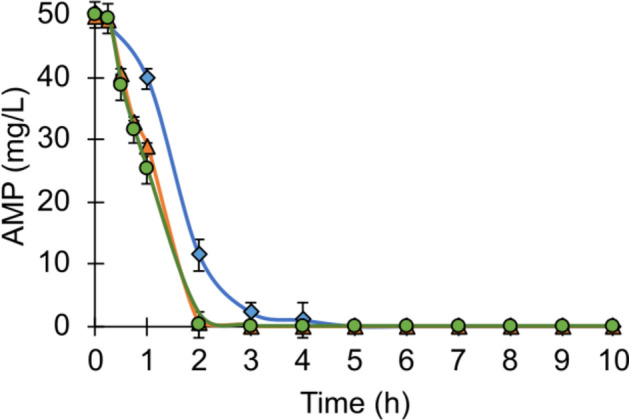
The presence of antibiotics in wastewater discharges significantly affects the environment, mainly due to the generation of bacterial populations with multiple antibiotic resistances. The cometabolic capacity of nitrifying sludge to simultaneously remove ammonium (NH) and emerging organic contaminants (EOCs), including antibiotics, has been reported. In the present study, the removal capacity of 50 mg ampicillin (AMP)/L by nitrifying cultures associated with biosorption and biotransformation processes was evaluated in a sequencing batch reactor (SBR) system. The contribution of nitrifying enzymes (ammonium monooxygenase (AMO) and nitrite oxidoreductase (NOR)) and β-lactamases in AMP biodegradation was evaluated using specific inhibitors in batch cultures. AMP was 100% eliminated after 5 h since the first cycle of operation. The sludge maintained its ammonium oxidizing capacity with the total consumption of 102.0 ± 2.5 mg NH-N/L in 9 h, however, the addition of AMP altered the nitrite-oxidizing process of nitrification, recovering 30 cycles later at both physiological and kinetic level. The kinetic activity of the nitrifying sludge improved along the operating cycles for both AMP removal and nitrification processes. The elimination of 24% AMP was attributed to the biosorption process and 76% to biotransformation, wherein the AMO enzyme contributed 95% to its biodegradation. Finally, the repeated exposure of the sludge to AMP for 72 operating cycles (36 days) was not sufficient to detect β-lactamase activity. The cometabolic ability of ammonium-oxidizing bacteria for biodegrading AMP could be employed for bioremediation of wastewater.
废水排放中抗生素的存在对环境有显著影响,主要是因为会产生具有多种抗生素抗性的细菌种群。已有报道称硝化污泥具有共代谢能力,可同时去除铵(NH)和包括抗生素在内的新型有机污染物(EOCs)。在本研究中,在序批式反应器(SBR)系统中评估了与生物吸附和生物转化过程相关的硝化培养物对50 mg/L氨苄青霉素(AMP)的去除能力。在分批培养中使用特异性抑制剂评估了硝化酶(铵单加氧酶(AMO)和亚硝酸氧化还原酶(NOR))和β-内酰胺酶在AMP生物降解中的作用。自运行的第一个周期起5小时后,AMP被100%去除。污泥保持了其铵氧化能力,在9小时内总共消耗了102.0±2.5 mg NH-N/L,然而,AMP的添加改变了硝化作用的亚硝酸盐氧化过程,在30个周期后在生理和动力学水平上都得以恢复。对于AMP去除和硝化过程,硝化污泥的动力学活性在运行周期中均有所提高。24%的AMP去除归因于生物吸附过程,76%归因于生物转化,其中AMO酶对其生物降解的贡献为95%。最后,污泥反复暴露于AMP 72个运行周期(36天),仍不足以检测到β-内酰胺酶活性。铵氧化细菌对AMP的共代谢能力可用于废水的生物修复。