Kahn Rebecca, Moiane Benild, Lessa Fernanda C, Massora Sergio, Mabombo Viviana, Chauque Alberto, Tembe Nelson, Mucavele Helio, Whitney Cynthia G, Sacoor Charfudin, Matsinhe Graca, Pimenta Fabiana C, da Gloria Carvalho Maria, Sigauque Betuel, Verani Jennifer
Respiratory Diseases Branch, Division of Bacterial Diseases, Centers for Disease Control and Prevention, Atlanta, United States.
Centro de Investigação em Saúde da Manhiça (CISM), Maputo, Mozambique.
Vaccine. 2025 Feb 15;47:126691. doi: 10.1016/j.vaccine.2024.126691. Epub 2025 Jan 8.
Streptococcus pneumoniae is an important cause of pneumonia, sepsis, and meningitis, which are leading causes of child mortality. Pneumococcal conjugate vaccines (PCVs) protect against disease and nasopharyngeal colonization with vaccine serotypes, reducing transmission to and among unvaccinated individuals. Mozambique introduced 10-valent PCV (PCV10) in 2013. In 2017-2019, 13-valent PCV (PCV13) replaced PCV10, and in September 2019 the schedule changed from three primary doses to two primary doses and a booster; the booster-containing schedule may increase indirect effects. We examined pneumococcal carriage in Mozambique to establish a baseline for estimating the impact of policy changes and to estimate the long-term impact of PCV10 in children aged <5 years.
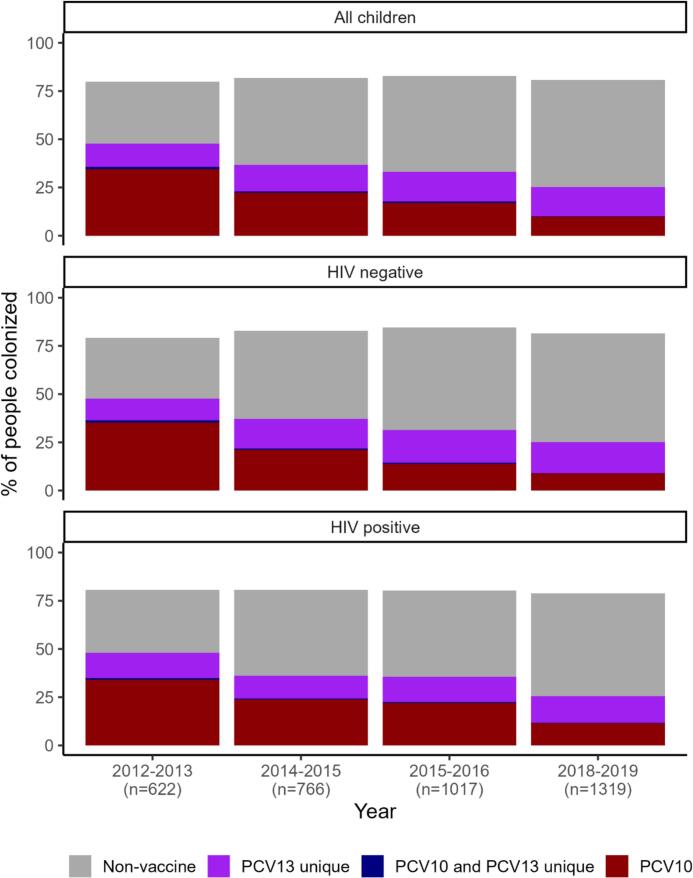
We calculated prevalence of carriage of PCV10 serotypes and the 3 additional PCV13 serotypes ('PCV13-unique') among children aged <5 years and their household members in southern Mozambique, between October 2018 and July 2019. Nasopharyngeal swabs were cultured, and isolates underwent Quellung serotyping. For children, we compared these "long-term post-PCV10" data with prior surveys ("pre-PCV" (2012-2013) and "post-PCV10" (2015-2016)) that used the same methods.
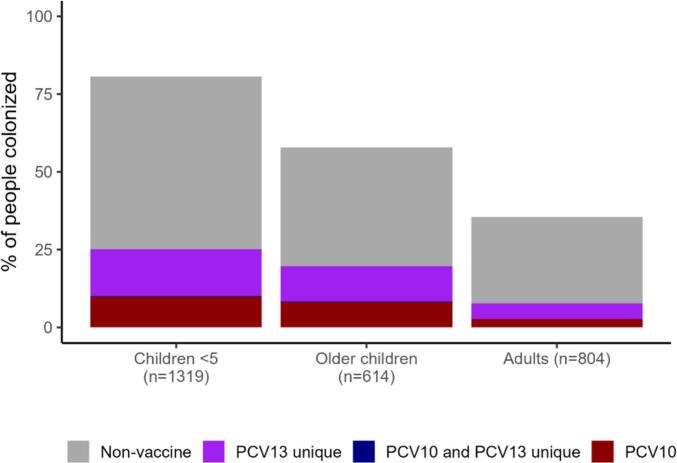
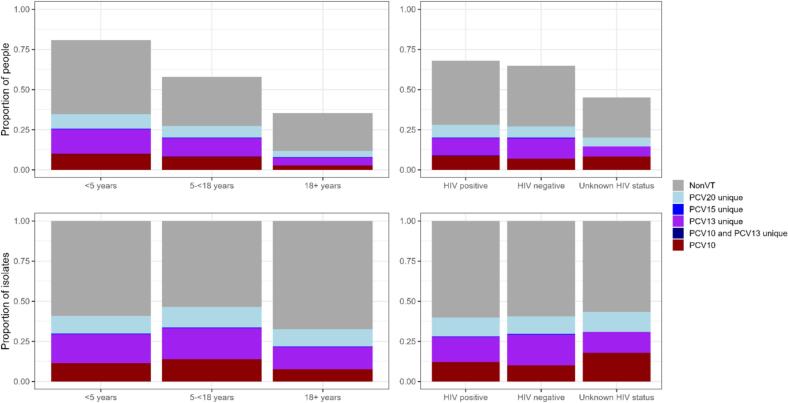
In 2018-2019, among 1319 children aged under five years, 1064 (80.7 %) were colonized with pneumococcus, among 614 children aged 5- < 18 years, 355 (57.8 %) were colonized, and among 804 adults (aged ≥18 years), 285 (35.4 %) were colonized. The most frequently observed serotypes were 19 A (n = 154, 8.5 % of isolates) and 6 A (n = 107, 5.9 %), both PCV13-unique serotypes. Overall carriage prevalence among children under five years remained stable at approximately 80 % across the carriage studies conducted between 2012 and 2019; between 2015 and 2016 and 2018-2019, the prevalence of PCV10-type carriage declined from 17.7 % to 10.1 %.
Despite substantial declines in PCV10-type carriage initially following vaccine introduction, the continued circulation of PCV10 serotypes and relative high prevalence of PCV13-unique serotypes underscore the need to understand the impact of policy changes on pneumococcus transmission.
肺炎链球菌是肺炎、败血症和脑膜炎的重要病因,而这些疾病是儿童死亡的主要原因。肺炎球菌结合疫苗(PCV)可预防疫苗血清型引起的疾病和鼻咽部定植,减少向未接种疫苗个体的传播以及在未接种疫苗个体之间的传播。莫桑比克于2013年引入了10价PCV(PCV10)。在2017 - 2019年期间,13价PCV(PCV13)取代了PCV10,并且在2019年9月,免疫程序从三剂基础免疫改为两剂基础免疫加一剂加强免疫;含加强免疫的程序可能会增加间接效应。我们在莫桑比克对肺炎球菌定植情况进行了调查,以建立一个基线,用于评估政策变化的影响,并估计PCV10对5岁以下儿童的长期影响。
我们计算了2018年10月至2019年7月期间莫桑比克南部5岁以下儿童及其家庭成员中PCV10血清型和另外3种PCV13血清型(“PCV13特有血清型”)的定植率。采集鼻咽拭子进行培养,分离株进行荚膜肿胀血清分型。对于儿童,我们将这些“PCV10接种后长期”数据与之前采用相同方法的调查(“PCV接种前”(2012 - 2013年)和“PCV10接种后”(2015 - 2016年))数据进行了比较。
在2018 - 2019年,1319名5岁以下儿童中,1064名(80.7%)携带肺炎球菌,614名5 - 18岁儿童中,355名(57.8%)携带肺炎球菌,804名成人(≥18岁)中,285名(35.4%)携带肺炎球菌。最常观察到的血清型是19A(n = 154,占分离株的8.5%)和6A(n = 107,占5.9%),均为PCV13特有血清型。在2012年至2019年进行的各项定植研究中,5岁以下儿童的总体定植率保持在约80%的稳定水平;在2015 - 2016年和2018 - 2019年期间,PCV10血清型的定植率从17.7%降至10.1%。
尽管在疫苗引入后PCV10血清型的定植率最初大幅下降,但PCV10血清型的持续传播以及PCV13特有血清型的相对高流行率凸显了了解政策变化对肺炎球菌传播影响的必要性。