Farkas Sanja A, Qvick Alvida, Helenius Gisela, Lillsunde-Larsson Gabriella
Department of Laboratory Medicine, Clinical Pathology and Genetics, Faculty of Medicine and Health, Örebro University, Örebro, Sweden.
Clinical Research Center, Faculty of Medicine and Health, Örebro University, Örebro, Sweden.
Sci Rep. 2025 Jan 9;15(1):1486. doi: 10.1038/s41598-024-84688-3.
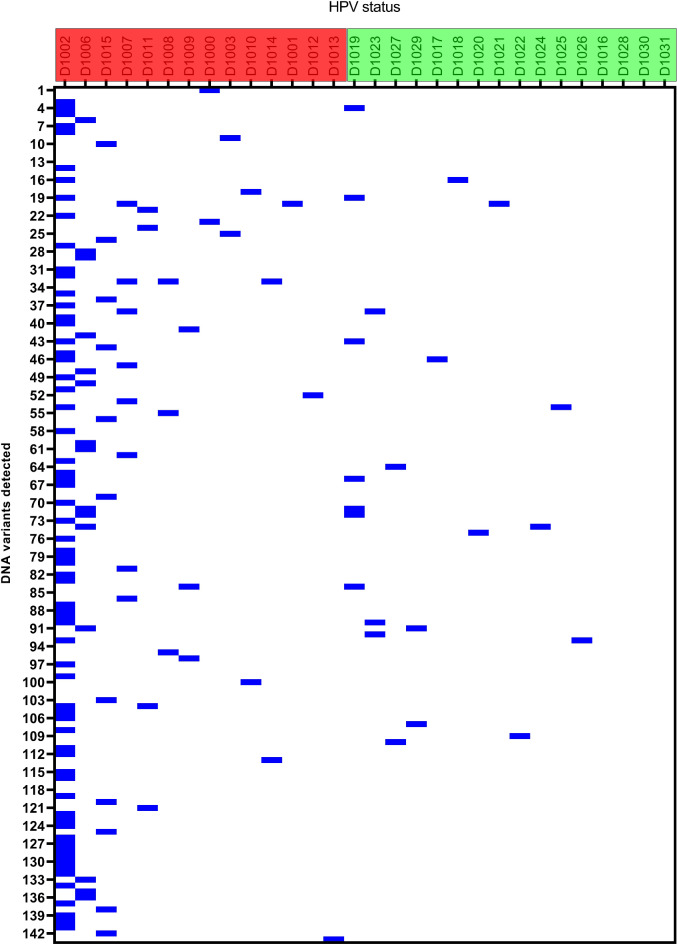
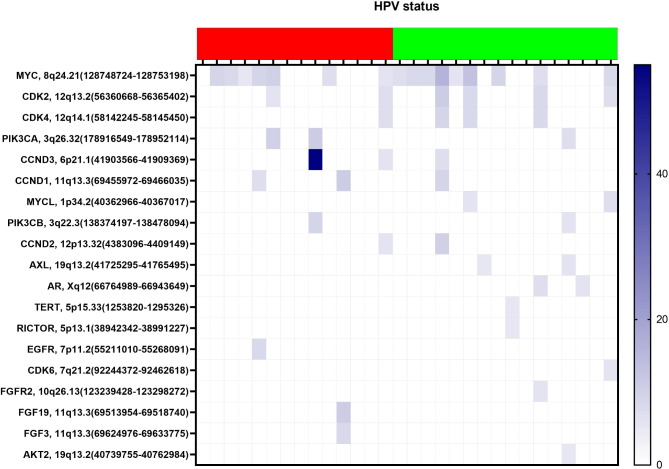
Vulvar cancer is a rare gynaecological disease that can be caused by infection with human papillomavirus (HPV). The mutational frequencies and landscape for HPV-associated and HPV-independent vulvar tumor development are supposedly two distinctly different pathways and more detailed knowledge on target biological mechanisms for individualized future treatments is needed. The study included formalin-fixed paraffin-embedded (FFPE) samples from 32 cancer patients (16 HPV-negative and 16 HPV-associated), treated in Örebro, Sweden from 1988 to 2008. The Oncomine™ Comprehensive Assay v3 was used to detect variants across 161 different tumor relevant genes. Data analysis included quality assessment followed by variant analysis of DNA with the Oncomine Comprehensive v3 workflow and with a custom filter using the VarSome Clinical software. The RNA-analysis was performed with the Oncomine Comprehensive v3 workflow. Totally, 94% of DNA libraries and 81% of RNA libraries were of adequate quality for further downstream analysis. With the Oncomine™ filter chain there was an increased number of variants in the HPV-negative group (2.5 variants) compared to the HPV-associated group (1.5 variants). Using custom filter and the Varsome Clinical software; additional single nucleotide variants (SNV) were detected where the vast majority were classified as likely benign/benign. HPV-negative tumors had a larger fraction of variants of unknown significance (VUS), and likely pathogenic/pathogenic compared to the HPV-associated tumours. The top 10 frequently mutated genes in HPV-indepentent tumors were TP53, POLE, PTCH1, BRCA2, CREBBP, NOTCH2, ARID1A, CDKN2A, MSH2, and NOTCH1. Three fusion genes were detected; TBL1XR1(1)::PIK3CA(2) (n = 2) and NF1(5)::PSMD11(2) (n = 1). Copy number variations (CNV) were more common in HPV-associated tumors (n = 13/16, 81%) compared to HPV-negative tumors (n = 9/14, 64%). The most frequent CNV was found in the cMYC gene, followed by CDK2 (n = 5) and CDK4 (n = 4). The main outcome of this study show that vulvar cancer harbour genetic variations of different types and specifically, HPV-independent tumours are molecularly very heterogeneous and harboured more SNVs while HPV-associated tumors more frequently presented with gene amplifications. The PI3K/AKT/mTOR1 pathway was affected in both the groups as well as the cell cycle regulation pathway. Similarly, the DNA repair gene POLE was found mutated in both vulvar cancer groups.
外阴癌是一种罕见的妇科疾病,可由人乳头瘤病毒(HPV)感染引起。HPV相关和HPV非依赖性外阴肿瘤发生的突变频率和图谱可能是两条截然不同的途径,需要更详细地了解个体化未来治疗的目标生物学机制。该研究纳入了1988年至2008年在瑞典厄勒布鲁接受治疗的32例癌症患者(16例HPV阴性和16例HPV相关)的福尔马林固定石蜡包埋(FFPE)样本。使用Oncomine™综合分析v3检测161个不同肿瘤相关基因的变异。数据分析包括质量评估,随后使用Oncomine综合v3工作流程和使用VarSome临床软件的定制过滤器对DNA进行变异分析。RNA分析采用Oncomine综合v3工作流程进行。总体而言,94%的DNA文库和81%的RNA文库质量足以进行进一步的下游分析。与HPV相关组(1.5个变异)相比,HPV阴性组(2.5个变异)使用Oncomine™过滤链检测到的变异数量增加。使用定制过滤器和Varsome临床软件;检测到额外的单核苷酸变异(SNV),其中绝大多数被分类为可能良性/良性。与HPV相关肿瘤相比,HPV阴性肿瘤具有更大比例的意义未明变异(VUS)以及可能致病/致病变异。HPV非依赖性肿瘤中前10个最常突变的基因是TP53、POLE、PTCH1、BRCA2、CREBBP、NOTCH2、ARID1A、CDKN2A、MSH2和NOTCH1。检测到三个融合基因;TBL1XR1(1)::PIK3CA(2)(n = 2)和NF1(5)::PSMD11(2)(n = 1)。与HPV阴性肿瘤(n = 9/14,64%)相比,拷贝数变异(CNV)在HPV相关肿瘤中更常见(n = 13/16,81%)。最常见的CNV见于cMYC基因,其次是CDK2(n = 5)和CDK4(n = 4)。本研究的主要结果表明,外阴癌存在不同类型的基因变异,具体而言,HPV非依赖性肿瘤在分子水平上非常异质,含有更多的SNV,而HPV相关肿瘤更频繁地出现基因扩增。PI3K/AKT/mTOR1途径在两组中均受影响,细胞周期调控途径也是如此。同样,DNA修复基因POLE在两个外阴癌组中均被发现发生突变。