Moriwaki Mutsuko, Kakehashi Masayuki, Hayashida Kenshi, Koizumi Masato, Horiguchi Hiromasa
Quality Management Center, Institute of Science Tokyo Hospital, 1-5-45 Yushima, Bunkyo-ku, Tokyo 113-8510, Japan.
Department of Clinical Data Management and Research, Clinical Research Center, National Hospital Organization Headquarters, 2-5-11 Higashigaoka, Meguro-ku, Tokyo 152-8621, Japan.
Healthcare (Basel). 2025 Jan 6;13(1):88. doi: 10.3390/healthcare13010088.
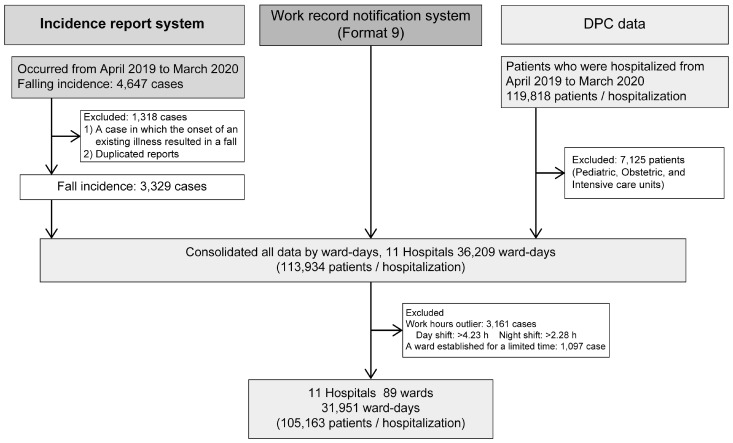
: Falls are common adverse events among hospitalized patients, affecting outcomes and placing a financial burden on patients and hospitals. This study investigated the relationship between nurse staffing/workload and patient falls during hospitalization. : The patients studied were hospitalized in the general wards (excluding pediatrics and obstetrics/gynecology) of 11 National Hospital Organization institutions between April 2019 and March 2020. The data were obtained from the Diagnosis Procedure Combination Work Record and institutional fall reports. The variables used in the analyses included patient conditions, number of hospitalization cases, emergency hospitalizations, surgeries/examinations, disease composition ratio, patient attributes, hospital stay duration, hospital bed size, and nursing time per patient (day and night) on a ward-day basis. Multivariate analysis was performed to determine the effects of these factors on fall events. : A total of 36,209 ward days were analyzed, with falls reported on 2866 days (fall event rate of 9.0%). The mean nursing times per patient were 1.99 h (day) and 1.47 h (night). The nursing time per patient in the fall group compared to the non-fall group showed an odds ratio of 1.19 ( < 0.01) during day shifts and 0.17 ( < 0.02) during night shifts. An increase in nursing time per patient during the night was associated with fewer fall events, whereas during the day, increased nursing time appeared to contribute to more falls. Common background factors that increased nurse staffing and patient falls simultaneously could be suggested to exist during the day. : Increased nursing time was correlated with reduced fall incidence, indicating the need for policy improvements in nurse staffing practices in Japan to enhance patient safety and outcomes. Further research is needed to accumulate evidence reflecting policies regarding nurse staffing.
跌倒在住院患者中是常见的不良事件,会影响治疗结果,并给患者和医院带来经济负担。本研究调查了护士人员配备/工作量与患者住院期间跌倒之间的关系。:研究对象为2019年4月至2020年3月期间在11家国立医院机构的普通病房(不包括儿科和妇产科)住院的患者。数据来自诊断程序组合工作记录和机构跌倒报告。分析中使用的变量包括患者状况、住院病例数、急诊住院、手术/检查、疾病构成比、患者属性、住院时间、医院床位规模以及按病房日计算的每位患者的护理时间(白天和夜间)。进行多变量分析以确定这些因素对跌倒事件的影响。:共分析了36209个病房日,其中2866天报告有跌倒事件(跌倒事件发生率为9.0%)。每位患者的平均护理时间为白天1.99小时,夜间1.47小时。与未跌倒组相比,跌倒组患者在白班期间的护理时间优势比为1.19(<0.01),夜班期间为0.17(<0.02)。夜间每位患者护理时间的增加与跌倒事件减少相关,而在白天,护理时间的增加似乎导致更多跌倒。可以推测,白天存在同时增加护士人员配备和患者跌倒的常见背景因素。:护理时间增加与跌倒发生率降低相关,这表明日本需要改进护士人员配备的政策,以提高患者安全性和治疗结果。需要进一步研究以积累反映护士人员配备政策的证据。