Barwig Mark, Janisch Michael, Gessl Johannes, Kübler Wolfgang, König Christopher, Schwantzer Gerold, Schöllnast Helmut
Institute of Radiology, LKH Graz II, Graz, Austria.
Division of Neuroradiology, Vascular and Interventional Radiology, Department of Radiology, Medical University of Graz, Graz, Austria.
Insights Imaging. 2025 Jan 10;16(1):13. doi: 10.1186/s13244-024-01892-5.
To assess the efficacy of bolus injections of landiolol hydrochloride as premedication in coronary artery CT angiography (CCTA).
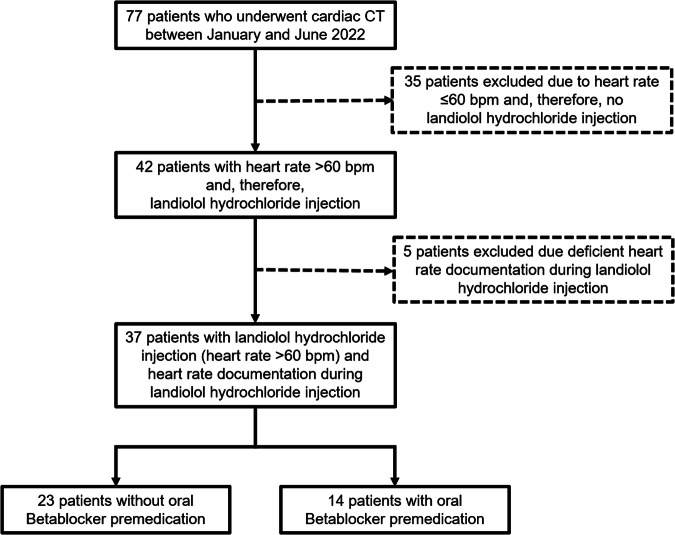
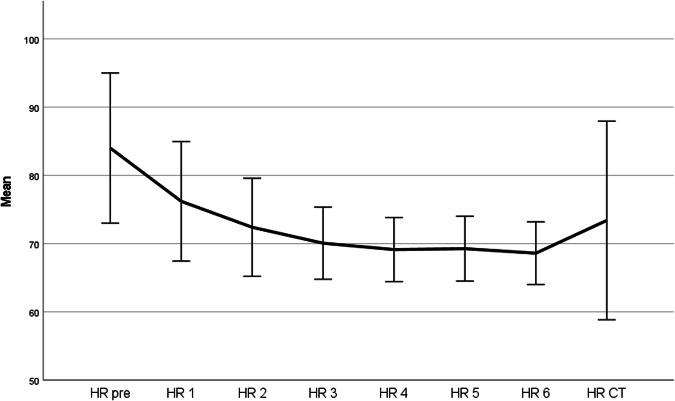
The study population consisted of 37 patients (17 female; median age, 56 years; IQR, 19 years; range, 19-88 years) who underwent CCTA after intravenous injection of landiolol hydrochloride due to a heart rate > 60 bpm. Landiolol hydrochloride was administered in a stepwise manner until a heart rate of ≤ 60 bpm was achieved or a maximum dose of 60 mg was reached after six injections. Heart rates routinely displayed continuously on the CT scanner before the start of the landiolol hydrochloride injection (HR), after each partial dose (HR), during the CT scan (HR), and after the examination before moving from the CT table (HR) were recorded. Furthermore, the blood pressure routinely measured before (BP) and after the examination before moving from the CT table (BP) was recorded.
A HR of ≤ 60 bpm was achieved in 13 patients (35%) and a HR ≤ 65 bpm was achieved in 25 patients (68%). The mean difference (± SD) between HR and HR was -11 ± 9 bpm in total, -14 ± 10 bpm in patients without oral beta-blocker premedication and -6 ± 5 bpm in patients with oral Beta-blocker premedication.
Landiolol hydrochloride enables a reduction of the heart rate in patients with and without oral beta-blocker premedication, whereby the use of serial partial doses is a simple and effective approach in clinical routine.
In cardiac CT, weight-independent, stepwise landiolol hydrochloride injection up to 40 mg reduces heart rate by -14 bpm without and -5 bpm with oral beta-blocker premedication, and achieves heart rates of ≤ 65 bpm in a significant proportion of patients.
The ideal heart rate for cardiac CT is ≤ 60-65 bpm, which improves image quality and reduces radiation dose. In cardiac CT, landiolol hydrochloride intravenously reduces heart rate by -14 bpm. Heart rate of ≤ 65 bpm can be achieved in a significant proportion of patients.
评估冠状动脉CT血管造影(CCTA)前静脉推注盐酸兰地洛尔作为术前用药的疗效。
研究对象为37例患者(17例女性;年龄中位数56岁;四分位距19岁;范围19 - 88岁),因心率>60次/分在静脉注射盐酸兰地洛尔后接受CCTA检查。盐酸兰地洛尔逐步给药,直至心率≤60次/分或6次注射后达到最大剂量60mg。记录在开始注射盐酸兰地洛尔前(HR)、每次部分剂量注射后(HR)、CT扫描期间(HR)以及检查后离开CT检查床前(HR)CT扫描仪上常规连续显示的心率。此外,记录检查前(BP)和检查后离开CT检查床前(BP)常规测量的血压。
13例患者(35%)心率≤60次/分,25例患者(68%)心率≤65次/分。HR与HR之间的平均差值(±标准差)总体为-11±9次/分,未使用口服β受体阻滞剂进行术前用药的患者为-14±10次/分,使用口服β受体阻滞剂进行术前用药的患者为-6±5次/分。
无论患者是否使用口服β受体阻滞剂进行术前用药,盐酸兰地洛尔均可降低心率,在临床常规中采用分次部分剂量给药是一种简单有效的方法。
在心脏CT检查中,不考虑体重,逐步静脉注射高达40mg盐酸兰地洛尔,未使用口服β受体阻滞剂进行术前用药时心率降低-14次/分,使用口服β受体阻滞剂进行术前用药时心率降低-5次/分,且相当比例的患者心率可降至≤65次/分。
心脏CT的理想心率为≤60 - 65次/分,这可提高图像质量并降低辐射剂量。在心脏CT检查中,静脉注射盐酸兰地洛尔可使心率降低-14次/分。相当比例的患者心率可降至≤65次/分。